Sheryl Sandberg
Field: business
In her 2014 commencement address at City Colleges of Chicago, Sheryl Sandberg congratulates graduates—many the first in their families to earn a degree—and shares three pieces of advice for achieving their potential: believe in yourself and overcome self-doubt, break big dreams into small manageable steps while asking for help, and recognize that the world needs them to change it toward greater equality. She draws on personal anecdotes about self-doubt, learning a software program at her first job, and skiing to illustrate her points, and closes by urging graduates to ask themselves what they would do if they weren't afraid.
Key moments
- 01 Celebrating first-generation graduates and the role of education in lifting families
- 02 Urging students to believe in themselves and 'sit at the table' despite self-doubt
- 03 Advising graduates to break big dreams into small steps and ask for help
- 04 Calling on graduates to create a more equal world and become the 'Lean In Generation'
Save the visual map
Download or open the generated poster as a standalone PNG.
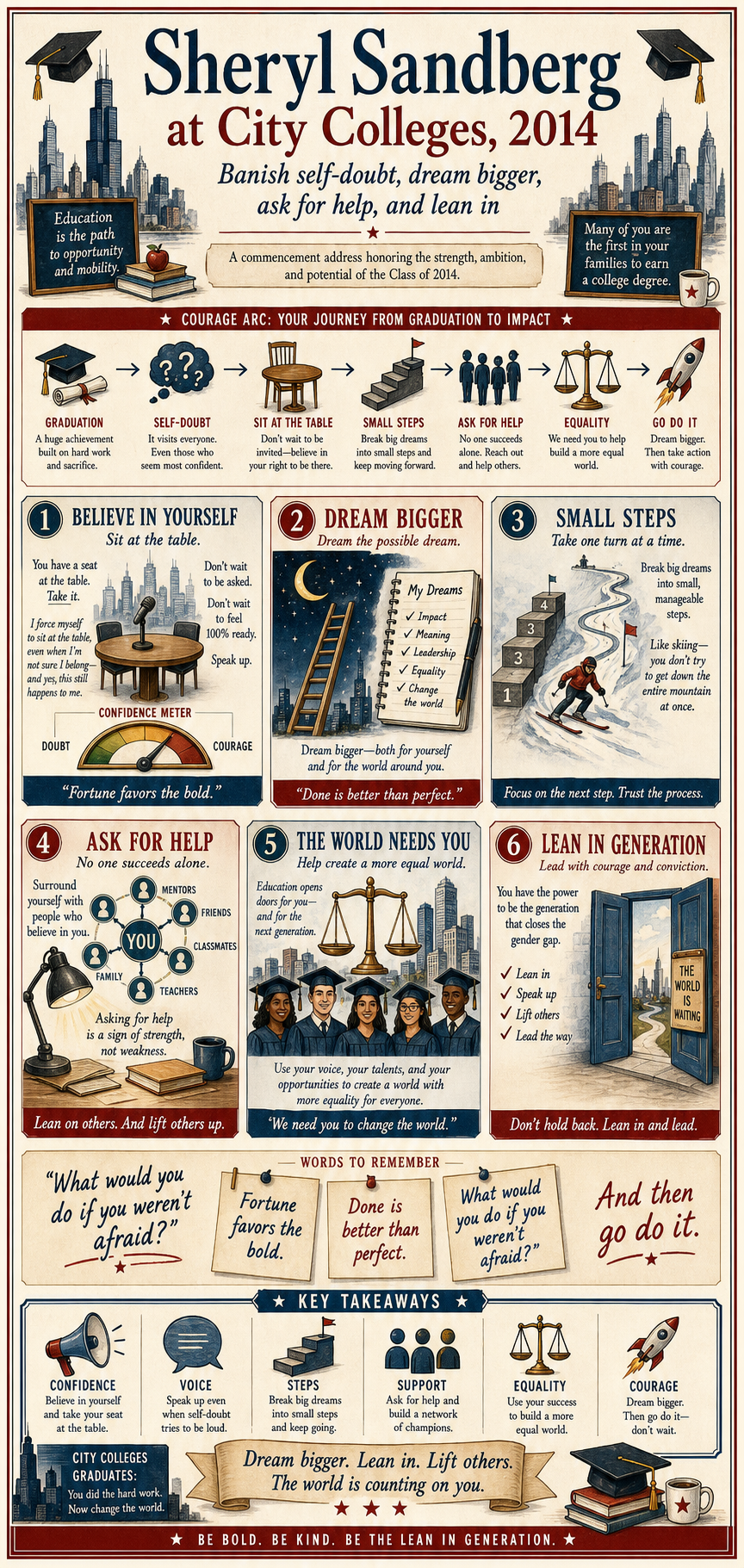
Sheryl Sandberg at City Colleges, 2014
A City Colleges of Chicago address about self-belief, small steps, asking for help, equality, and acting before fear has the final word.
Speech arc
- 01City Colleges of Chicago
Opening move
- 02Prepared full text
Speech beat
- 03First-generation pride
Speech beat
- 04Self-doubt named directly
Speech beat
- 05Sit at the table
Speech beat
- 06Small manageable steps
Speech beat
- 07Ask for help
Speech beat
- 08What would you do if unafraid?
Final charge
Belief: Take the seat before certainty arrives
Sandberg treats self-doubt as common rather than disqualifying, urging graduates to speak up, take a place at the table, and stop waiting to feel fully ready.
Audience
She honors graduates whose education often came through work, family sacrifice, and being first in their families to earn a degree.
Obstacle
The speech names internal hesitation directly: even accomplished people can wonder whether their voice belongs.
Practice
Confidence becomes an action first and a feeling later: sit down, speak up, and keep contributing.
Sandberg treats self-doubt as common rather than disqualifying, urging graduates to speak up, take a place at the table, and stop waiting to feel fully ready.
Ambition: Dream bigger, then break the dream into steps
The address pairs large ambition with a practical method: aim high, then take the next manageable move rather than trying to solve the whole mountain at once.
Scale
Sandberg asks graduates to dream bigger for themselves and for the world around them.
Method
The skiing image turns ambition into sequence: make one turn, then another, until the descent becomes possible.
Motion
The point is forward movement, not perfect readiness or flawless planning.
The address pairs large ambition with a practical method: aim high, then take the next manageable move rather than trying to solve the whole mountain at once.
Support: Asking for help is a sign of strength
Sandberg rejects the myth of solitary success and frames mentors, classmates, friends, family, and colleagues as part of how graduates build capacity.
Network
The speech invites graduates to surround themselves with people who believe in them and can help them keep going.
Learning
Her first-job software story makes growth practical: ask, learn, and improve rather than pretending mastery.
Reciprocity
Support is not only received; graduates are called to lift others as they move forward.
Sandberg rejects the myth of solitary success and frames mentors, classmates, friends, family, and colleagues as part of how graduates build capacity.
• Key takeaways •
Self-doubt is not a stop sign
Connects to self-doubt.
A seat at the table is taken by action
Connects to ambition.
Big dreams need small steps
Connects to gender equality.
Support networks build courage
Connects to perseverance.
Equality needs graduates who speak up
Connects to education.
Closing charge
The closing turns individual courage outward, calling graduates to become part of a generation that speaks up, closes gaps, and changes the world.
Use your education to widen opportunity
Justice
Equality is presented as unfinished work that needs the graduates’ voices and talents.
Motto
The Facebook poster slogans become portable commands: boldness, completion over perfection, and courage in the face of fear.
Question
The final prompt asks what each person would do without fear, then pushes them to go do it.
The closing turns individual courage outward, calling graduates to become part of a generation that speaks up, closes gaps, and changes the world.
Visual speech maps
Browse more visual maps from City Colleges of Chicago or continue with related mapped speeches below.
Transcript
The full transcript is hosted by the original publisher. Commencement Archive links to the source rather than republishing copyrighted text.
Read the full transcript at source →Provenance
Imported from NPR commencement archive; cross-referenced with Open Commencement DB
NPR archive last updated in 2015; destination availability has not been exhaustively rechecked | Open Commencement DB transcript; not independently verified against the original recording
Explore this speech
Find the next thread through the archive
Themes in this address
Speeches like this one
Search all speeches ->