David Byrne
Field: arts
Save the visual map
Download or open the generated poster as a standalone PNG.
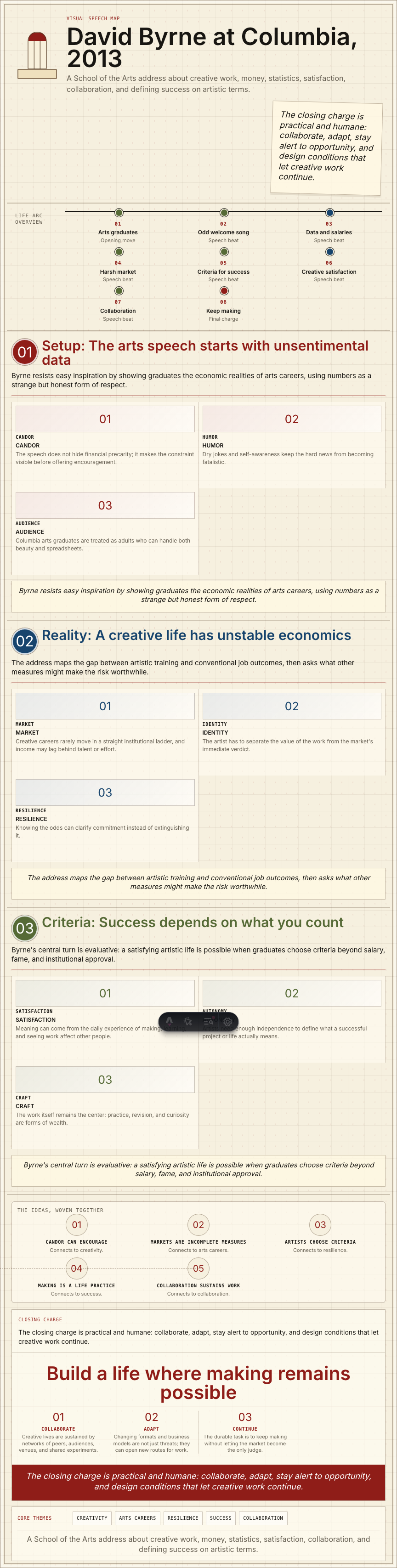
David Byrne at Columbia, 2013
A School of the Arts address about creative work, money, statistics, satisfaction, collaboration, and defining success on artistic terms.
Speech arc
- 01Arts graduates
Opening move
- 02Odd welcome song
Speech beat
- 03Data and salaries
Speech beat
- 04Harsh market
Speech beat
- 05Criteria for success
Speech beat
- 06Creative satisfaction
Speech beat
- 07Collaboration
Speech beat
- 08Keep making
Final charge
Setup: The arts speech starts with unsentimental data
Byrne resists easy inspiration by showing graduates the economic realities of arts careers, using numbers as a strange but honest form of respect.
Candor
The speech does not hide financial precarity; it makes the constraint visible before offering encouragement.
Humor
Dry jokes and self-awareness keep the hard news from becoming fatalistic.
Audience
Columbia arts graduates are treated as adults who can handle both beauty and spreadsheets.
Byrne resists easy inspiration by showing graduates the economic realities of arts careers, using numbers as a strange but honest form of respect.
Reality: A creative life has unstable economics
The address maps the gap between artistic training and conventional job outcomes, then asks what other measures might make the risk worthwhile.
Market
Creative careers rarely move in a straight institutional ladder, and income may lag behind talent or effort.
Identity
The artist has to separate the value of the work from the market's immediate verdict.
Resilience
Knowing the odds can clarify commitment instead of extinguishing it.
The address maps the gap between artistic training and conventional job outcomes, then asks what other measures might make the risk worthwhile.
Criteria: Success depends on what you count
Byrne's central turn is evaluative: a satisfying artistic life is possible when graduates choose criteria beyond salary, fame, and institutional approval.
Satisfaction
Meaning can come from the daily experience of making, learning, and seeing work affect other people.
Autonomy
Artists need enough independence to define what a successful project or life actually means.
Craft
The work itself remains the center: practice, revision, and curiosity are forms of wealth.
Byrne's central turn is evaluative: a satisfying artistic life is possible when graduates choose criteria beyond salary, fame, and institutional approval.
• Key takeaways •
Candor can encourage
Connects to creativity.
Markets are incomplete measures
Connects to arts careers.
Artists choose criteria
Connects to resilience.
Making is a life practice
Connects to success.
Collaboration sustains work
Connects to collaboration.
Closing charge
The closing charge is practical and humane: collaborate, adapt, stay alert to opportunity, and design conditions that let creative work continue.
Build a life where making remains possible
Collaborate
Creative lives are sustained by networks of peers, audiences, venues, and shared experiments.
Adapt
Changing formats and business models are not just threats; they can open new routes for work.
Continue
The durable task is to keep making without letting the market become the only judge.
The closing charge is practical and humane: collaborate, adapt, stay alert to opportunity, and design conditions that let creative work continue.
Visual speech maps
Browse more visual maps from Columbia University or continue with related mapped speeches below.
Transcript
No official full transcript has been located yet. A video of the address is available above.
Provenance
Imported from NPR commencement archive
NPR archive last updated in 2015; destination availability has not been exhaustively rechecked
Explore this speech
Find the next thread through the archive
Themes in this address
No canonical themes have been assigned yet.