Wally Lamb
Field: letters
Save the visual map
Download or open the generated poster as a standalone PNG.
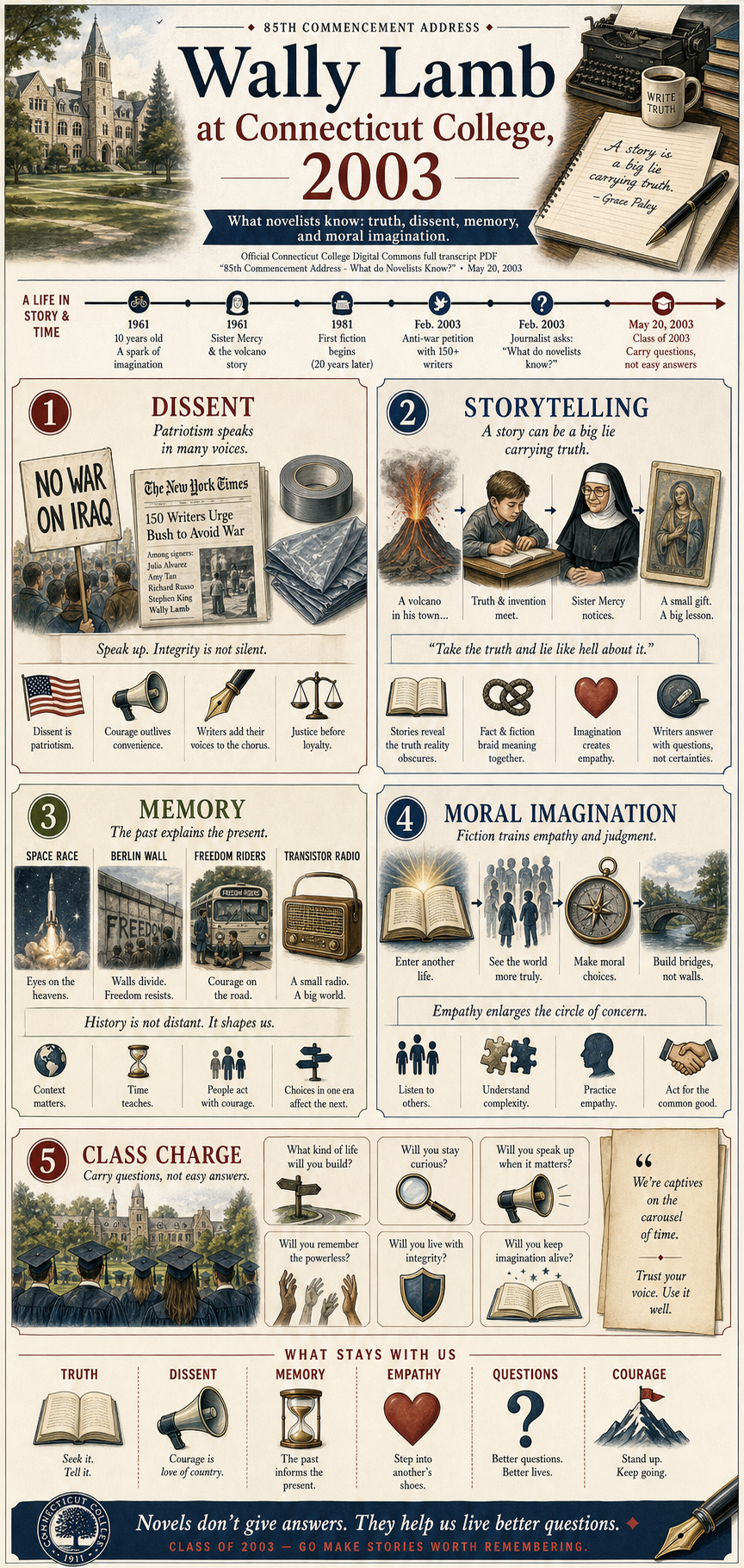
Wally Lamb at Connecticut College, 2003
A Connecticut College address about truth, dissent, memory, storytelling, and the moral imagination fiction can train.
Speech arc
- 01Connecticut College
Opening move
- 02Class of 2003
Speech beat
- 03What novelists know
Speech beat
- 04Anti-war petition
Speech beat
- 05Sister Mercy story
Speech beat
- 061961 memory map
Speech beat
- 07Fiction and truth
Speech beat
- 08Better questions
Final charge
Dissent: Patriotism can speak in many voices
Lamb opens from the Iraq War moment and a writers petition, turning public dissent into a test of integrity rather than disloyalty.
Moment
February 2003 brings invasion talk, duct tape anxiety, and pressure to stay silent.
Choice
Signing the petition becomes a practical decision about what children learn from adult courage.
Question
A journalist asks why novelists should claim any authority about war.
Lamb opens from the Iraq War moment and a writers petition, turning public dissent into a test of integrity rather than disloyalty.
Story: Fiction can carry truth through invention
The childhood Sister Mercy story shows Lamb discovering how fact, imagination, desire, and consequence can combine into narrative power.
Classroom
A timid child tries to be seen and improvises a heroic family story.
Craft
The volcano and medal become comic evidence of how storytelling bends reality.
Lesson
The speech treats fiction as a way to reveal truth, not escape it.
The childhood Sister Mercy story shows Lamb discovering how fact, imagination, desire, and consequence can combine into narrative power.
• Key takeaways •
Dissent can be patriotic
Connects to storytelling.
Stories reveal truth
Connects to truth.
Memory gives context
Connects to dissent.
Empathy expands judgment
Connects to memory.
Questions outlast answers
Connects to empathy.
Closing charge
Lamb moves through 1961, placing personal memory alongside the space race, civil rights violence, Berlin, Cold War fear, and popular culture.
The past keeps explaining the present
Context
Public history and private formation are braided together.
Pattern
Fear, racism, war, and official stories recur across eras.
Charge
Graduates are asked to live with questions instead of easy answers.
Lamb moves through 1961, placing personal memory alongside the space race, civil rights violence, Berlin, Cold War fear, and popular culture.
Visual speech maps
Browse more visual maps from Connecticut College or continue with related mapped speeches below.
Transcript
The full transcript is hosted by the original publisher. Commencement Archive links to the source rather than republishing copyrighted text.
Read the full transcript at source →Provenance
Imported from NPR commencement archive; cross-referenced with Open Commencement DB
NPR archive last updated in 2015; destination availability has not been exhaustively rechecked | Open Commencement DB transcript; not independently verified against the original recording
Explore this speech
Find the next thread through the archive
Themes in this address
No canonical themes have been assigned yet.
Speeches like this one
Search all speeches ->