Carl Icahn
Field: business
Save the visual map
Download or open the generated poster as a standalone PNG.
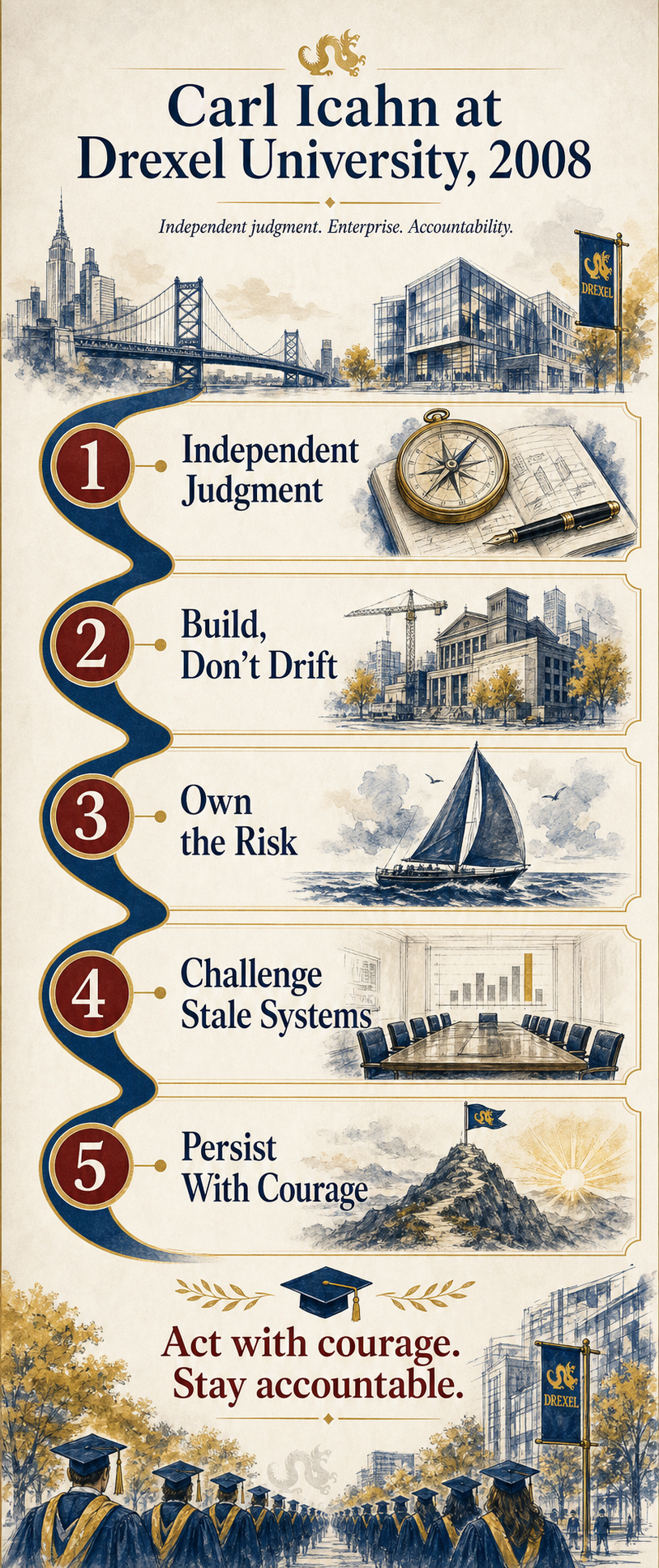
Carl Icahn at Drexel, 2008
A commencement address about corporate accountability, dysfunctional boards, competitive pressure, management failure, and refusing the comfortable CEO mold.
Speech arc
- 01LeBow ceremony
Opening move
- 022008 economy
Speech beat
- 03Activist investor
Speech beat
- 04Board critique
Speech beat
- 05CEO mold
Speech beat
- 06Accountability
Speech beat
- 07Competition
Speech beat
- 08Direct advice
Final charge
Setting: A business address during a crisis year
Icahn speaks to Drexel business graduates in 2008, using a ceremonial platform to diagnose management failure rather than offer generic optimism.
Moment
The financial climate makes corporate competence more than an abstract business-school topic.
Speaker
His activist-investor identity gives the address a confrontational view of boards and executives.
Audience
Graduates are asked to see business as a system they may have to challenge from inside or outside.
Icahn speaks to Drexel business graduates in 2008, using a ceremonial platform to diagnose management failure rather than offer generic optimism.
Diagnosis: Boards can reward the wrong behavior
The speech centers on weak governance: boards, CEOs, and incentives can protect incumbents instead of forcing accountability and competition.
Boards
The boardroom becomes the symbol of institutional comedy and institutional risk.
Incentives
When leaders face little challenge, organizations drift toward comfort and self-protection.
Accountability
Pressure from owners, markets, and challengers is framed as a corrective force.
The speech centers on weak governance: boards, CEOs, and incentives can protect incumbents instead of forcing accountability and competition.
Warning: Do not become the anti-Darwinian executive
Icahn warns graduates against copying a leadership mold that advances by conformity rather than competence, candor, or competitive discipline.
Mold
The comfortable path upward can select for political survival instead of real performance.
Competition
Companies lose ground when leaders are insulated from consequences.
Candor
The address models blunt diagnosis as a business skill, not a breach of etiquette.
Icahn warns graduates against copying a leadership mold that advances by conformity rather than competence, candor, or competitive discipline.
• Key takeaways •
Governance shapes outcomes
Connects to business.
Comfort can weaken competition
Connects to accountability.
Accountability needs challengers
Connects to management.
Candor is a business tool
Connects to competition.
Do not copy the CEO mold
Connects to leadership.
Closing charge
The closing lesson is hard-edged: graduates should learn enough to see dysfunction clearly and be willing to contest it when the system rewards passivity.
Challenge systems that cannot correct themselves
Skill
Expertise gives criticism force; vague dissatisfaction does not change institutions.
Courage
The useful graduate is not merely employable, but capable of asking who is accountable.
Reform
Business success is tied to systems that promote competence and punish complacency.
The closing lesson is hard-edged: graduates should learn enough to see dysfunction clearly and be willing to contest it when the system rewards passivity.
Visual speech maps
Browse more visual maps from Drexel University .
Transcript
The previously catalogued transcript link is no longer live and is queued for re-sourcing. A video of the address is available above.
Provenance
BROKEN transcript link (checked 2026-06-26): gradspeeches.com is a parked/redirecting domain serving no real content. Provenance: Imported from NPR commencement archive
NPR archive last updated in 2015; destination availability has not been exhaustively rechecked | Transcript URL dead (gradspeeches.com is a parked/redirecting domain serving no real content); video fallback present
Explore this speech
Find the next thread through the archive
Themes in this address
No canonical themes have been assigned yet.