Barbara Kingsolver
Field: letters
Save the visual map
Download or open the generated poster as a standalone PNG.
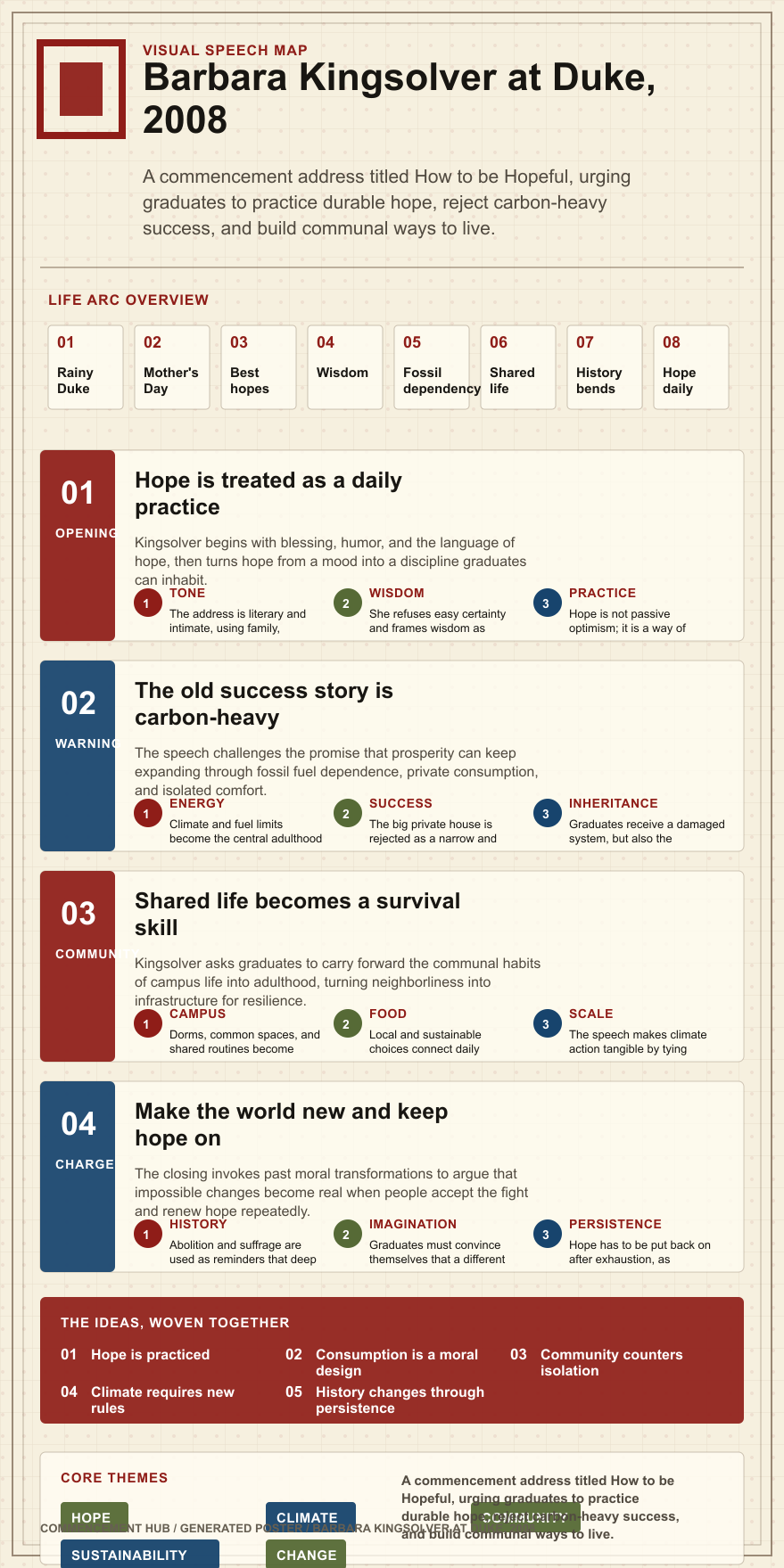
Barbara Kingsolver at Duke, 2008
A commencement address titled How to be Hopeful, urging graduates to practice durable hope, reject carbon-heavy success, and build communal ways to live.
Speech arc
- 01Rainy Duke
Opening move
- 02Mother's Day
Speech beat
- 03Best hopes
Speech beat
- 04Wisdom
Speech beat
- 05Fossil dependency
Speech beat
- 06Shared life
Speech beat
- 07History bends
Speech beat
- 08Hope daily
Final charge
Opening: Hope is treated as a daily practice
Kingsolver begins with blessing, humor, and the language of hope, then turns hope from a mood into a discipline graduates can inhabit.
Tone
The address is literary and intimate, using family, campus, and weather to make the global argument personal.
Wisdom
She refuses easy certainty and frames wisdom as something accumulated while doing necessary work.
Practice
Hope is not passive optimism; it is a way of staying inside the work long enough to change it.
Kingsolver begins with blessing, humor, and the language of hope, then turns hope from a mood into a discipline graduates can inhabit.
Warning: The old success story is carbon-heavy
The speech challenges the promise that prosperity can keep expanding through fossil fuel dependence, private consumption, and isolated comfort.
Energy
Climate and fuel limits become the central adulthood problem for the graduating class.
Success
The big private house is rejected as a narrow and lonely emblem of achievement.
Inheritance
Graduates receive a damaged system, but also the authority to redesign its rules.
The speech challenges the promise that prosperity can keep expanding through fossil fuel dependence, private consumption, and isolated comfort.
Community: Shared life becomes a survival skill
Kingsolver asks graduates to carry forward the communal habits of campus life into adulthood, turning neighborliness into infrastructure for resilience.
Campus
Dorms, common spaces, and shared routines become evidence that less isolated living is possible.
Food
Local and sustainable choices connect daily consumption to ecological responsibility.
Scale
The speech makes climate action tangible by tying vast systems to ordinary household decisions.
Kingsolver asks graduates to carry forward the communal habits of campus life into adulthood, turning neighborliness into infrastructure for resilience.
• Key takeaways •
Hope is practiced
Connects to hope.
Consumption is a moral design
Connects to climate.
Community counters isolation
Connects to community.
Climate requires new rules
Connects to sustainability.
History changes through persistence
Connects to change.
Closing charge
The closing invokes past moral transformations to argue that impossible changes become real when people accept the fight and renew hope repeatedly.
Make the world new and keep hope on
History
Abolition and suffrage are used as reminders that deep rule changes once looked unthinkable.
Imagination
Graduates must convince themselves that a different arrangement is possible.
Persistence
Hope has to be put back on after exhaustion, as routinely as getting dressed.
The closing invokes past moral transformations to argue that impossible changes become real when people accept the fight and renew hope repeatedly.
Visual speech maps
Browse more visual maps from Duke University .
Transcript
The full transcript is hosted by the original publisher. Commencement Archive links to the source rather than republishing copyrighted text.
Read the full transcript at source →Provenance
RECOVERED 2026-08-29: Complete transcript page validated by matching speaker, institution, year, and substantial speech text. Original transcript location remains unavailable.
Source recovery audit 2026-08-29 checked the original URL, institutional sources, Commencement DB, targeted web/PDF results, and public video platforms. The Internet Archive CDX endpoint was also attempted but timed out from the audit environment. The recovered community transcript replaces the broken catalog link; the original publisher location remains unavailable.
Explore this speech
Find the next thread through the archive
Themes in this address
No canonical themes have been assigned yet.