Gary Malkowski
Field: politics
Save the visual map
Download or open the generated poster as a standalone PNG.
Gary Malkowski at Gallaudet, 2011
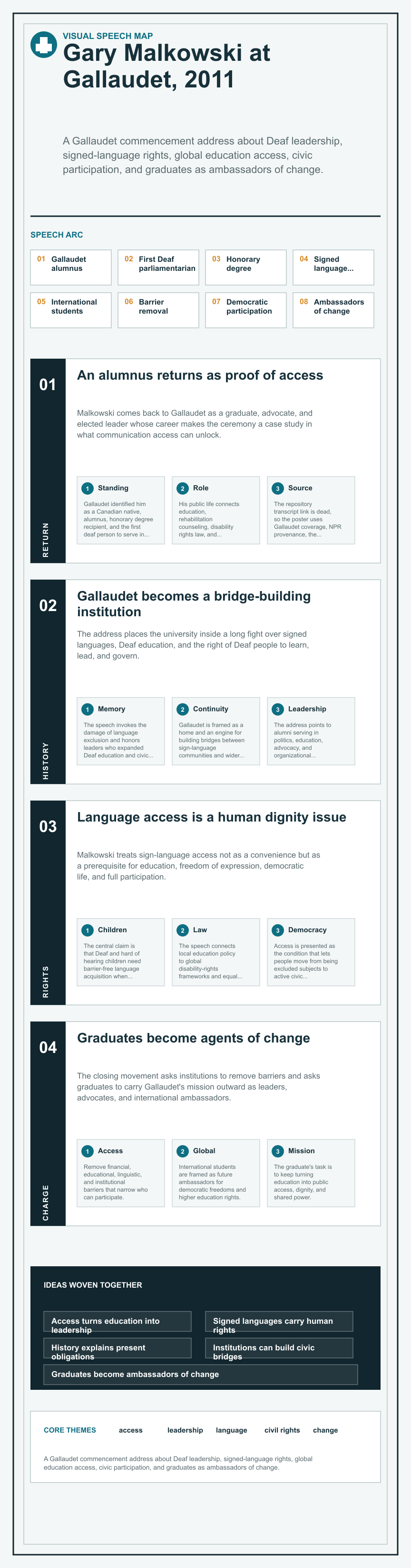
A Gallaudet commencement address about Deaf leadership, signed-language rights, global education access, civic participation, and graduates as ambassadors of change.
Speech arc
- 01Gallaudet alumnus
Opening move
- 02First Deaf parliamentarian
Speech beat
- 03Honorary degree
Speech beat
- 04Signed language rights
Speech beat
- 05International students
Speech beat
- 06Barrier removal
Speech beat
- 07Democratic participation
Speech beat
- 08Ambassadors of change
Final charge
Return: An alumnus returns as proof of access
Malkowski comes back to Gallaudet as a graduate, advocate, and elected leader whose career makes the ceremony a case study in what communication access can unlock.
Standing
Gallaudet identified him as a Canadian native, alumnus, honorary degree recipient, and the first deaf person to serve in Ontario's Legislative Assembly.
Role
His public life connects education, rehabilitation counseling, disability rights law, and government relations.
Source
The repository transcript link is dead, so the poster uses Gallaudet coverage, NPR provenance, the surviving video record, and indexed excerpts.
Malkowski comes back to Gallaudet as a graduate, advocate, and elected leader whose career makes the ceremony a case study in what communication access can unlock.
History: Gallaudet becomes a bridge-building institution
The address places the university inside a long fight over signed languages, Deaf education, and the right of Deaf people to learn, lead, and govern.
Memory
The speech invokes the damage of language exclusion and honors leaders who expanded Deaf education and civic access.
Continuity
Gallaudet is framed as a home and an engine for building bridges between sign-language communities and wider public institutions.
Leadership
The address points to alumni serving in politics, education, advocacy, and organizational leadership across countries.
The address places the university inside a long fight over signed languages, Deaf education, and the right of Deaf people to learn, lead, and govern.
Rights: Language access is a human dignity issue
Malkowski treats sign-language access not as a convenience but as a prerequisite for education, freedom of expression, democratic life, and full participation.
Children
The central claim is that Deaf and hard of hearing children need barrier-free language acquisition when language is most readily learned.
Law
The speech connects local education policy to global disability-rights frameworks and equal recognition of signed languages.
Democracy
Access is presented as the condition that lets people move from being excluded subjects to active civic participants.
Malkowski treats sign-language access not as a convenience but as a prerequisite for education, freedom of expression, democratic life, and full participation.
• Key takeaways •
Access turns education into leadership
Connects to access.
Signed languages carry human rights
Connects to leadership.
History explains present obligations
Connects to language.
Institutions can build civic bridges
Connects to civil rights.
Graduates become ambassadors of change
Connects to change.
Closing charge
The closing movement asks institutions to remove barriers and asks graduates to carry Gallaudet's mission outward as leaders, advocates, and international ambassadors.
Graduates become agents of change
Access
Remove financial, educational, linguistic, and institutional barriers that narrow who can participate.
Global
International students are framed as future ambassadors for democratic freedoms and higher education rights.
Mission
The graduate's task is to keep turning education into public access, dignity, and shared power.
The closing movement asks institutions to remove barriers and asks graduates to carry Gallaudet's mission outward as leaders, advocates, and international ambassadors.
Visual speech maps
Browse more visual maps from Gallaudet University .
Transcript
The previously catalogued transcript link is no longer live and is queued for re-sourcing. A video of the address is available above.
Machine transcript available for archive analysis; it is unverified and may contain transcription errors. Machine transcript source ->
Provenance
BROKEN transcript link (checked 2026-06-26): gradspeeches.com is a parked/redirecting domain serving no real content. Provenance: Imported from NPR commencement archive; cross-referenced with Open Commencement DB
NPR archive last updated in 2015; destination availability has not been exhaustively rechecked | Open Commencement DB transcript; not independently verified against the original recording | Transcript URL dead (gradspeeches.com is a parked/redirecting domain serving no real content); video fallback present
Explore this speech
Find the next thread through the archive
Themes in this address
No canonical themes have been assigned yet.