Clayborne Carson
Save the visual map
Download or open the generated poster as a standalone PNG.
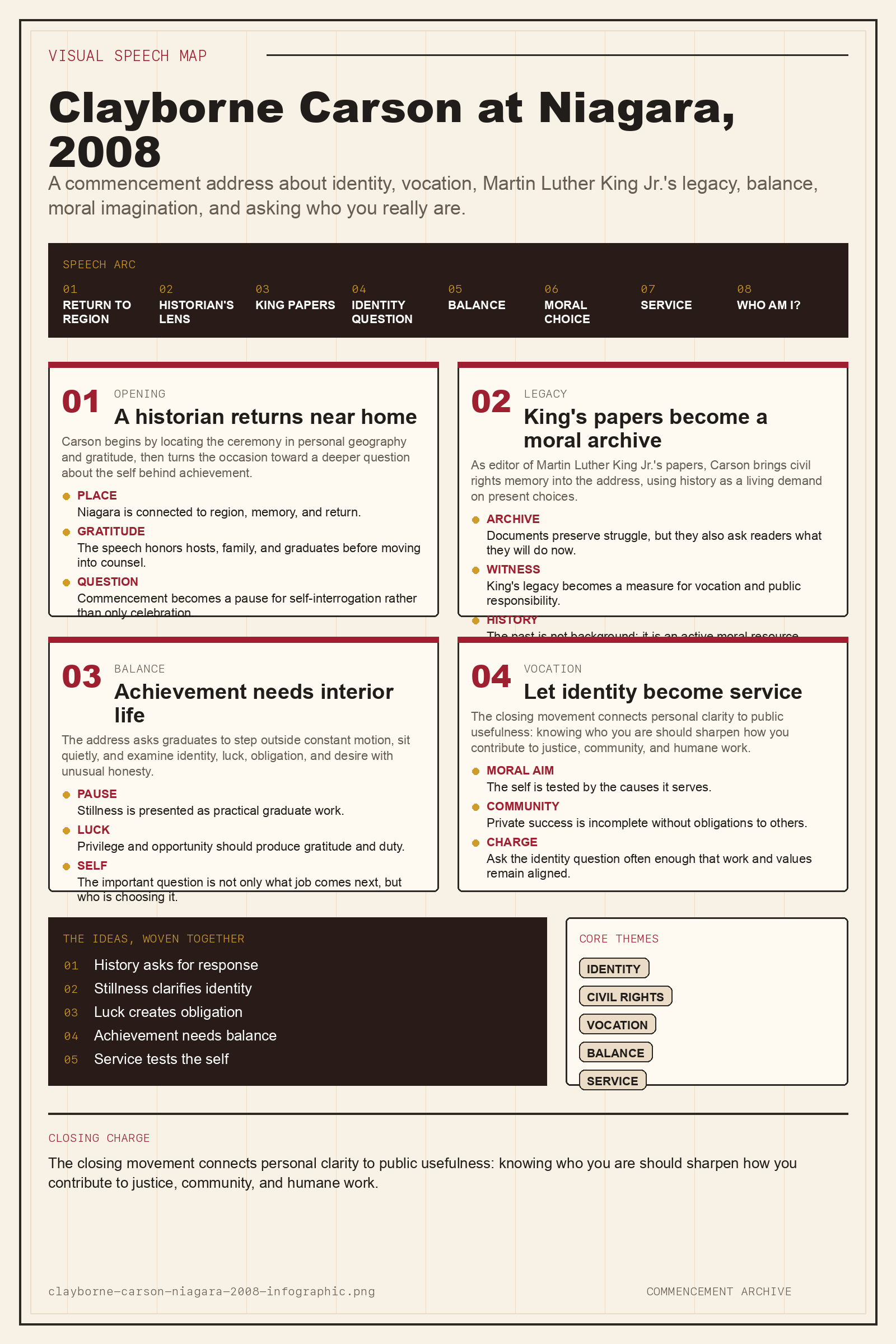
Clayborne Carson at Niagara, 2008
A commencement address about identity, vocation, Martin Luther King Jr.'s legacy, balance, moral imagination, and asking who you really are.
Speech arc
- 01Return to region
Opening move
- 02Historian's lens
Speech beat
- 03King Papers
Speech beat
- 04Identity question
Speech beat
- 05Balance
Speech beat
- 06Moral choice
Speech beat
- 07Service
Speech beat
- 08Who am I?
Final charge
Opening: A historian returns near home
Carson begins by locating the ceremony in personal geography and gratitude, then turns the occasion toward a deeper question about the self behind achievement.
Place
Niagara is connected to region, memory, and return.
Gratitude
The speech honors hosts, family, and graduates before moving into counsel.
Question
Commencement becomes a pause for self-interrogation rather than only celebration.
Carson begins by locating the ceremony in personal geography and gratitude, then turns the occasion toward a deeper question about the self behind achievement.
Legacy: King's papers become a moral archive
As editor of Martin Luther King Jr.'s papers, Carson brings civil rights memory into the address, using history as a living demand on present choices.
Archive
Documents preserve struggle, but they also ask readers what they will do now.
Witness
King's legacy becomes a measure for vocation and public responsibility.
History
The past is not background; it is an active moral resource.
As editor of Martin Luther King Jr.'s papers, Carson brings civil rights memory into the address, using history as a living demand on present choices.
Balance: Achievement needs interior life
The address asks graduates to step outside constant motion, sit quietly, and examine identity, luck, obligation, and desire with unusual honesty.
Pause
Stillness is presented as practical graduate work.
Luck
Privilege and opportunity should produce gratitude and duty.
Self
The important question is not only what job comes next, but who is choosing it.
The address asks graduates to step outside constant motion, sit quietly, and examine identity, luck, obligation, and desire with unusual honesty.
• Key takeaways •
History asks for response
Connects to identity.
Stillness clarifies identity
Connects to civil rights.
Luck creates obligation
Connects to vocation.
Achievement needs balance
Connects to balance.
Service tests the self
Connects to service.
Closing charge
The closing movement connects personal clarity to public usefulness: knowing who you are should sharpen how you contribute to justice, community, and humane work.
Let identity become service
Moral aim
The self is tested by the causes it serves.
Community
Private success is incomplete without obligations to others.
Charge
Ask the identity question often enough that work and values remain aligned.
The closing movement connects personal clarity to public usefulness: knowing who you are should sharpen how you contribute to justice, community, and humane work.
Visual speech maps
Browse more visual maps from Niagara University or continue with related mapped speeches below.
Transcript
The full transcript is hosted by the original publisher. Commencement Archive links to the source rather than republishing copyrighted text.
Read the full transcript at source →Provenance
RECOVERED 2026-08-29: Complete transcript page validated by matching speaker, institution, year, and substantial speech text. Original transcript location remains unavailable.
Source recovery audit 2026-08-29 checked the original URL, institutional sources, Commencement DB, targeted web/PDF results, and public video platforms. The Internet Archive CDX endpoint was also attempted but timed out from the audit environment. The recovered community transcript replaces the broken catalog link; the original publisher location remains unavailable.
Explore this speech
Find the next thread through the archive
Themes in this address
No canonical themes have been assigned yet.
Speeches like this one
Search all speeches ->