Alice Greenwald
Field: arts
Save the visual map
Download or open the generated poster as a standalone PNG.
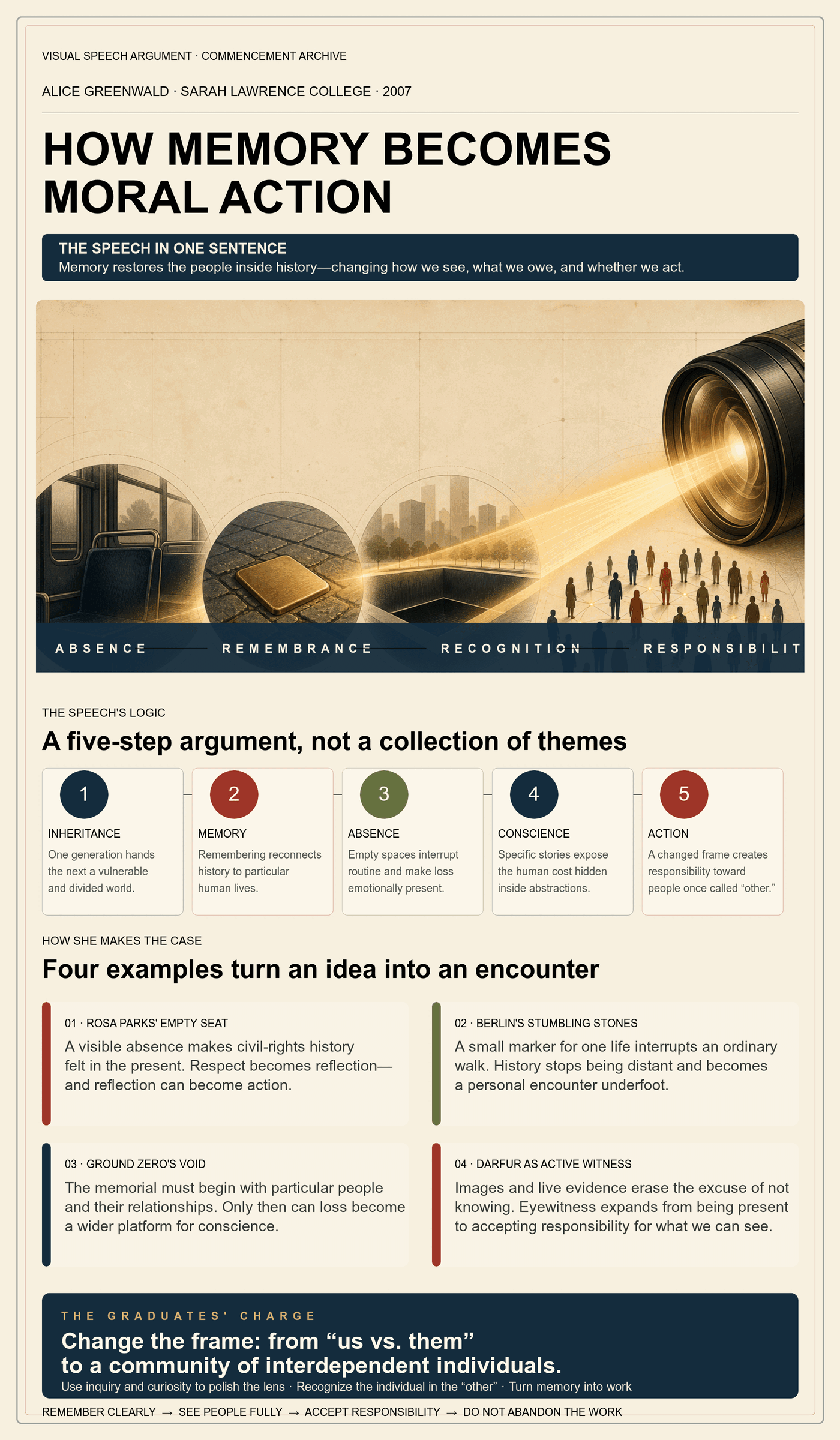
Alice Greenwald at Sarah Lawrence, 2007
A commencement address about memory, moral responsibility, absence, memorial work, curiosity, and seeing individuals beyond abstractions.
Speech arc
- 011973 memory
Opening move
- 02Parent's view
Speech beat
- 03World inherited
Speech beat
- 04Ethics of memory
Speech beat
- 05Rosa Parks seat
Speech beat
- 06Stumbling stones
Speech beat
- 07Ground Zero
Speech beat
- 08Different lens
Final charge
Return: Commencement becomes a generational mirror
Greenwald begins with her own 1973 graduation, then shifts to watching her son's NYU ceremony and asking what kind of world one generation leaves the next.
Memory
She remembers the weather, clothing, friends, parents, and feeling of ending more vividly than the speaker's words.
Parenthood
Watching another ceremony makes commencement a rite for families as well as graduates.
Inheritance
The speech asks whether older generations have honored the moral promises they once claimed.
Greenwald begins with her own 1973 graduation, then shifts to watching her son's NYU ceremony and asking what kind of world one generation leaves the next.
Memory: Remembering is a moral practice
Drawing on Holocaust memory work, Greenwald argues that societies become diminished when they lose the capacity to connect history, persons, and responsibility.
Ethics
Memory is framed not as nostalgia, but as the basis for recognizing persons and making moral decisions.
Absence
Empty seats and small memorial stones show how absence can force reflection.
Witness
Technology changes what eyewitness means, expanding public responsibility for distant suffering.
Drawing on Holocaust memory work, Greenwald argues that societies become diminished when they lose the capacity to connect history, persons, and responsibility.
Memorial: The human story must resist abstraction
Her World Trade Center Memorial Museum work becomes a case study in how particular loss can speak to conscience without turning people into symbols.
Particularity
The site must honor specific lives, events, responders, families, and communities before making broader claims.
People
Terrorism does not strike abstractions; it strikes individual human beings with names and relationships.
Frame
Changing the frame from us-versus-them to interdependence is the civic work memory can do.
Her World Trade Center Memorial Museum work becomes a case study in how particular loss can speak to conscience without turning people into symbols.
• Key takeaways •
Memory carries obligation
Connects to memory.
Absence can teach conscience
Connects to moral responsibility.
People outrank abstractions
Connects to public history.
Curiosity changes the frame
Connects to curiosity.
The work remains unfinished
Connects to interdependence.
Closing charge
Greenwald closes by returning to Sarah Lawrence habits: deep inquiry, curiosity, audacious challenges, and the obligation to continue unfinished repair.
Polish the lens for others
Education
Small seminars, dons, books, and conversations become the lens through which graduates will engage the world.
Moment
Graduates have a limited window on the stage, whether or not they hold formal power.
Promise
Memory turns the past into promises made toward the future.
Greenwald closes by returning to Sarah Lawrence habits: deep inquiry, curiosity, audacious challenges, and the obligation to continue unfinished repair.
Visual speech maps
Browse more visual maps from Sarah Lawrence College or continue with related mapped speeches below.
Transcript
The full transcript is hosted by the original publisher. Commencement Archive links to the source rather than republishing copyrighted text.
Read the full transcript at source →Provenance
RECOVERED 2026-08-29: Complete transcript page validated by matching speaker, institution, year, and substantial speech text. Original transcript location remains unavailable.
Source recovery audit 2026-08-29 checked the original URL, institutional sources, Commencement DB, targeted web/PDF results, and public video platforms. The Internet Archive CDX endpoint was also attempted but timed out from the audit environment. The recovered community transcript replaces the broken catalog link; the original publisher location remains unavailable.
Explore this speech
Find the next thread through the archive
Themes in this address
No canonical themes have been assigned yet.
Speeches like this one
Search all speeches ->