Greil Marcus
Field: letters
Save the visual map
Download or open the generated poster as a standalone PNG.
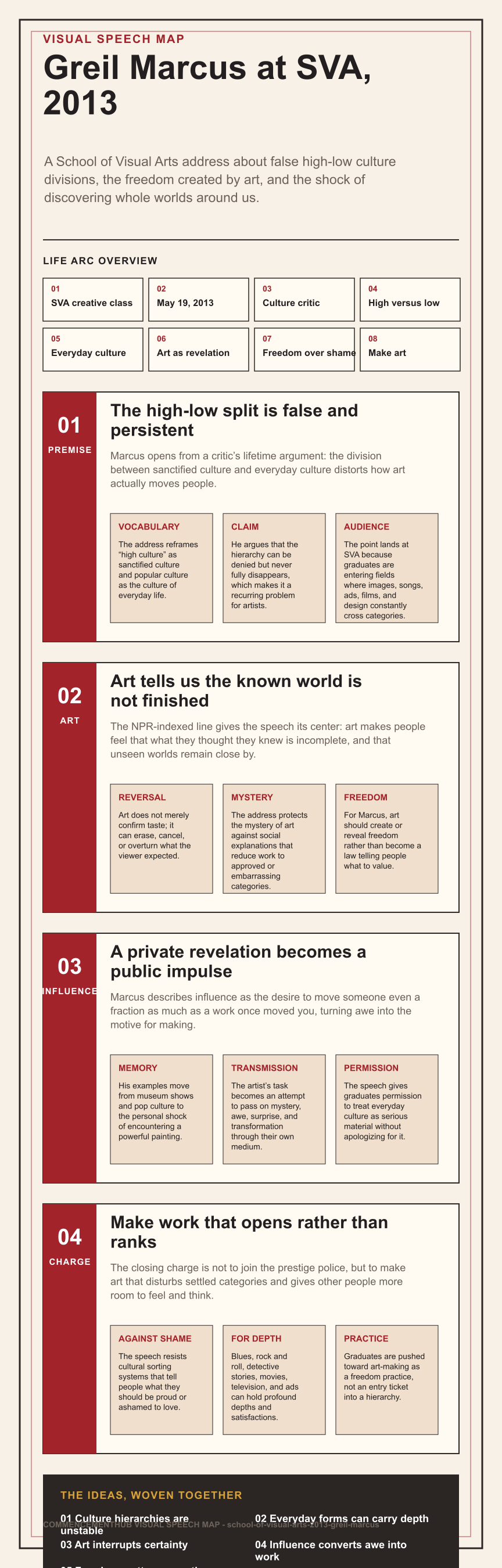
Greil Marcus at SVA, 2013
A School of Visual Arts address about false high-low culture divisions, the freedom created by art, and the shock of discovering whole worlds around us.
Speech arc
- 01SVA creative class
Opening move
- 02May 19, 2013
Speech beat
- 03Culture critic
Speech beat
- 04High versus low
Speech beat
- 05Everyday culture
Speech beat
- 06Art as revelation
Speech beat
- 07Freedom over shame
Speech beat
- 08Make art
Final charge
Premise: The high-low split is false and persistent
Marcus opens from a critic's lifetime argument: the division between sanctified culture and everyday culture distorts how art actually moves people.
Vocabulary
The address reframes "high culture" as sanctified culture and popular culture as the culture of everyday life.
Claim
He argues that the hierarchy can be denied but never fully disappears, which makes it a recurring problem for artists.
Audience
The point lands at SVA because graduates are entering fields where images, songs, ads, films, and design constantly cross categories.
Marcus opens from a critic's lifetime argument: the division between sanctified culture and everyday culture distorts how art actually moves people.
Art: Art tells us the known world is not finished
The NPR-indexed line gives the speech its center: art makes people feel that what they thought they knew is incomplete, and that unseen worlds remain close by.
Reversal
Art does not merely confirm taste; it can erase, cancel, or overturn what the viewer expected.
Mystery
The address protects the mystery of art against social explanations that reduce work to approved or embarrassing categories.
Freedom
For Marcus, art should create or reveal freedom rather than become a law telling people what to value.
The NPR-indexed line gives the speech its center: art makes people feel that what they thought they knew is incomplete, and that unseen worlds remain close by.
Influence: A private revelation becomes a public impulse
Marcus describes influence as the desire to move someone even a fraction as much as a work once moved you, turning awe into the motive for making.
Memory
His examples move from museum shows and pop culture to the personal shock of encountering a powerful painting.
Transmission
The artist's task becomes an attempt to pass on mystery, awe, surprise, and transformation through their own medium.
Permission
The speech gives graduates permission to treat everyday culture as serious material without apologizing for it.
Marcus describes influence as the desire to move someone even a fraction as much as a work once moved you, turning awe into the motive for making.
• Key takeaways •
Culture hierarchies are unstable
Connects to art.
Everyday forms can carry depth
Connects to culture.
Art interrupts certainty
Connects to freedom.
Influence converts awe into work
Connects to creativity.
Freedom matters more than ranking
Connects to identity.
Closing charge
The closing charge is not to join the prestige police, but to make art that disturbs settled categories and gives other people more room to feel and think.
Make work that opens rather than ranks
Against shame
The speech resists cultural sorting systems that tell people what they should be proud or ashamed to love.
For depth
Blues, rock and roll, detective stories, movies, television, and ads can hold profound depths and satisfactions.
Practice
Graduates are pushed toward art-making as a freedom practice, not an entry ticket into a hierarchy.
The closing charge is not to join the prestige police, but to make art that disturbs settled categories and gives other people more room to feel and think.
Visual speech maps
Browse more visual maps from School of Visual Arts .
Transcript
No official full transcript has been located yet. If you know of one, suggestions are welcome.
Provenance
Imported from NPR commencement archive
NPR archive last updated in 2015; destination availability has not been exhaustively rechecked
Explore this speech
Find the next thread through the archive
Themes in this address
No canonical themes have been assigned yet.