Neil Gaiman
Field: letters
“Make good art.”
Save the visual map
Download or open the generated poster as a standalone PNG.
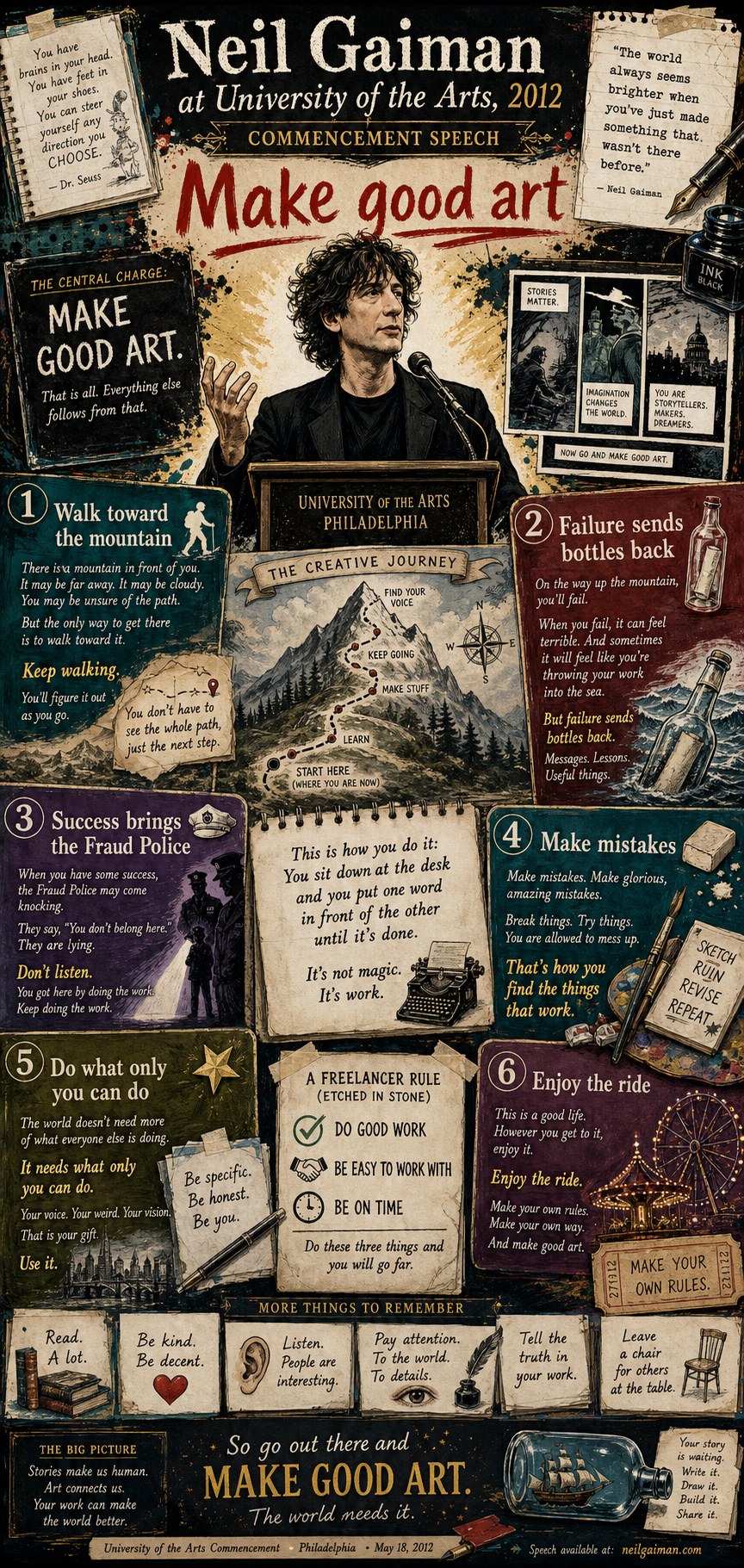
Neil Gaiman at University of the Arts, 2012
A creative-life address about making your own rules, walking toward the mountain, surviving failure and success, and making good art.
Speech arc
- 01Make good art
Opening move
- 02No career plan
Speech beat
- 03Walk to the mountain
Speech beat
- 04Messages in bottles
Speech beat
- 05Fraud Police
Speech beat
- 06Make mistakes
Speech beat
- 07Only you can do it
Speech beat
- 08Enjoy the ride
Final charge
Beginning: Not knowing the rules can be useful
Gaiman turns his lack of formal higher education into a creative principle: people who do not know the limits are freer to test them.
Origin
He describes leaving school, writing, and being paid while making up the path as he went.
Permission
The arts reward people willing to go beyond rules set by those who had not tested the possible.
List
His early list of desired forms becomes a practical substitute for a conventional career plan.
Gaiman turns his lack of formal higher education into a creative principle: people who do not know the limits are freer to test them.
Compass: Walk toward the mountain
When choices are unclear, the mountain image lets graduates ask whether a job, compromise, or adventure moves them closer to the work they want to make.
Direction
The distant mountain stands for the creative life he wanted: books, comics, stories, and words.
Tradeoff
Some respectable jobs paid well but would have carried him away from the mountain.
Adventure
He learned to keep doing things while they felt like adventure and stop when they became only work.
When choices are unclear, the mountain image lets graduates ask whether a job, compromise, or adventure moves them closer to the work they want to make.
Pressure: Failure and success both bring problems
The bottle metaphor makes failure concrete, while the Fraud Police image names the fear that success may be revoked at any moment.
Failure
Creative work can mean sending out many bottles before any answer returns.
Success
Success can turn the maker into someone who answers email instead of doing the work.
Protection
The remedy is to keep making work one is proud of, not work made only for money.
The bottle metaphor makes failure concrete, while the Fraud Police image names the fear that success may be revoked at any moment.
• Key takeaways •
Make the work only you can make
Connects to creativity.
Use the mountain as a compass
Connects to resilience.
Failure sends bottles slowly
Connects to purpose.
Success requires protection
Connects to work.
Art is the response to trouble
Connects to identity.
Closing charge
The famous charge is not vague inspiration; it is a discipline for trouble, originality, freelance survival, and joy.
Make mistakes, then make the work only you can make
Mistakes
Mistakes prove that a graduate is out doing something, and some mistakes become new names, stories, or paths.
Voice
After imitation comes the harder work of using one’s own voice, mind, story, and vision.
Rules
Freelancers keep working by doing good work, being easy to work with, and delivering on time.
The famous charge is not vague inspiration; it is a discipline for trouble, originality, freelance survival, and joy.
Visual speech maps
Browse more visual maps from The University of the Arts .
Transcript
The full transcript is hosted by the original publisher. Commencement Archive links to the source rather than republishing copyrighted text.
Read the full transcript at source →Provenance
Imported from NPR commencement archive; cross-referenced with Open Commencement DB
NPR archive last updated in 2015; destination availability has not been exhaustively rechecked | Open Commencement DB transcript; not independently verified against the original recording
Explore this speech
Find the next thread through the archive
Themes in this address
No canonical themes have been assigned yet.