Jean Andrews
Save the visual map
Download or open the generated poster as a standalone PNG.
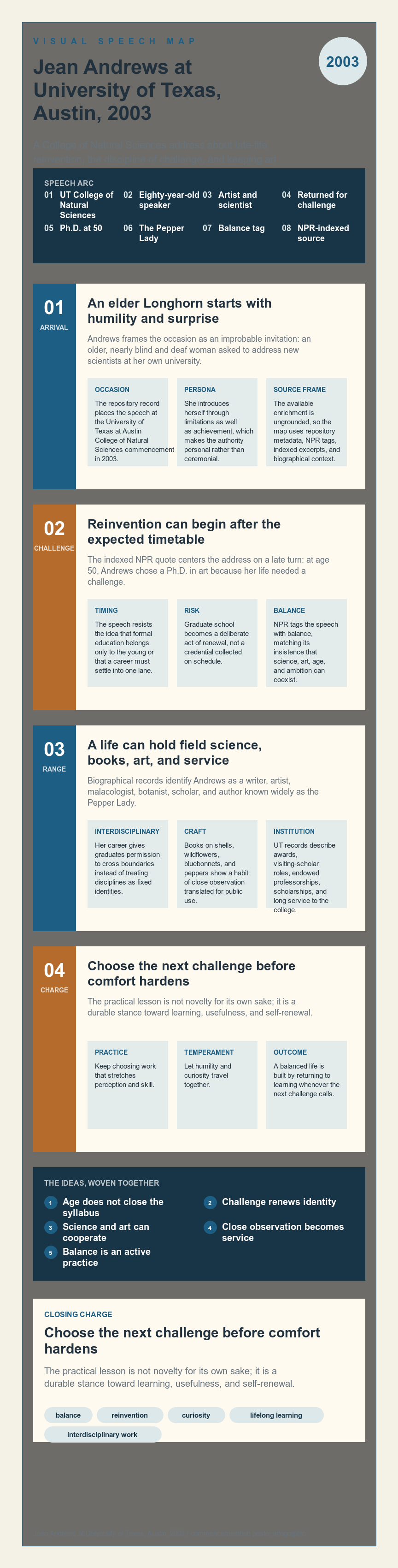
Jean Andrews at University of Texas, Austin, 2003
A College of Natural Sciences address about late-life reinvention, the discipline of challenge, and keeping art and science in the same life.
Speech arc
- 01UT College of Natural Sciences
Opening move
- 02Eighty-year-old speaker
Speech beat
- 03Artist and scientist
Speech beat
- 04Returned for challenge
Speech beat
- 05Ph.D. at 50
Speech beat
- 06The Pepper Lady
Speech beat
- 07Balance tag
Speech beat
- 08NPR-indexed source
Final charge
Arrival: An elder Longhorn starts with humility and surprise
Andrews frames the occasion as an improbable invitation: an older, nearly blind and deaf woman asked to address new scientists at her own university.
Occasion
The repository record places the speech at the University of Texas at Austin College of Natural Sciences commencement in 2003.
Persona
She introduces herself through limitations as well as achievement, which makes the authority personal rather than ceremonial.
Source frame
The available enrichment is ungrounded, so the map uses repository metadata, NPR tags, indexed excerpts, and biographical context.
Andrews frames the occasion as an improbable invitation: an older, nearly blind and deaf woman asked to address new scientists at her own university.
Challenge: Reinvention can begin after the expected timetable
The indexed NPR quote centers the address on a late turn: at age 50, Andrews chose a Ph.D. in art because her life needed a challenge.
Timing
The speech resists the idea that formal education belongs only to the young or that a career must settle into one lane.
Risk
Graduate school becomes a deliberate act of renewal, not a credential collected on schedule.
Balance
NPR tags the speech with balance, matching its insistence that science, art, age, and ambition can coexist.
The indexed NPR quote centers the address on a late turn: at age 50, Andrews chose a Ph.D.
in art because her life needed a challenge.
Range: A life can hold field science, books, art, and service
Biographical records identify Andrews as a writer, artist, malacologist, botanist, scholar, and author known widely as the Pepper Lady.
Interdisciplinary
Her career gives graduates permission to cross boundaries instead of treating disciplines as fixed identities.
Craft
Books on shells, wildflowers, bluebonnets, and peppers show a habit of close observation translated for public use.
Institution
UT records describe awards, visiting-scholar roles, endowed professorships, scholarships, and long service to the college.
Biographical records identify Andrews as a writer, artist, malacologist, botanist, scholar, and author known widely as the Pepper Lady.
• Key takeaways •
Age does not close the syllabus
Connects to balance.
Challenge renews identity
Connects to reinvention.
Science and art can cooperate
Connects to curiosity.
Close observation becomes service
Connects to lifelong learning.
Balance is an active practice
Connects to interdisciplinary work.
Closing charge
The practical lesson is not novelty for its own sake; it is a durable stance toward learning, usefulness, and self-renewal.
Choose the next challenge before comfort hardens
Practice
Keep choosing work that stretches perception and skill.
Temperament
Let humility and curiosity travel together.
Outcome
A balanced life is built by returning to learning whenever the next challenge calls.
The practical lesson is not novelty for its own sake; it is a durable stance toward learning, usefulness, and self-renewal.
Visual speech maps
Browse more visual maps from University of Texas, Austin or continue with related mapped speeches below.
Transcript
No official full transcript has been located yet. If you know of one, suggestions are welcome.
Provenance
Imported from NPR commencement archive; cross-referenced with Open Commencement DB
NPR archive last updated in 2015; destination availability has not been exhaustively rechecked | Open Commencement DB transcript; not independently verified against the original recording
Explore this speech
Find the next thread through the archive
Themes in this address
No canonical themes have been assigned yet.
Speeches like this one
Search all speeches ->