Stephen R. Kellert
Save the visual map
Download or open the generated poster as a standalone PNG.
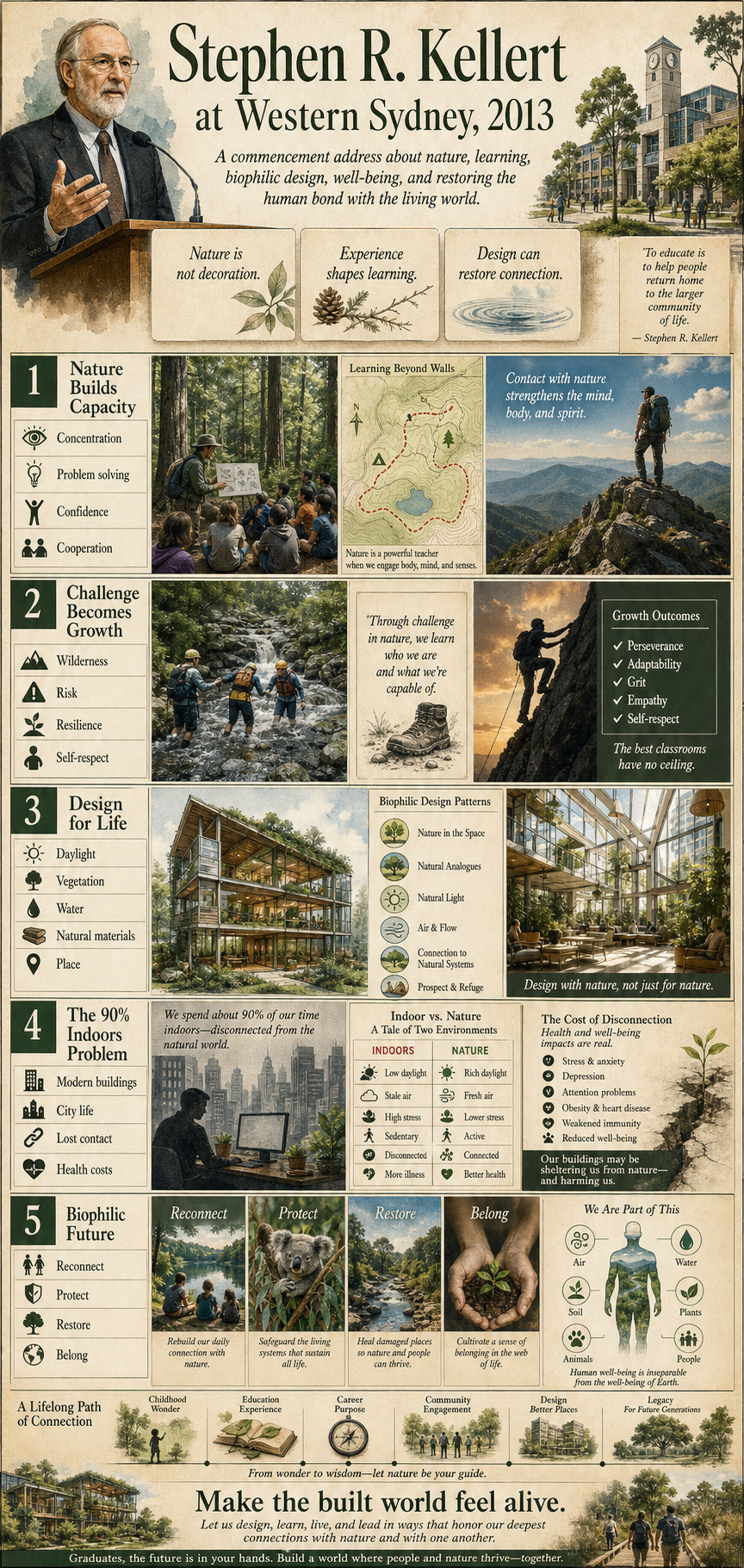
Stephen R. Kellert at Western Sydney, 2013
A commencement address about nature, learning, biophilic design, well-being, and restoring the human bond with the living world.
Speech arc
- 01University of Western Sydney
Opening move
- 02Class of 2013
Speech beat
- 03Nature as teacher
Speech beat
- 04Outdoor challenge
Speech beat
- 0590% indoors
Speech beat
- 06Biophilic design
Speech beat
- 07Health and learning
Speech beat
- 08Built world alive
Final charge
Learning: Nature builds capacities classrooms often need
Kellert argues that concentration, problem solving, confidence, cooperation, and resilience have long been strengthened by direct experience in natural settings.
Skills
The address names mental concentration, critical thinking, coping, competitiveness, self-confidence, and self-esteem as capacities shaped through experience.
Setting
Traditional learning is placed outside the classroom, where terrain, weather, risk, and living systems make abstract growth concrete.
Claim
Nature is not decorative scenery; it is a formative environment that teaches body, mind, and social judgment together.
Kellert argues that concentration, problem solving, confidence, cooperation, and resilience have long been strengthened by direct experience in natural settings.
Challenge: Growth comes through risk, discomfort, and adaptation
Outdoor programs become Kellert’s example of how adversity can produce self-respect, cooperation, purpose, and a stronger sense of one’s place in the world.
Risk
Students leave comfort and face cold, fatigue, uncertainty, steep terrain, and dependence on others.
Reward
The quoted participant describes strengthened selfhood, purposefulness, confidence, and the belief that future problems are manageable.
Lesson
Challenge is not romanticized as hardship alone; it is valuable because it joins difficulty to reflection and belonging.
Outdoor programs become Kellert’s example of how adversity can produce self-respect, cooperation, purpose, and a stronger sense of one’s place in the world.
Indoors: Modern life weakens contact with living systems
Kellert warns that people now spend most of life inside built environments, often in cities, so the developmental value of nature must be designed back into daily life.
Statistic
The speech frames modern society around the problem of spending roughly 90 percent of time indoors.
Cost
Disconnection from daylight, vegetation, water, fresh air, and natural patterns affects well-being, attention, and emotional health.
Question
The address asks whether nature still matters when daily life is increasingly urban and enclosed.
Kellert warns that people now spend most of life inside built environments, often in cities, so the developmental value of nature must be designed back into daily life.
Design: Biophilic buildings can restore everyday contact
A sustainably designed building becomes a case study for bringing daylight, vegetation, water, natural materials, and ecological cues into ordinary work and learning.
Patterns
Kellert points to natural light, views, plants, water, air flow, materials, and place-based design as more than aesthetic choices.
Outcome
Design succeeds when people feel connected, calmer, more attentive, and more fully present in the spaces they use.
Principle
The built world should function as habitat for human flourishing, not merely as efficient shelter.
A sustainably designed building becomes a case study for bringing daylight, vegetation, water, natural materials, and ecological cues into ordinary work and learning.
• Key takeaways •
Nature is a teacher
Connects to nature.
Challenge builds confidence
Connects to learning.
Indoor life has costs
Connects to biophilic design.
Design can restore contact
Connects to well-being.
Human well-being depends on living systems
Connects to sustainability.
Closing charge
The closing charge is ecological and civic: restore the bond with living systems so education, work, community, and stewardship can support one another.
A healthier society reconnects people and nature
Reconnect
Graduates are invited to rebuild daily contact with nature instead of treating it as a distant vacation landscape.
Protect
Human well-being is tied to safeguarding the living systems that make health and community possible.
Belong
The address ends with a broader identity: people are participants in the web of life, not observers outside it.
The closing charge is ecological and civic: restore the bond with living systems so education, work, community, and stewardship can support one another.
Visual speech maps
Browse more visual maps from University of Western Sydney, Australia .
Transcript
The previously catalogued transcript link is no longer live and is queued for re-sourcing.
Machine transcript available for archive analysis; it is unverified and may contain transcription errors. Machine transcript source ->
Provenance
BROKEN transcript link (checked 2026-06-26): humanity.org removed its /voices/commencements section. Provenance: Imported from NPR commencement archive; cross-referenced with Open Commencement DB
NPR archive last updated in 2015; destination availability has not been exhaustively rechecked | Open Commencement DB transcript; not independently verified against the original recording | Transcript URL dead (humanity.org removed its /voices/commencements section); no video fallback — needs re-sourcing
Explore this speech
Find the next thread through the archive
Themes in this address
No canonical themes have been assigned yet.