Martha Nussbaum
Field: letters
Save the visual map
Download or open the generated poster as a standalone PNG.
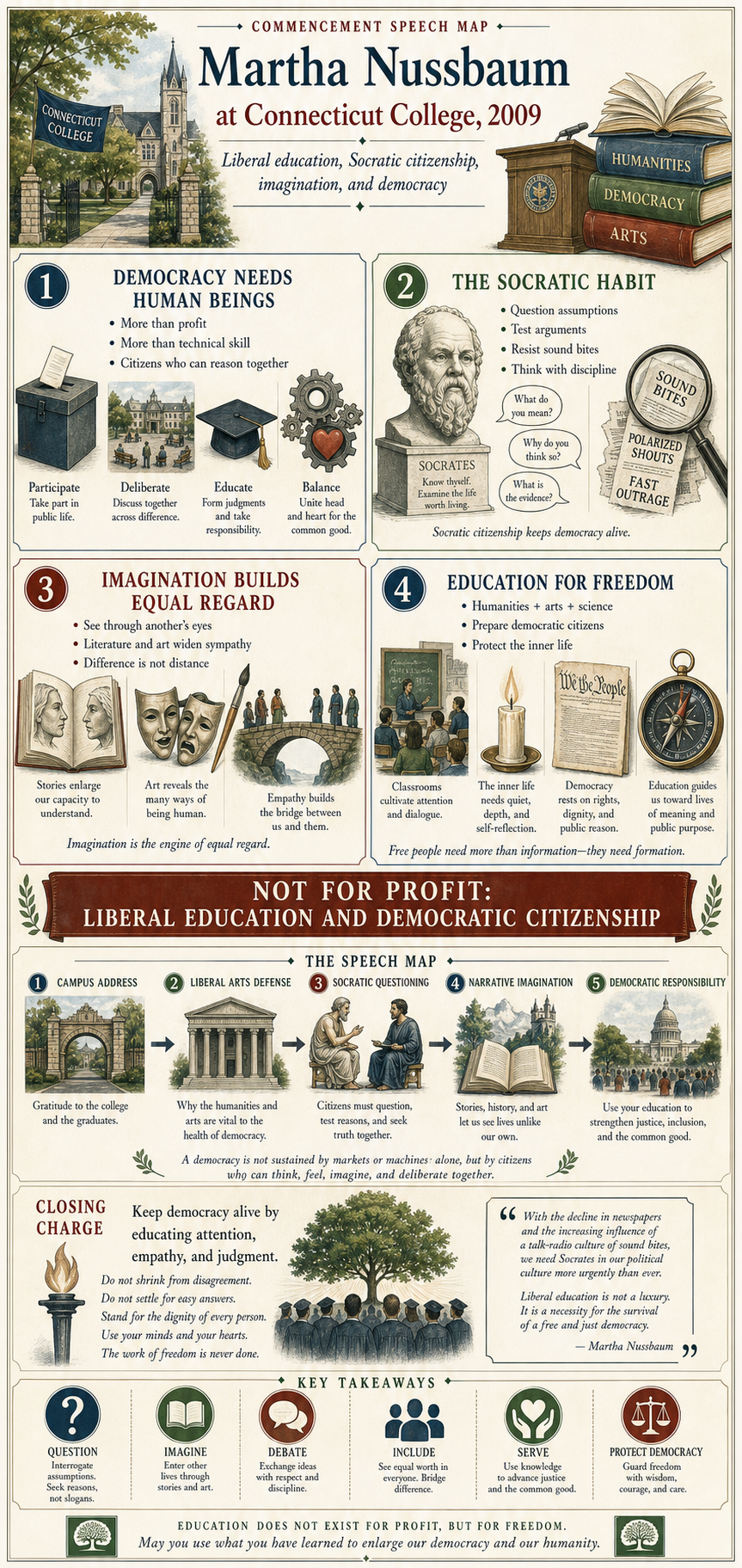
Martha Nussbaum at Connecticut College, 2009
A Connecticut College address about liberal education, Socratic citizenship, imagination, and the habits that keep democracy alive.
Speech arc
- 01Connecticut College
Opening move
- 02Official full text
Speech beat
- 03Not for Profit
Speech beat
- 04Liberal education
Speech beat
- 05Socratic questioning
Speech beat
- 06Narrative imagination
Speech beat
- 07Democratic citizenship
Speech beat
- 08Humanities and arts
Final charge
Democracy: Democracy needs more than economic training
Nussbaum frames liberal education as preparation for citizenship, arguing that a healthy democracy depends on people who can reason, deliberate, and see others as fully human.
Purpose
The address resists reducing education to profit, productivity, or technical competence alone.
Citizen
Graduates are asked to become people capable of public reason, ethical attention, and democratic responsibility.
Institution
Connecticut College's official archive preserves the address as full text in its commencement collection.
Nussbaum frames liberal education as preparation for citizenship, arguing that a healthy democracy depends on people who can reason, deliberate, and see others as fully human.
Socratic Habit: Questioning is civic infrastructure
The speech treats Socratic examination as a democratic discipline: citizens must test assumptions, evaluate arguments, and resist slogans when public life becomes shallow.
Inquiry
Questioning prevents inherited opinions from becoming unexamined public commitments.
Discipline
Critical thought is presented as a practiced habit rather than a decorative academic skill.
Public life
Reasoned disagreement becomes a way to strengthen democratic life instead of merely winning arguments.
The speech treats Socratic examination as a democratic discipline: citizens must test assumptions, evaluate arguments, and resist slogans when public life becomes shallow.
Imagination: The arts teach equal regard
Nussbaum emphasizes narrative imagination: literature, art, and humanities study help people imagine other lives and recognize dignity across difference.
Sympathy
Stories widen the graduate's capacity to notice lives unlike their own.
Difference
Education should make difference intelligible without flattening it into sameness.
Humanity
The arts are treated as democratic formation, not as ornamental enrichment.
Nussbaum emphasizes narrative imagination: literature, art, and humanities study help people imagine other lives and recognize dignity across difference.
• Key takeaways •
Democracy requires educated judgment
Connects to democracy.
Question assumptions before slogans harden
Connects to liberal education.
Art and literature enlarge sympathy
Connects to humanities.
Science and humanities belong together
Connects to citizenship.
Freedom depends on civic imagination
Connects to empathy.
Closing charge
The closing charge links humanities, arts, and science to freedom: graduates need attention, empathy, and judgment to keep democratic citizenship from becoming mechanical or market-driven.
Education protects judgment and the inner life
Formation
Liberal education forms people who can think, feel, imagine, and deliberate together.
Responsibility
The speech makes democracy an active practice renewed by each educated generation.
Charge
Graduates are sent to protect public reason and equal dignity in the communities they enter.
The closing charge links humanities, arts, and science to freedom: graduates need attention, empathy, and judgment to keep democratic citizenship from becoming mechanical or market-driven.
Visual speech maps
Browse more visual maps from Connecticut College or continue with related mapped speeches below.
Transcript
The full transcript is hosted by the original publisher. Commencement Archive links to the source rather than republishing copyrighted text.
Read the full transcript at source →Provenance
Imported from NPR commencement archive; cross-referenced with Open Commencement DB
NPR archive last updated in 2015; destination availability has not been exhaustively rechecked | Open Commencement DB transcript; not independently verified against the original recording
Explore this speech
Find the next thread through the archive
Themes in this address
No canonical themes have been assigned yet.
Speeches like this one
Search all speeches ->