Year
Class of 2009
Browse commencement speeches from 2009, including addresses by Anthony Kennedy, Barack Obama, and Carl Schramm. Each record links to the available source material, transcript, video, and archive context.
25 addresses 10 themes 6 highlights
Highlights from 2009
Records with stronger source signals, summaries, transcripts, videos, or visual archive material.
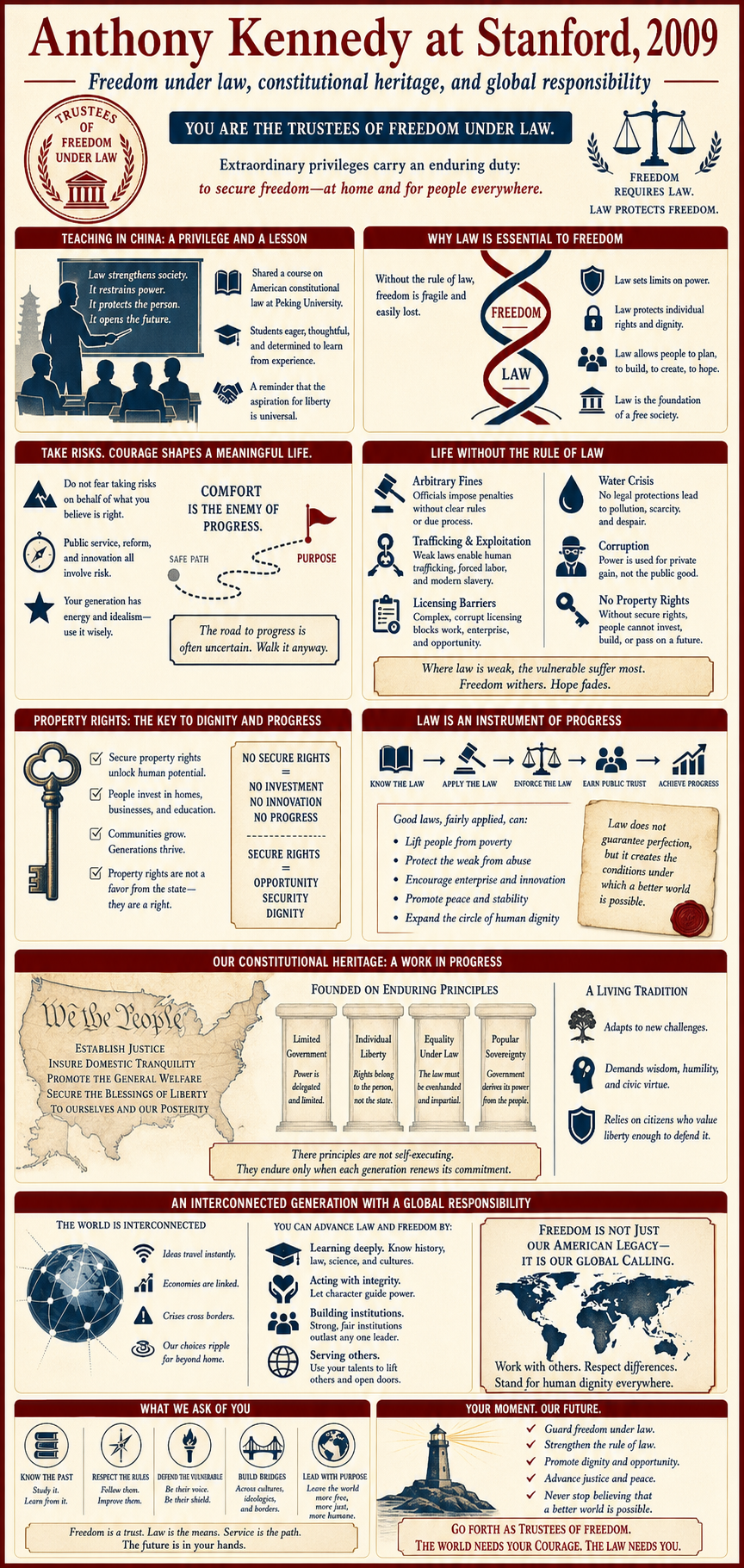 Anthony Kennedy Stanford University Justice Anthony Kennedy urges Stanford graduates to see themselves as trustees of freedom under law, arguing that American freedom carries a duty to help secure it for others around the world. Drawing on examples from his teaching in China, the absence of the rule of law in struggling nations, and the costs of corruption and lack of property rights, he contends that law is an instrument of progress rather than a threat. He calls on graduates to know and revere their constitutional heritage and to use their interconnected, empowered generation to advance law and freedom globally. InfographicSummaryTranscriptOfficial source
  Barack Obama Arizona State University President Obama addresses ASU's Class of 2009 amid economic recession and global challenges, urging graduates to reject a 'me-first' definition of success based on titles, wealth, and status. He argues that such a focus distracts from values and breeds complacency, and instead calls on graduates to pursue meaningful work, serve others, and continually build a lifelong 'body of work.' He cites historical and contemporary figures who succeeded without prestige to encourage graduates to change the world.
Photo: Official White House Photo by Pete Souza / Public domain / source InfographicSummaryTranscriptVideo
Barack Obama Arizona State University President Obama addresses ASU's Class of 2009 amid economic recession and global challenges, urging graduates to reject a 'me-first' definition of success based on titles, wealth, and status. He argues that such a focus distracts from values and breeds complacency, and instead calls on graduates to pursue meaningful work, serve others, and continually build a lifelong 'body of work.' He cites historical and contemporary figures who succeeded without prestige to encourage graduates to change the world.
Photo: Official White House Photo by Pete Souza / Public domain / source InfographicSummaryTranscriptVideo 
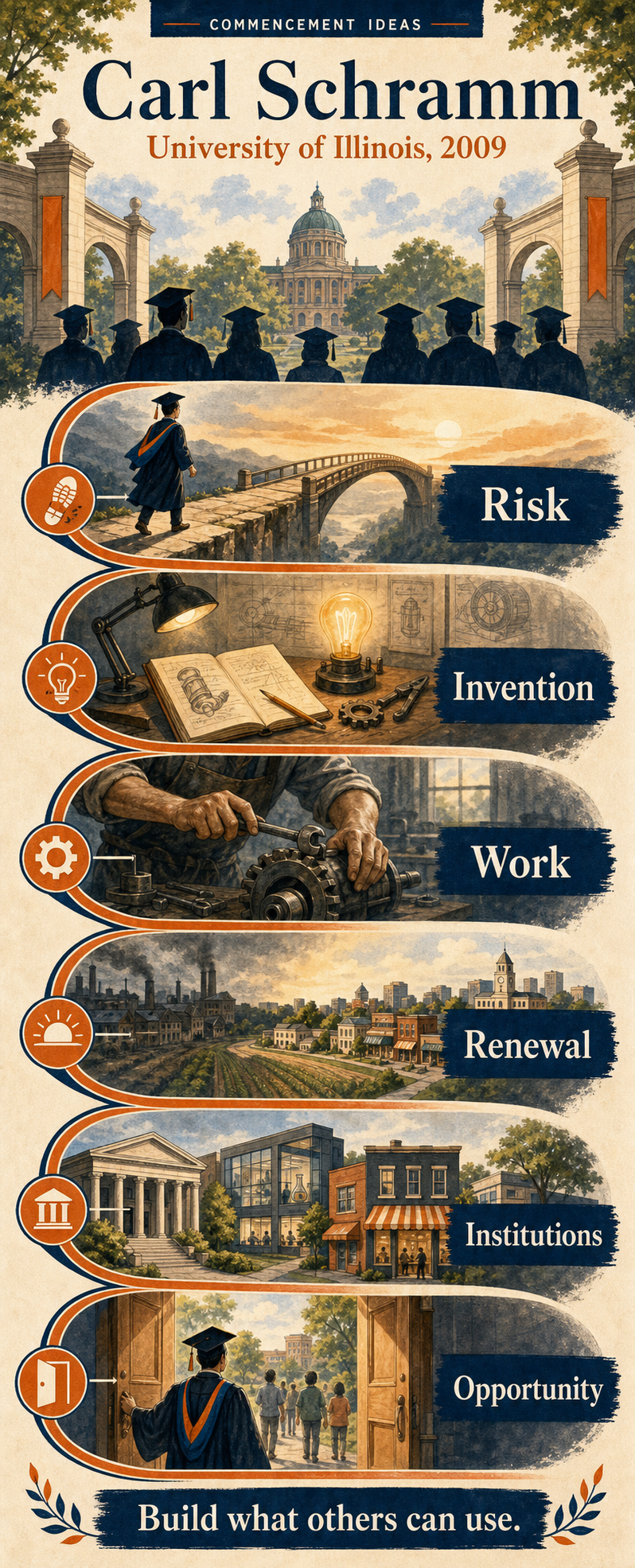 Carl Schramm University of Illinois at Urbana-Champaign Carl Schramm urges University of Illinois graduates to consider entrepreneurship as a vocation, telling the story of Ewing Kauffman, who built a pharmaceutical company from nothing and later created a foundation to teach entrepreneurship. He challenges the notion that non-profit and government work is inherently more virtuous than business, arguing that entrepreneurship is itself a form of service that creates wealth, jobs, and innovation. Speaking during the 2009 recession, he places current economic hardship in historical context and calls on graduates to become America's most entrepreneurial generation. InfographicSummaryTranscriptVideo
  Fareed Zakaria Bates College Fareed Zakaria acknowledges that the Class of 2009 is graduating into difficult economic and geopolitical times, but argues he remains optimistic because of the graduates themselves. Using examples like the swine flu response and Thomas Malthus's failed predictions, he stresses that it is easy to describe the world's problems but impossible to predict the human response that ultimately changes history. He urges graduates to recognize themselves as agents of change and to pursue enduring qualities such as intelligence, hard work, honesty, character, loyalty, love, and faith. InfographicSummaryTranscriptOfficial source
 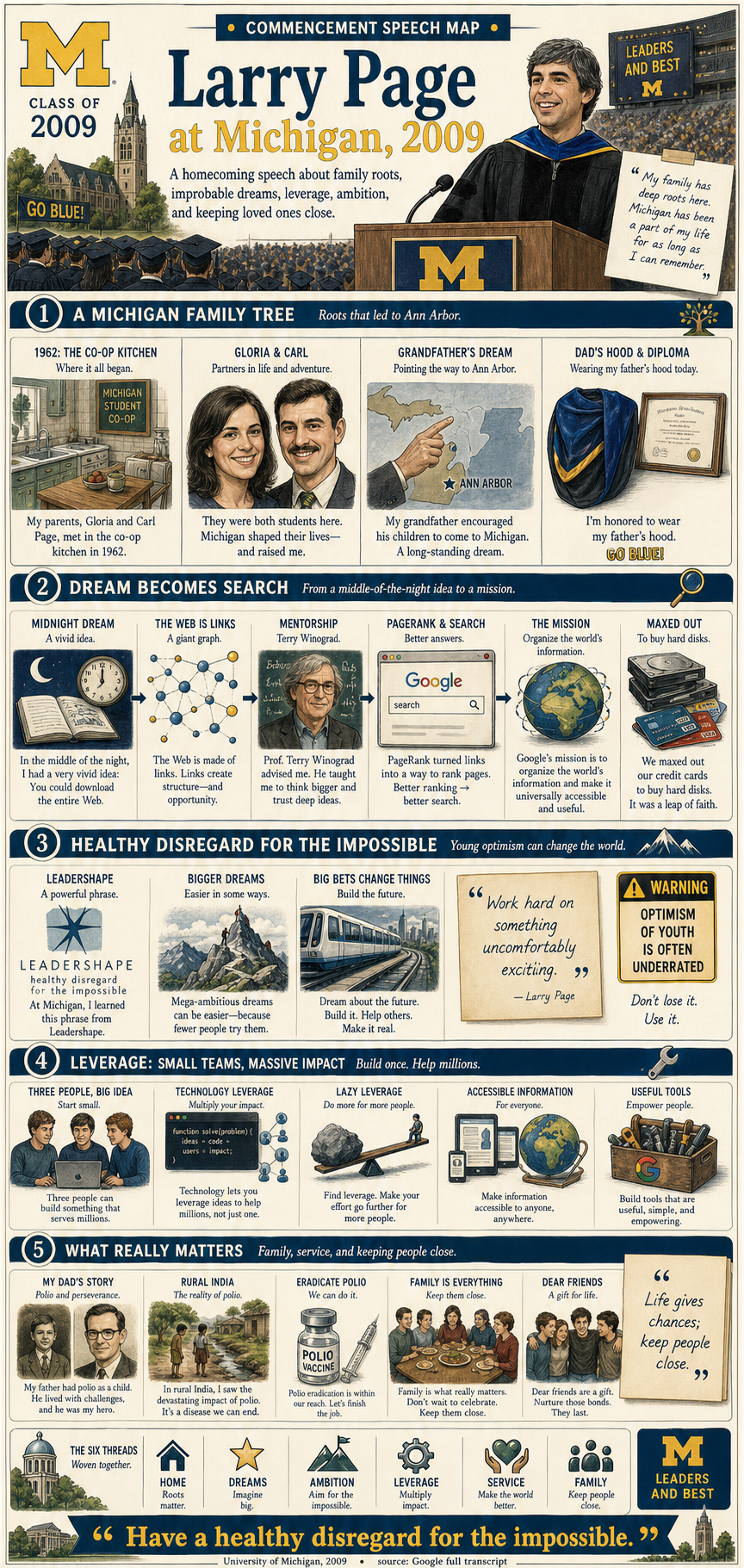 Larry Page University of Michigan Larry Page recounts his deep family ties to the University of Michigan, where his parents met and where multiple family members earned degrees, framing the address as a personal homecoming. He shares the origin of the idea behind Google, born from a late-night dream, and encourages graduates to pursue ambitious goals with a 'healthy disregard for the impossible.' He closes by reflecting on his father's death and battle with polio, urging graduates to value family and pursue work that could make a difference in the world. InfographicSummaryTranscriptVideo
 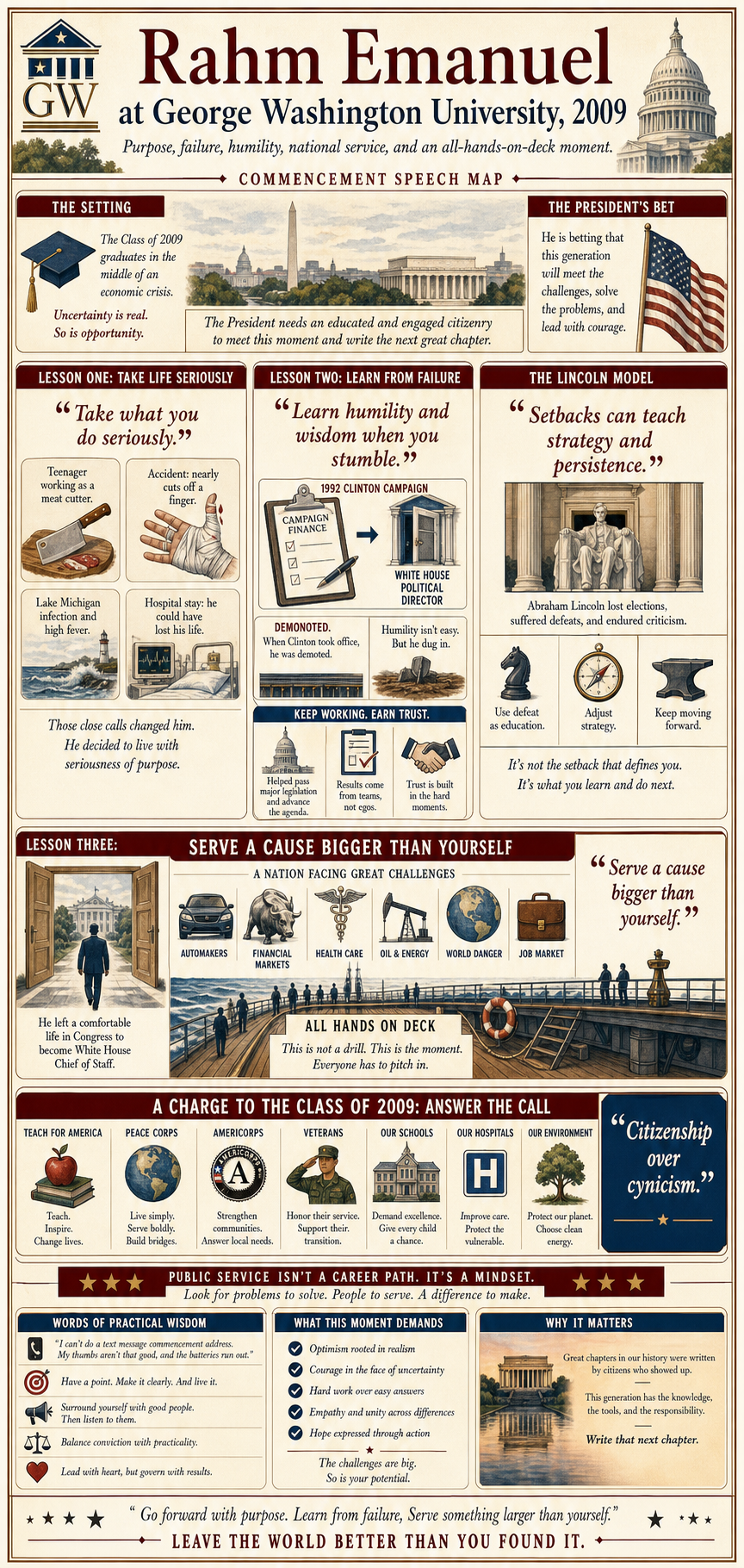 Rahm Emanuel George Washington University Rahm Emanuel, then White House Chief of Staff, addresses the George Washington University Class of 2009 by sharing three personal lessons drawn from his own life: take life seriously, learn humility from failure, and serve a cause greater than oneself. He frames graduation amid economic crisis as both a responsibility and an opportunity, urging graduates to engage in public service. He cites rising applications to programs like Teach for America, the Peace Corps, and AmeriCorps, and references a newly signed national service bill. InfographicSummaryTranscriptVideo
 Represented themes
Common ideas classified across this year's speeches.
All 2009 addresses
Complete archive records for this year, sorted by institution.
№ 2009.001 № 2009.002 № 2009.003 № 2009.004 № 2009.005 № 2009.006 № 2009.007 № 2009.008 № 2009.009 № 2009.010 № 2009.011 № 2009.012 № 2009.013 № 2009.014 № 2009.015 № 2009.016 № 2009.017 № 2009.018 № 2009.019 № 2009.020 № 2009.021 № 2009.022 № 2009.023 № 2009.024 № 2009.025
Barack Obama
Arizona State University
Bo Jackson
Auburn University
Fareed Zakaria
Bates College
Anthony Corvino
Binghamton University
Martha Nussbaum
Connecticut College
Jonathon Youshaei
Deerfield High School
Rahm Emanuel
George Washington University
Marissa Mayer
Illinois Institute of Technology
Eugene Mirman
Lexington High School
Deval Patrick
Massachusetts Institute of Technology
Gabrielle Giffords
Scripps College
Anthony Kennedy
Stanford University
Ellen DeGeneres
Tulane University
Chris Gardner
University of California, Berkeley
Mike Judge
University of California, San Diego
Robert M. Gates
University of Georgia
Jerry Yang
University of Hawaii
Carl Schramm
University of Illinois at Urbana-Champaign
Larry Page
University of Michigan
Paul Hawken
University of Portland
Arnold Schwarzenegger
University of Southern California
Dolly Parton
University of Tennessee
Robert Rodriguez
University of Texas, Austin
Jarl Mohn
USC Annenberg School for Communication and Journalism
Christopher Buckley
Yale University