Deval Patrick
Governor of Massachusetts
Massachusetts Gov. Deval Patrick addressed MIT's 143rd Commencement, framing the economic crisis as an opportunity for change and urging graduates to use their MIT skills to "write the next chapter of the American story." He encouraged them not to fear the crisis but to embrace its potential as a platform for change, telling them to be the change they want to see in the world. MIT President Susan Hockfield's accompanying charge echoed his call, urging graduates to apply their talents to global problems.
“Be the change you want to see in the world”
Key moments
- 01 Framing the economic crisis as an opportunity in disguise
- 02 Urging graduates to 'be the change you want to see in the world'
- 03 Describing crisis as a platform for change whose outcomes defy prediction
- 04 Calling on graduates to apply MIT skills to shape the future
Save the visual map
Download or open the generated poster as a standalone PNG.
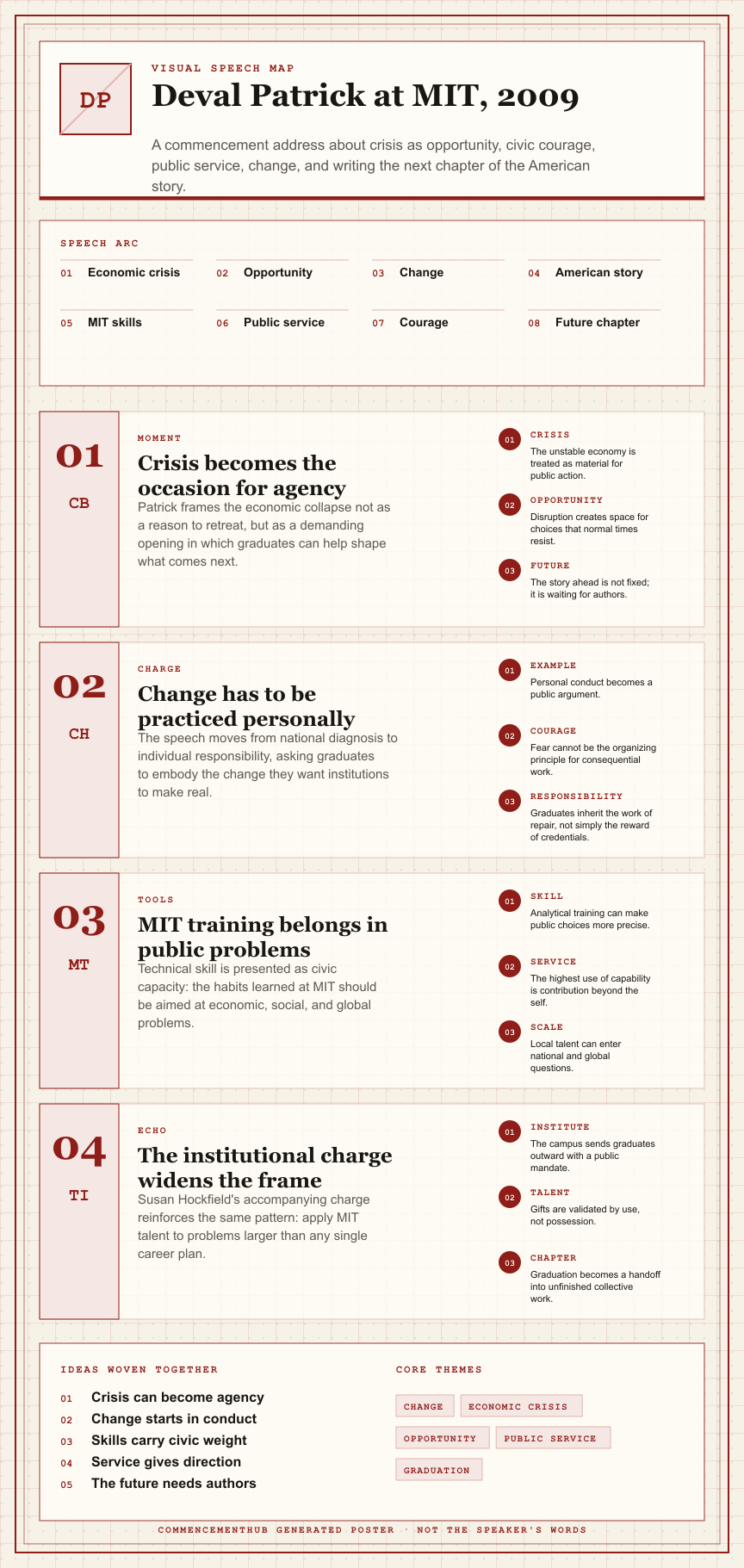
Deval Patrick at MIT, 2009
A commencement address about crisis as opportunity, civic courage, public service, change, and writing the next chapter of the American story.
Speech arc
- 01Economic crisis
Opening move
- 02Opportunity
Speech beat
- 03Change
Speech beat
- 04American story
Speech beat
- 05MIT skills
Speech beat
- 06Public service
Speech beat
- 07Courage
Speech beat
- 08Future chapter
Final charge
Moment: Crisis becomes the occasion for agency
Patrick frames the economic collapse not as a reason to retreat, but as a demanding opening in which graduates can help shape what comes next.
Crisis
The unstable economy is treated as material for public action.
Opportunity
Disruption creates space for choices that normal times resist.
Future
The story ahead is not fixed; it is waiting for authors.
Patrick frames the economic collapse not as a reason to retreat, but as a demanding opening in which graduates can help shape what comes next.
Charge: Change has to be practiced personally
The speech moves from national diagnosis to individual responsibility, asking graduates to embody the change they want institutions to make real.
Example
Personal conduct becomes a public argument.
Courage
Fear cannot be the organizing principle for consequential work.
Responsibility
Graduates inherit the work of repair, not simply the reward of credentials.
The speech moves from national diagnosis to individual responsibility, asking graduates to embody the change they want institutions to make real.
Tools: MIT training belongs in public problems
Technical skill is presented as civic capacity: the habits learned at MIT should be aimed at economic, social, and global problems.
Skill
Analytical training can make public choices more precise.
Service
The highest use of capability is contribution beyond the self.
Scale
Local talent can enter national and global questions.
Technical skill is presented as civic capacity: the habits learned at MIT should be aimed at economic, social, and global problems.
• Key takeaways •
Crisis can become agency
Connects to change.
Change starts in conduct
Connects to economic crisis.
Skills carry civic weight
Connects to opportunity.
Service gives direction
Connects to public service.
The future needs authors
Connects to graduation.
Closing charge
Susan Hockfield's accompanying charge reinforces the same pattern: apply MIT talent to problems larger than any single career plan.
The institutional charge widens the frame
Institute
The campus sends graduates outward with a public mandate.
Talent
Gifts are validated by use, not possession.
Chapter
Graduation becomes a handoff into unfinished collective work.
Susan Hockfield's accompanying charge reinforces the same pattern: apply MIT talent to problems larger than any single career plan.
Visual speech maps
Browse more visual maps from Massachusetts Institute of Technology or continue with related mapped speeches below.
Transcript
No official full transcript has been located yet. If you know of one, suggestions are welcome.
Provenance
Verified from official archive
Explore this speech
Find the next thread through the archive
Themes in this address
Speeches like this one
Search all speeches ->