Reed Hastings
Co-founder and co-CEO, Netflix
Reed Hastings tells Stanford's Class of 2022 that human progress is driven by two forces: inventions and stories. He urges graduates to apply inventive energy to climate change and to craft new, more constructive stories around equality and global interdependence to replace ones his generation failed to fully develop. He closes by encouraging graduates to embrace their own pace in life, whether they are 'hares' who succeed early or 'tortoises' who progress slowly.
“Doubt is an essential counterbalance to story.”
Key moments
- 01 Argues inventions and stories are the two main drivers of human progress
- 02 Calls on graduates to invent solutions to climate change rather than only reducing consumption
- 03 Describes how accepted 'stories' like money, rights, and government legitimacy shape society, and warns of destructive stories
- 04 Reflects on his own slow 'tortoise' path and encourages graduates to embrace their unique journeys
Save the visual map
Download or open the generated poster as a standalone PNG.
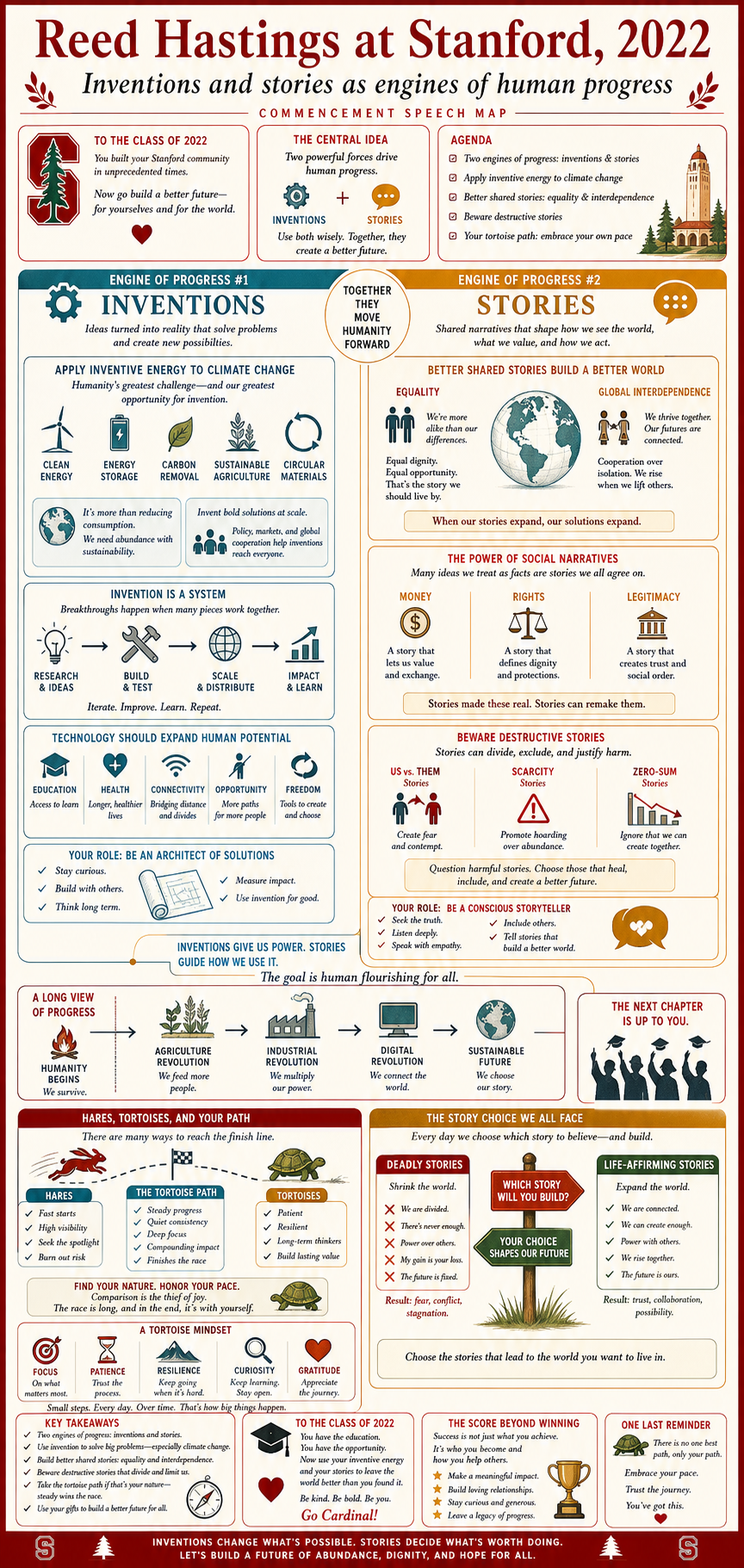
Reed Hastings at Stanford, 2022
A commencement address about inventions, stories, climate action, equality, and finding your own pace.
Speech arc
- 01Progress engines
Opening move
- 02Inventions
Speech beat
- 03Stories
Speech beat
- 04Climate
Speech beat
- 05Equality
Speech beat
- 06Interdependence
Speech beat
- 07Destructive narratives
Speech beat
- 08Tortoise path
Final charge
Thesis: Two engines of progress
Hastings argues that human progress moves through material inventions and shared stories that organize collective life.
Inventions
Tools and systems change what people can do.
Stories
Shared beliefs change what people can imagine together.
Progress
Neither engine works well without the other.
Hastings argues that human progress moves through material inventions and shared stories that organize collective life.
Invention: Build for climate
The speech asks graduates to apply ambitious inventive energy to climate change rather than settling for smaller reductions alone.
Challenge
Climate becomes the hard problem for this generation.
Action
Inventive work can expand what solutions are possible.
Scale
The work must reach beyond individual restraint.
The speech asks graduates to apply ambitious inventive energy to climate change rather than settling for smaller reductions alone.
Story: Rewrite what binds us
Hastings turns to equality and global interdependence as stories that need to become more durable than division.
Rights
Societies depend on narratives people agree to honor.
Warning
Destructive stories can organize fear and exclusion.
Repair
Better stories widen the circle of responsibility.
Hastings turns to equality and global interdependence as stories that need to become more durable than division.
• Key takeaways •
Invent tools
Connects to innovation.
Tell better stories
Connects to storytelling.
Confront climate
Connects to climate.
Widen equality
Connects to equality.
Honor your pace
Connects to resilience.
Closing charge
His personal reflection on a slower path gives graduates permission to move at a pace that fits their own becoming.
Hares and tortoises
Tortoise
A slow start can still become meaningful progress.
Timing
Early success is not the only valid route.
Charge
Keep moving in the direction of useful work.
His personal reflection on a slower path gives graduates permission to move at a pace that fits their own becoming.
Visual speech maps
Browse more visual maps from Stanford University or continue with related mapped speeches below.
Transcript
The full transcript is hosted by the original publisher. Commencement Archive links to the source rather than republishing copyrighted text.
Read the full transcript at source →Provenance
Verified from official archive
Explore this speech
Find the next thread through the archive
Themes in this address
Speeches like this one
Search all speeches ->