Atul Gawande
Surgeon, writer, and public-health leader
Speaking to advanced degree candidates during the COVID-19 pandemic, Dr. Atul Gawande reflects on the unpredictability of careers and lives, urging graduates to say yes to new experiences early in life and pay attention to what truly energizes them. He recounts how his own path combined surgery, public health, and journalism despite advice to choose one, and how each ultimately reinforced the others. He closes by drawing lessons from the pandemic about leadership, unity versus division, and finding worth by helping others.
“What now? is a question you will ask your whole life.”
Key moments
- 01 Reflects on the pandemic's losses and the role of vaccines in allowing graduation to occur
- 02 Advises saying yes to everything before forty and no after forty, paying attention to what energizes you
- 03 Describes combining surgery, public health, and journalism despite pressure to specialize
- 04 Contrasts divisive versus unifying leadership in the pandemic response and affirms confidence in graduates
Save the visual map
Download or open the generated poster as a standalone PNG.
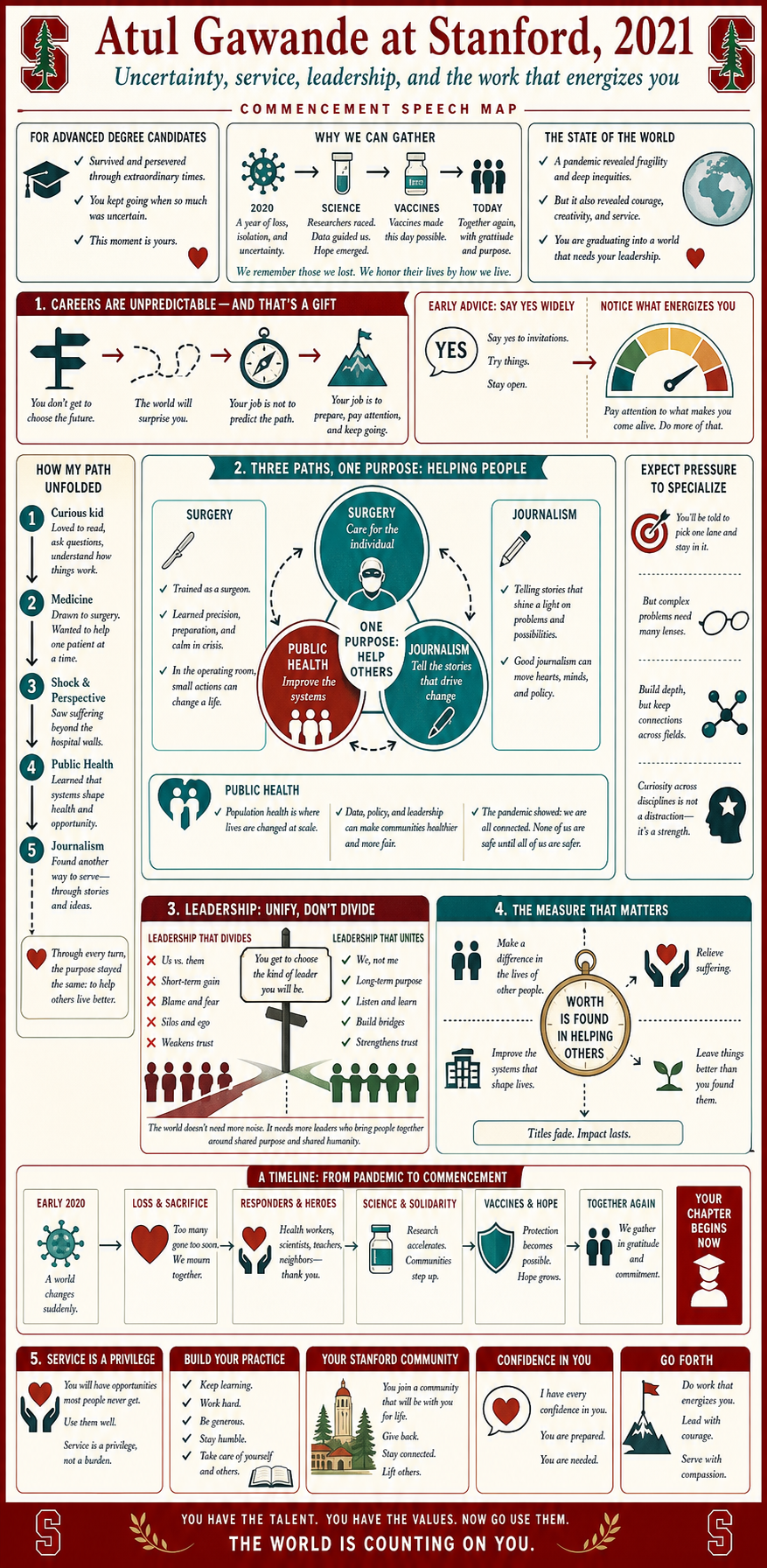
Atul Gawande at Stanford, 2021
A commencement address about uncertainty, interdisciplinary work, leadership, and finding worth through service.
Speech arc
- 01Pandemic losses
Opening move
- 02Vaccines
Speech beat
- 03Uncertain careers
Speech beat
- 04Say yes
Speech beat
- 05Energy test
Speech beat
- 06Surgery
Speech beat
- 07Public health
Speech beat
- 08Unifying leadership
Final charge
Context: Graduating through a pandemic
Gawande begins from loss, vaccines, and the fragile possibility of gathering after COVID-19.
Loss
The celebration carries the weight of a difficult year.
Science
Vaccines become a practical symbol of collective effort.
Moment
Graduation is both relief and responsibility.
Gawande begins from loss, vaccines, and the fragile possibility of gathering after COVID-19.
Career: Say yes, then listen
The speech treats early adulthood as a period for exploration: try widely, then notice what actually energizes you.
Yes
Experiences reveal interests that planning alone cannot.
Energy
Pay attention to what leaves you more alive.
Discernment
Over time, choose with greater precision.
The speech treats early adulthood as a period for exploration: try widely, then notice what actually energizes you.
Integration: Paths can reinforce each other
Surgery, public health, and journalism become not competing identities but mutually strengthening practices.
Surgery
Hands-on care grounds the work.
Public health
Systems thinking widens the frame.
Writing
Communication turns insight into public usefulness.
Surgery, public health, and journalism become not competing identities but mutually strengthening practices.
• Key takeaways •
Uncertainty is normal
Connects to uncertainty.
Try widely
Connects to public health.
Follow energy
Connects to leadership.
Integrate disciplines
Connects to service.
Serve beyond yourself
Connects to interdisciplinary work.
Closing charge
Pandemic leadership becomes a moral lesson: division corrodes capacity, while service gives work durable worth.
Unify and serve
Fork
Leadership can divide or unify.
Worth
Helping others gives achievement its deeper meaning.
Confidence
Graduates are trusted to carry public responsibility forward.
Pandemic leadership becomes a moral lesson: division corrodes capacity, while service gives work durable worth.
Visual speech maps
Browse more visual maps from Stanford University or continue with related mapped speeches below.
Transcript
The full transcript is hosted by the original publisher. Commencement Archive links to the source rather than republishing copyrighted text.
Read the full transcript at source →Provenance
Verified from official archive
Explore this speech
Find the next thread through the archive
Themes in this address
Speeches like this one
Search all speeches ->