Bono
Field: arts
Bono opens with self-deprecating humor about being a rock star receiving an honorary law degree before challenging graduates to identify and pursue a 'big idea' worth their moral and intellectual investment. Drawing on his experiences in Africa, he frames the AIDS crisis and extreme poverty as an emergency demanding justice rather than charity, arguing this generation has the resources to end it. He celebrates America as an idea built on equality and possibility, and urges graduates to take bold action and shape the future.
Key moments
- 01 Humorous reflection on receiving an honorary doctorate and his lack of formal education
- 02 The poet's line 'if you want to serve the age, betray it' and exposing the blind spots of the era
- 03 Personal story of an Ethiopian father asking Bono to take his son
- 04 Distinction between charity and justice, and the ONE campaign to end AIDS and poverty in Africa
- 05 Praise of America as an idea and call for graduates to take bold measures
Save the visual map
Download or open the generated poster as a standalone PNG.
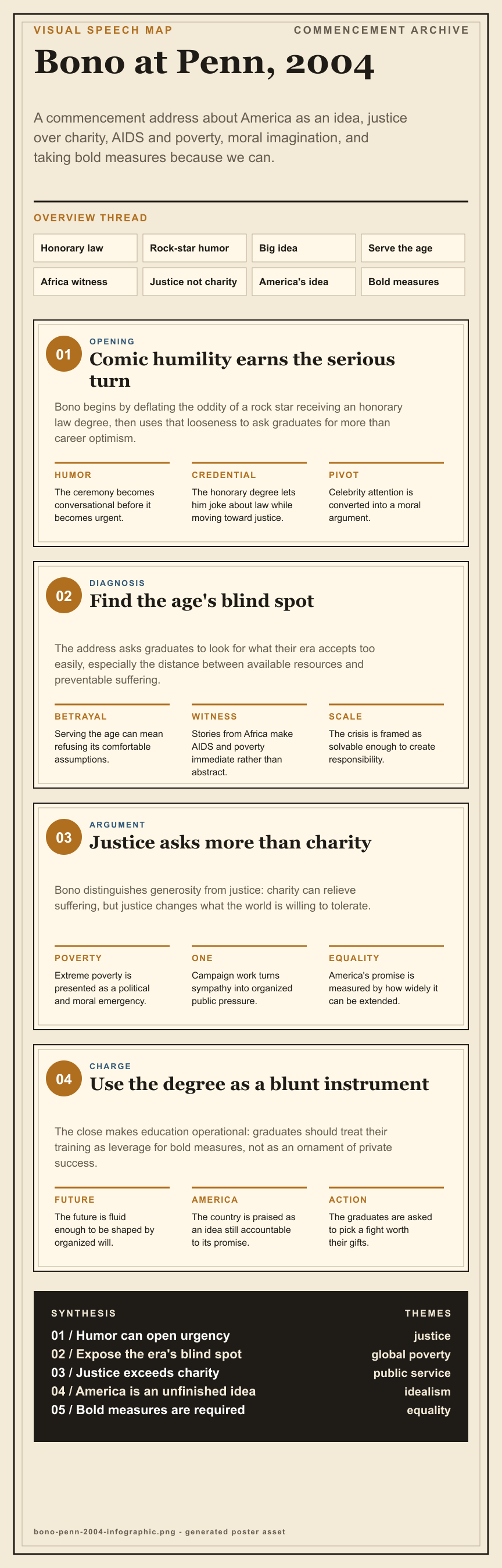
Bono at Penn, 2004
A commencement address about America as an idea, justice over charity, AIDS and poverty, moral imagination, and taking bold measures because we can.
Speech arc
- 01Honorary law
Opening move
- 02Rock-star humor
Speech beat
- 03Big idea
Speech beat
- 04Serve the age
Speech beat
- 05Africa witness
Speech beat
- 06Justice not charity
Speech beat
- 07America's idea
Speech beat
- 08Bold measures
Final charge
Opening: Comic humility earns the serious turn
Bono begins by deflating the oddity of a rock star receiving an honorary law degree, then uses that looseness to ask graduates for more than career optimism.
Humor
The ceremony becomes conversational before it becomes urgent.
Credential
The honorary degree lets him joke about law while moving toward justice.
Pivot
Celebrity attention is converted into a moral argument.
Bono begins by deflating the oddity of a rock star receiving an honorary law degree, then uses that looseness to ask graduates for more than career optimism.
Diagnosis: Find the age's blind spot
The address asks graduates to look for what their era accepts too easily, especially the distance between available resources and preventable suffering.
Betrayal
Serving the age can mean refusing its comfortable assumptions.
Witness
Stories from Africa make AIDS and poverty immediate rather than abstract.
Scale
The crisis is framed as solvable enough to create responsibility.
The address asks graduates to look for what their era accepts too easily, especially the distance between available resources and preventable suffering.
Argument: Justice asks more than charity
Bono distinguishes generosity from justice: charity can relieve suffering, but justice changes what the world is willing to tolerate.
Poverty
Extreme poverty is presented as a political and moral emergency.
ONE
Campaign work turns sympathy into organized public pressure.
Equality
America's promise is measured by how widely it can be extended.
Bono distinguishes generosity from justice: charity can relieve suffering, but justice changes what the world is willing to tolerate.
• Key takeaways •
Humor can open urgency
Connects to justice.
Expose the era's blind spot
Connects to global poverty.
Justice exceeds charity
Connects to public service.
America is an unfinished idea
Connects to idealism.
Bold measures are required
Connects to equality.
Closing charge
The close makes education operational: graduates should treat their training as leverage for bold measures, not as an ornament of private success.
Use the degree as a blunt instrument
Future
The future is fluid enough to be shaped by organized will.
America
The country is praised as an idea still accountable to its promise.
Action
The graduates are asked to pick a fight worth their gifts.
The close makes education operational: graduates should treat their training as leverage for bold measures, not as an ornament of private success.
Visual speech maps
Browse more visual maps from University of Pennsylvania or continue with related mapped speeches below.
Transcript
The full transcript is hosted by the original publisher. Commencement Archive links to the source rather than republishing copyrighted text.
Read the full transcript at source →Provenance
Imported from NPR commencement archive; cross-referenced with Open Commencement DB
NPR archive last updated in 2015; destination availability has not been exhaustively rechecked | Open Commencement DB transcript; not independently verified against the original recording
Explore this speech
Find the next thread through the archive
Themes in this address
Speeches like this one
Search all speeches ->