Felipe Calderón
President of Mexico
Mexican President Felipe Calderón urges Stanford graduates to graduate as human beings and good citizens, using their privileged education to serve others and become agents of positive change. He recounts his family's struggle against Mexico's autocratic regime and his father's advice to fight for what is right, then frames climate change and poverty as twin global challenges that can be addressed simultaneously through science and pragmatic policy. He closes by encouraging graduates to pursue happiness and meaning, citing the poem 'Ithaka.'
“Fight the good fight, and defend your principles in the face of adversity.”
Key moments
- 01 Defining commencement as a beginning and urging graduates to graduate as human beings
- 02 Personal story of his father organizing democratic opposition in Mexico
- 03 Identifying the gaps between man and nature and rich and poor as central challenges
- 04 Arguing economic growth and environmental preservation are not mutually exclusive, citing Mexico's forest-payment program
- 05 Advising graduates to seek happiness and meaning, quoting Cavafy's 'Ithaka'
Save the visual map
Download or open the generated poster as a standalone PNG.
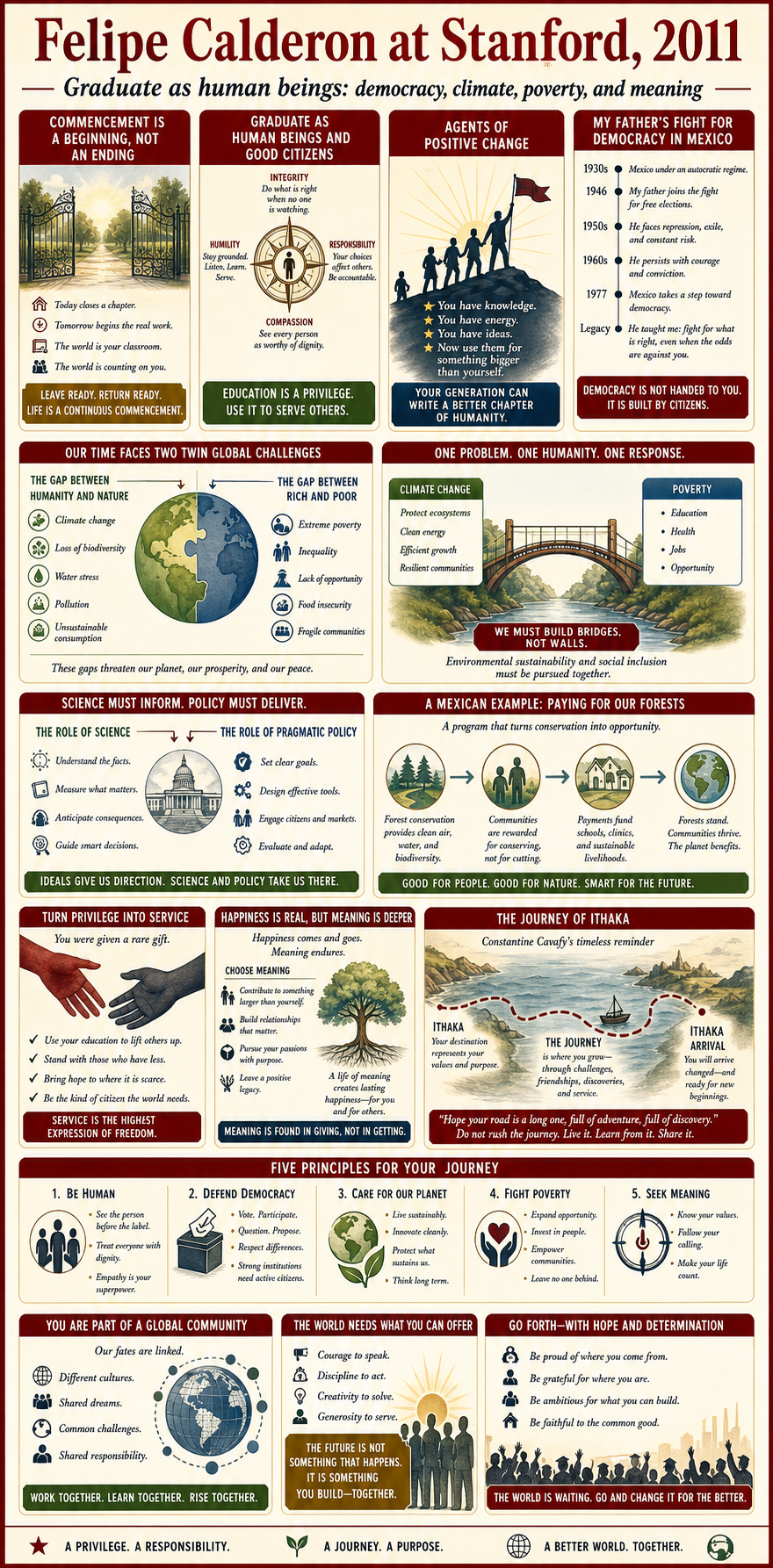
Felipe Calderon at Stanford, 2011
A commencement address about citizenship, democracy, climate, poverty, science, and the journey toward meaning.
Speech arc
- 01Commencement begins
Opening move
- 02Good citizens
Speech beat
- 03Father's example
Speech beat
- 04Democracy
Speech beat
- 05Nature gap
Speech beat
- 06Poverty gap
Speech beat
- 07Forest policy
Speech beat
- 08Ithaka
Final charge
Beginning: Graduate as human beings
Calderon treats commencement as a beginning and asks graduates to use privilege as good citizens and agents of change.
Beginning
Graduation opens responsibility rather than closing school.
Citizenship
Education should serve more than private gain.
Change
Graduates are asked to act on the world.
Calderon treats commencement as a beginning and asks graduates to use privilege as good citizens and agents of change.
Democracy: Fight for what is right
His father's opposition to autocracy becomes a family lesson in perseverance, public courage, and democratic duty.
Family
Political struggle becomes moral inheritance.
Autocracy
Democracy is hard-won, not automatic.
Courage
Doing right may require sustained opposition.
His father's opposition to autocracy becomes a family lesson in perseverance, public courage, and democratic duty.
Two gaps: Humanity, nature, rich, and poor
Climate change and poverty are framed as paired global challenges that must be addressed together.
Nature
The gap with nature threatens shared survival.
Poverty
The gap between rich and poor threatens justice.
Policy
Growth and environmental protection can reinforce each other.
Climate change and poverty are framed as paired global challenges that must be addressed together.
• Key takeaways •
Privilege should serve
Connects to democracy.
Democracy requires courage
Connects to climate.
Climate and poverty connect
Connects to poverty.
Policy can bridge gaps
Connects to citizenship.
Meaning lives in the journey
Connects to meaning.
Closing charge
The closing turns toward happiness, meaning, and the long voyage of life symbolized by Ithaka.
The journey matters
Science
Knowledge becomes a tool for pragmatic repair.
Happiness
Meaning is part of public achievement.
Journey
The destination matters because of who the journey makes.
The closing turns toward happiness, meaning, and the long voyage of life symbolized by Ithaka.
Visual speech maps
Browse more visual maps from Stanford University or continue with related mapped speeches below.
Transcript
The full transcript is hosted by the original publisher. Commencement Archive links to the source rather than republishing copyrighted text.
Read the full transcript at source →Provenance
Verified from official archive; targeted event-level link verified
Explore this speech
Find the next thread through the archive
Themes in this address
Speeches like this one
Search all speeches ->