Susan Rice
U.S. ambassador to the United Nations
Susan Rice reflects on how much the world has changed since her own 1986 Stanford graduation and argues that progress comes only from deliberate human effort. She challenges graduates to become agents of change in the fight against global poverty, framing it as both a moral and national security imperative, and illustrates this with the story of a destitute boy she met in Angola. She closes with personal advice about pursuing one's passions, being fearless, prioritizing family, and committing to service.
“Progress is the product of human energy.”
Key moments
- 01 Comparison of the world in 1986 versus 2010 to show the pace of change
- 02 Argument that global poverty is both a moral and national security challenge
- 03 Story of an unnamed Angolan boy as a call to serve the most vulnerable
- 04 Specific challenges in education, agriculture, disease, and climate
- 05 Personal career and life advice, including pursuing passion and valuing family
Save the visual map
Download or open the generated poster as a standalone PNG.
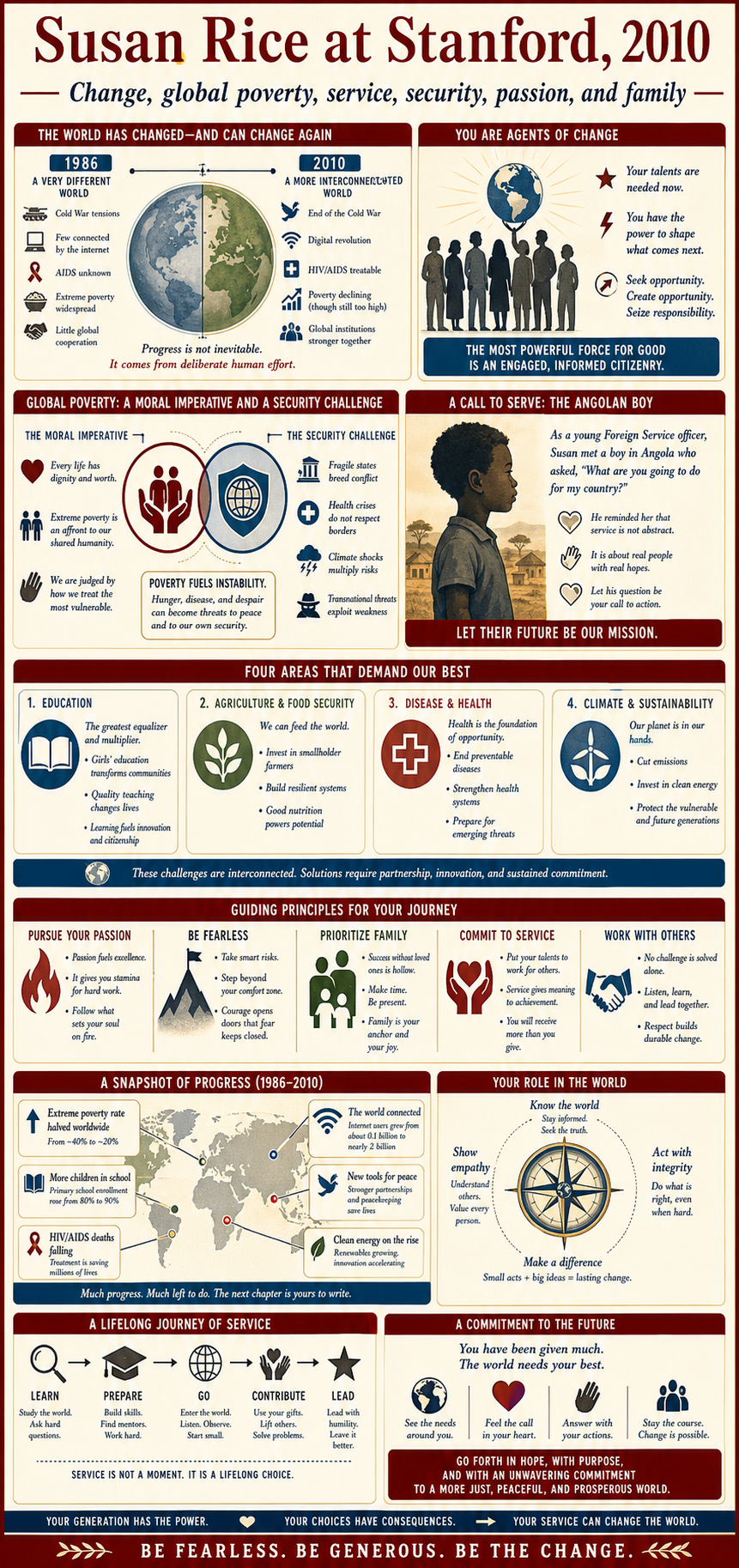
Susan Rice at Stanford, 2010
A commencement address about deliberate change, global poverty, security, service, passion, and family.
Speech arc
- 011986 to 2010
Opening move
- 02Human effort
Speech beat
- 03Agents of change
Speech beat
- 04Poverty
Speech beat
- 05Security
Speech beat
- 06Angola story
Speech beat
- 07Four challenges
Speech beat
- 08Family and passion
Final charge
Change: Progress is made, not automatic
Rice compares 1986 with 2010 to show how rapidly the world can change when people act deliberately.
Then/now
A generation of change proves history can move.
Effort
Progress requires people choosing to work.
Agency
Graduates are called to be agents, not spectators.
Rice compares 1986 with 2010 to show how rapidly the world can change when people act deliberately.
Moral test: Global poverty matters
Poverty is framed as both a moral emergency and a national security concern.
Moral
Extreme poverty demands human response.
Security
Instability and deprivation shape global safety.
Vulnerable
The Angolan boy becomes a symbol of people policy must see.
Poverty is framed as both a moral emergency and a national security concern.
Fields: Where service is needed
Education, agriculture, disease, and climate become concrete arenas where graduates can apply skill and commitment.
Education
Opportunity starts with learning.
Health
Disease work is part of justice.
Climate
Environmental change intensifies vulnerability.
Education, agriculture, disease, and climate become concrete arenas where graduates can apply skill and commitment.
• Key takeaways •
Change takes effort
Connects to poverty.
Poverty is moral and strategic
Connects to service.
Service needs concrete fields
Connects to security.
Passion sustains courage
Connects to change.
Family anchors ambition
Connects to family.
Closing charge
Rice closes with guidance on passion, fearlessness, family, and a durable commitment to public service.
Serve without losing the self
Passion
Choose work that keeps conviction alive.
Fearlessness
Do not shrink from hard assignments.
Family
Service and ambition need human anchors.
Rice closes with guidance on passion, fearlessness, family, and a durable commitment to public service.
Visual speech maps
Browse more visual maps from Stanford University or continue with related mapped speeches below.
Transcript
The full transcript is hosted by the original publisher. Commencement Archive links to the source rather than republishing copyrighted text.
Read the full transcript at source →Provenance
Verified from official archive; cross-referenced with NPR commencement archive; cross-referenced with Open Commencement DB; targeted event-level link verified
NPR archive last updated in 2015; destination availability has not been exhaustively rechecked | Open Commencement DB transcript; not independently verified against the original recording
Explore this speech
Find the next thread through the archive
Themes in this address
Speeches like this one
Search all speeches ->