Barack Obama
44th President of the United States
In his 2016 Howard University commencement address, President Obama argues that America, the world, and race relations have measurably improved over his lifetime while acknowledging persistent gaps in economic opportunity, education, pay, and criminal justice. He urges the graduating class to recognize this progress not as cause for complacency but as motivation for continued action. He offers advice for young leaders, beginning with being confident in their heritage and blackness and embracing the many ways of being black.
Key moments
- 01 Claims America, the world, and race relations are better than when he graduated in 1983
- 02 Cites data on poverty, crime, education, and global gains alongside persistent racial disparities
- 03 Notes remaining gaps in unemployment, pay, incarceration, and the school-to-prison pipeline
- 04 Advises graduates to be confident in their blackness and reject a single definition of it
Save the visual map
Download or open the generated poster as a standalone PNG.
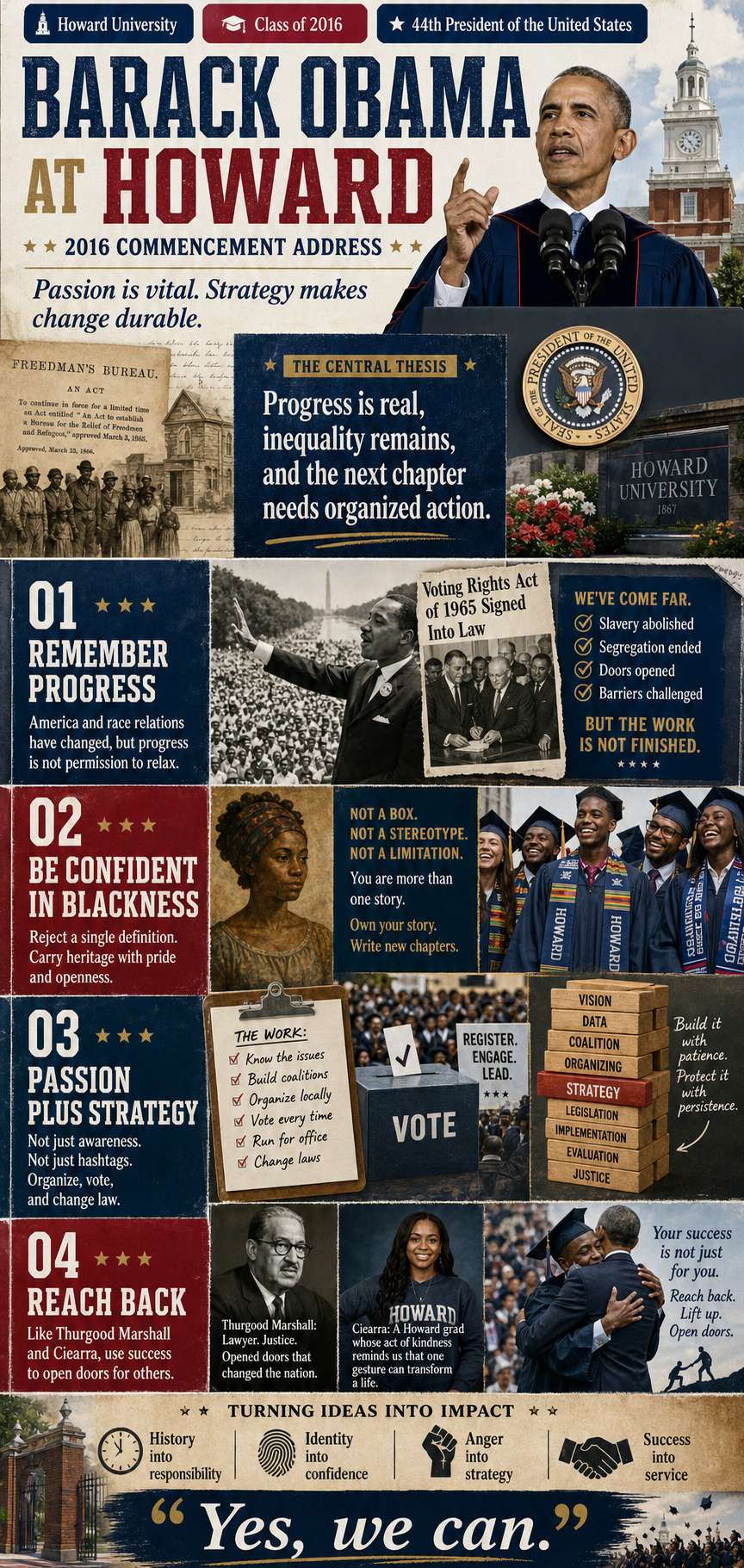
Barack Obama at Howard, 2016
A Howard University address about racial progress, black identity, persistent inequality, organizing, voting, strategy, and reaching back.
Speech arc
- 01Howard University
Opening move
- 02Class of 2016
Speech beat
- 03Progress is real
Speech beat
- 04Inequality remains
Speech beat
- 05Confident blackness
Speech beat
- 06Passion plus strategy
Speech beat
- 07Vote and organize
Speech beat
- 08Reach back
Final charge
Progress: Progress is real, but not finished
Obama argues that America, the world, and race relations have improved over his lifetime while warning that gains are not a reason for complacency.
History
Howard's founding after emancipation frames the ceremony inside a long story of uplift.
Evidence
The address points to reduced poverty, expanded rights, and broader opportunity alongside remaining gaps.
Balance
Hope and realism work together: progress should energize action rather than soften it.
Obama argues that America, the world, and race relations have improved over his lifetime while warning that gains are not a reason for complacency.
Identity: Be confident in blackness
The speech asks graduates to reject narrow definitions of black identity and to carry heritage with pride, openness, and range.
Plurality
There is no single way to be black, serve community, or lead a meaningful life.
Confidence
Self-knowledge becomes a foundation for public work rather than a performance for approval.
Belonging
Howard's tradition is presented as both inheritance and launchpad.
The speech asks graduates to reject narrow definitions of black identity and to carry heritage with pride, openness, and range.
Strategy: Awareness must become organized power
Obama praises activism while insisting that lasting change requires plans, institutions, laws, accountability, and voting.
Formula
Passion matters, but it must be joined to strategy, programs, and organizing.
Civics
He asks graduates to know district attorneys, attorneys general, police chiefs, and who writes policy.
Vote
The speech insists on voting all the time, not only when the presidency is on the ballot.
Obama praises activism while insisting that lasting change requires plans, institutions, laws, accountability, and voting.
• Key takeaways •
History into responsibility
Connects to racial progress.
Identity into confidence
Connects to black identity.
Anger into strategy
Connects to activism.
Success into service
Connects to voting.
Yes, we can
Connects to public service.
Closing charge
The closing links Thurgood Marshall, student stories, and broader American struggle to a charge to reach back and become change agents.
Success should open doors for others
Model
Marshall's return to serve the vulnerable turns achievement into obligation.
Example
Ciearra's story shows education as a route back into community service.
Charge
The final Yes, we can turns optimism into a mandate for graduates prepared to act.
The closing links Thurgood Marshall, student stories, and broader American struggle to a charge to reach back and become change agents.
Visual speech maps
Browse more visual maps from Howard University or continue with related mapped speeches below.
Transcript
The full transcript is hosted by the original publisher. Commencement Archive links to the source rather than republishing copyrighted text.
Read the full transcript at source →Provenance
Verified from official source
Explore this speech
Find the next thread through the archive
Themes in this address
Speeches like this one
Search all speeches ->