Zadie Smith
Field: letters
Zadie Smith reflects on her own 1997 graduation and her generation's emphasis on individuality, self-curation, and self-interest, tracing how she and her peers isolated themselves and only later realized they needed each other. She contrasts that mindset with the more collectively minded outlook she perceives in the 2014 graduates facing crises like climate and economic inequality. Drawing on personal anecdotes and examples like Dave Eggers's 826 National, she argues for finding joy and value in the work of many hands and in involvement in one another's lives.
Key moments
- 01 Recounts her 1997 graduation and generational obsession with individuality
- 02 Critiques the '90s culture of self-curation, celebrity, and 'be you' advertising
- 03 Praises collective action through examples like the rum-cake chain and 826 National
- 04 Urges graduates to choose the many over the few as a source of joy, not sacrifice
Save the visual map
Download or open the generated poster as a standalone PNG.
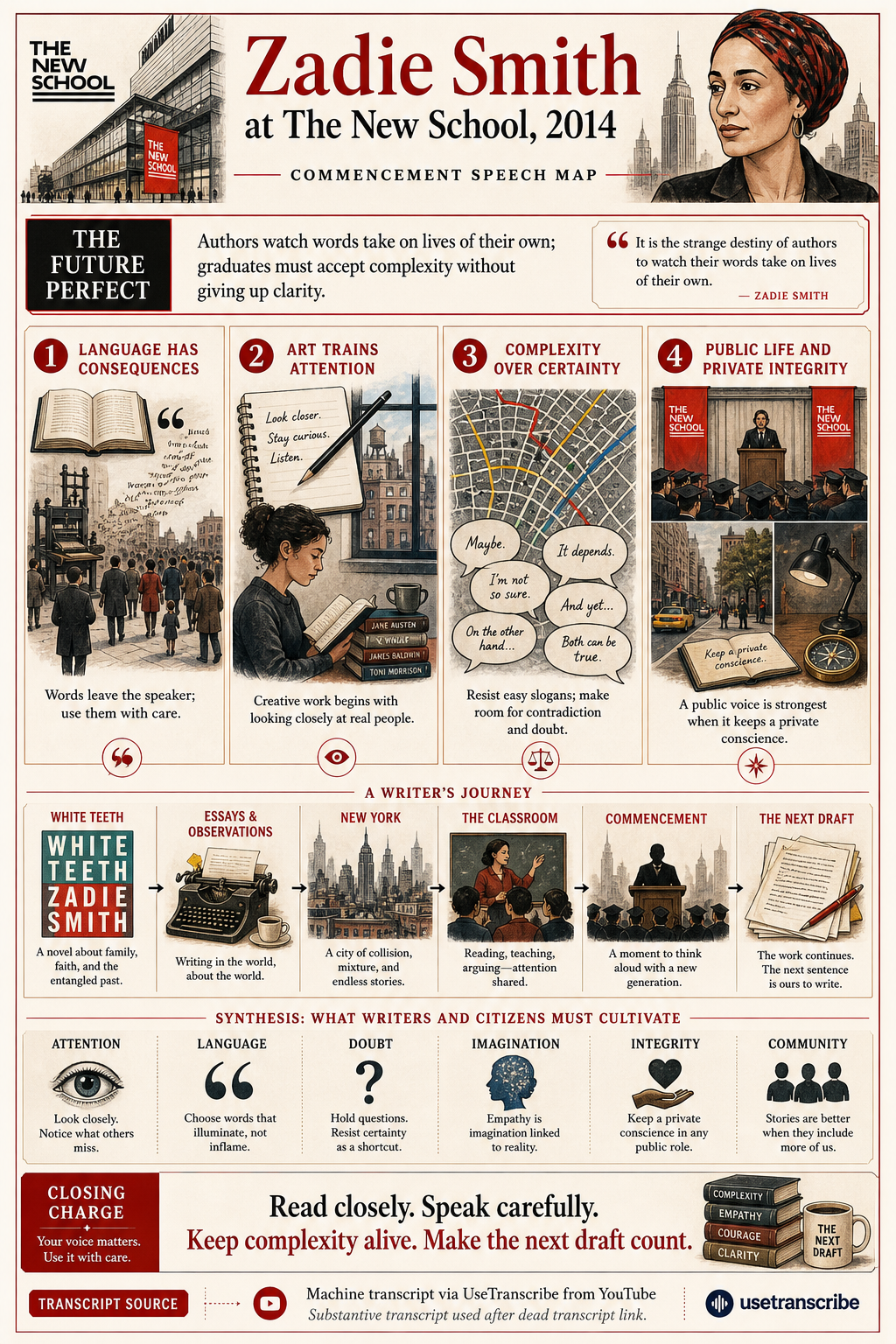
Zadie Smith at The New School, 2014
A New School address about language, attention, complexity, public voice, private conscience, and making the next draft count.
Speech arc
- 01The New School
Opening move
- 02Class of 2014
Speech beat
- 03Words take on lives
Speech beat
- 04Art trains attention
Speech beat
- 05Complexity over certainty
Speech beat
- 06Public voice
Speech beat
- 07Private conscience
Speech beat
- 08The next draft
Final charge
Language: Words leave the speaker and enter the world
Smith begins with the strange afterlife of sentences, framing language as powerful precisely because it escapes the control of its author.
Afterlife
A line can be repeated, repurposed, and made to serve moments the writer never imagined.
Care
Because words travel, graduates should use them with precision and humility.
Publicness
Speech is never only private once it enters a room, a page, or a crowd.
Smith begins with the strange afterlife of sentences, framing language as powerful precisely because it escapes the control of its author.
Attention: Creative work starts by looking closely
The address treats art as a discipline of attention, grounded in the effort to see real people and complicated situations clearly.
Practice
Writing is not only self-expression; it is sustained observation.
People
The work gets stronger when it refuses caricature.
Craft
Revision becomes a habit of seeing more honestly.
The address treats art as a discipline of attention, grounded in the effort to see real people and complicated situations clearly.
Complexity: Resist easy slogans and keep doubt alive
Smith’s literary charge pushes against false certainty, asking graduates to leave room for contradiction, ambiguity, and second thoughts.
Doubt
Not knowing can be an ethical posture, not a weakness.
Tension
Contradictory truths may need to remain visible instead of being flattened.
Judgment
Complexity asks for patience before conclusion.
Smith’s literary charge pushes against false certainty, asking graduates to leave room for contradiction, ambiguity, and second thoughts.
• Key takeaways •
Words carry consequences beyond intent
Connects to language.
Attention is a creative discipline
Connects to attention.
Doubt can protect honesty
Connects to complexity.
A public role needs a private conscience
Connects to integrity.
The next draft is still yours to write
Connects to imagination.
Closing charge
The speech links public language to inner integrity: the writer, citizen, and graduate need a conscience that is not outsourced to applause.
A public voice needs a private center
Role
A platform is not the same thing as a purpose.
Integrity
The strongest public voice keeps checking itself in private.
Draft
The closing charge is to keep revising the work and the self.
The speech links public language to inner integrity: the writer, citizen, and graduate need a conscience that is not outsourced to applause.
Visual speech maps
Browse more visual maps from New School or continue with related mapped speeches below.
Transcript
The previously catalogued transcript link is no longer live and is queued for re-sourcing. A video of the address is available above.
Machine transcript available for archive analysis; it is unverified and may contain transcription errors. Machine transcript source ->
Provenance
BROKEN transcript link (checked 2026-06-26): graduationwisdom.com repurposed into lifestyle blog; speech pages gone. Provenance: Imported from NPR commencement archive
NPR archive last updated in 2015; destination availability has not been exhaustively rechecked | Transcript URL dead (graduationwisdom.com repurposed into lifestyle blog; speech pages gone); video fallback present
Explore this speech
Find the next thread through the archive
Themes in this address
Speeches like this one
Search all speeches ->