Ben Bernanke
Field: politics
Ben Bernanke delivers a lighthearted commencement address framed as 'Ten Suggestions' rather than commandments, drawing on his experience leaving Princeton for Washington. He reflects on life's unpredictability, the ethical responsibilities that come with luck and meritocracy, the value of public service, and the importance of personal relationships and self-development. He closes with humorous but earnest advice about failure, money as a means rather than an end, and staying connected to family.
Key moments
- 01 Life is unpredictable; graduates' futures will differ from their plans
- 02 Meritocracy is only fair if the fortunate take greater responsibility to help others
- 03 Defense of public service and the idea that most policymakers act in good faith despite flawed results
- 04 Reflections on money, failure, choosing a life partner, and calling one's parents
Save the visual map
Download or open the generated poster as a standalone PNG.
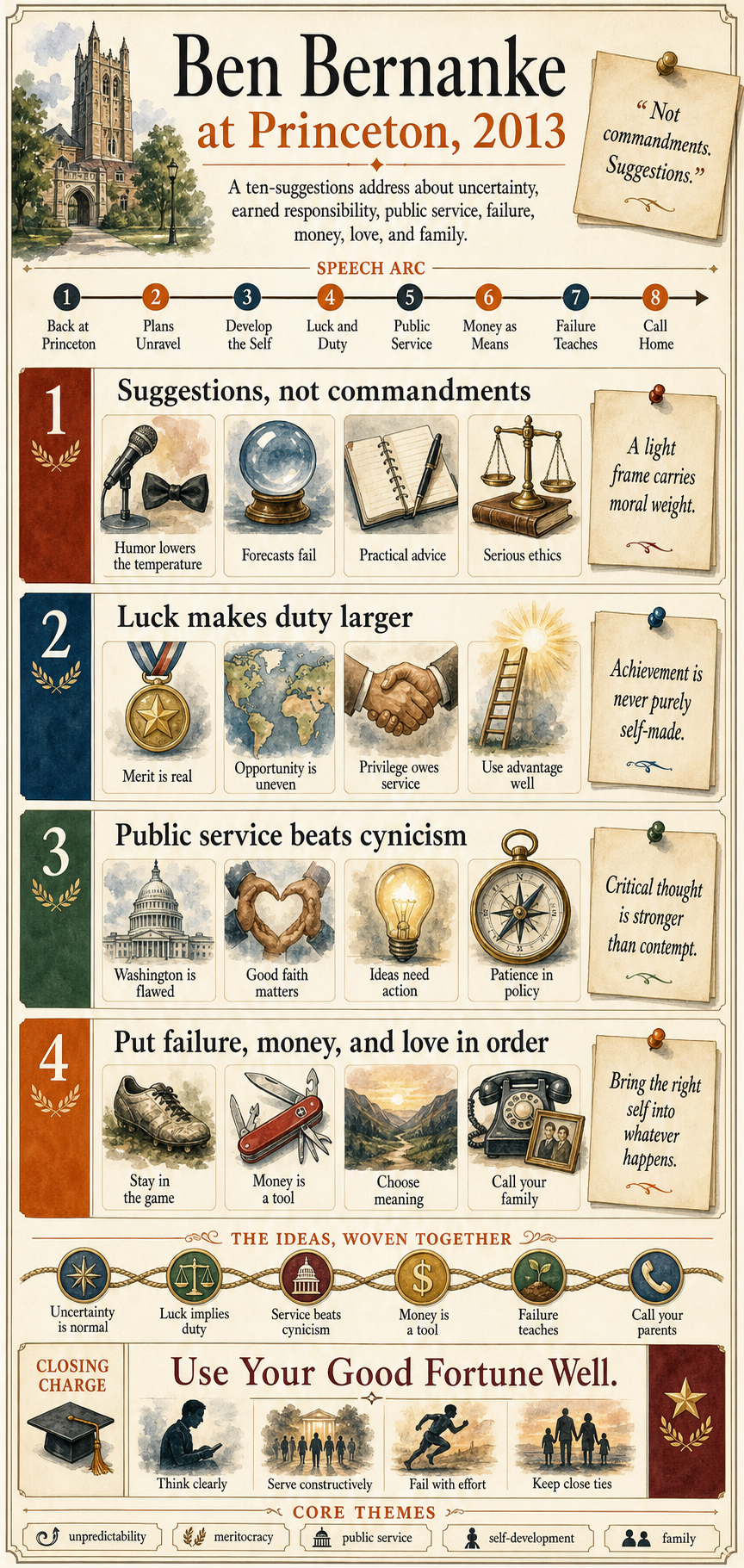
Ben Bernanke at Princeton, 2013
A ten-suggestions address about uncertainty, earned responsibility, public service, failure, money, love, and staying close to family.
Speech arc
- 01Back at Princeton
Opening move
- 02Plans unravel
Speech beat
- 03Develop the self
Speech beat
- 04Merit needs duty
Speech beat
- 05Public service
Speech beat
- 06Money as means
Speech beat
- 07Failure teaches
Speech beat
- 08Call home
Final charge
Frame: Advice arrives as suggestions, not commandments
Bernanke lowers the temperature with jokes about returning from Washington, then offers observations that are practical rather than grandiose. The structure lets humor carry serious moral advice.
Tone
Self-deprecation makes the authority conversational.
Device
Ten points create a clear map through life after Princeton.
Opening
The first lesson is that forecasts, including personal ones, fail.
Bernanke lowers the temperature with jokes about returning from Washington, then offers observations that are practical rather than grandiose.
The structure lets humor carry serious moral advice.
Ethics: Luck makes responsibility larger
The speech questions whether meritocracy is fully fair. Talent, family support, health, and opportunity are unevenly distributed, so the fortunate owe more to the world.
Merit
Achievement is real, but never purely self-made.
Duty
Privilege creates a stronger obligation to contribute.
Admiration
Respect belongs to people who use advantage well or bear adversity bravely.
The speech questions whether meritocracy is fully fair.
Talent, family support, health, and opportunity are unevenly distributed, so the fortunate owe more to the world.
Work: Public life requires ideas and patience
Bernanke defends public service without romanticizing it. Washington is flawed, but cynicism alone cannot replace critical thought, constructive action, and people willing to act on ideas.
Service
Policy work is difficult but worthy.
Errors
Bad outcomes often come from complexity, not only bad motives.
Action
Ideas matter when people are prepared to use them.
Bernanke defends public service without romanticizing it.
Washington is flawed, but cynicism alone cannot replace critical thought, constructive action, and people willing to act on ideas.
• Key takeaways •
Uncertainty is normal
Connects to unpredictability.
Luck implies duty
Connects to meritocracy.
Service beats cynicism
Connects to public service.
Money is a tool
Connects to self-development.
Failure teaches
Connects to family.
Call your parents
A core idea carried through the address.
Closing charge
The closing suggestions turn intimate: fail with effort, treat money as a means, choose a companion carefully, and maintain family ties after the ceremony ends.
Use failure, money, and love in the right order
Failure
A dirty uniform means you were in the game.
Money
Choose work for meaning, not pay alone.
Family
Remember the people who carried you to the day.
The closing suggestions turn intimate: fail with effort, treat money as a means, choose a companion carefully, and maintain family ties after the ceremony ends.
Visual speech maps
Browse more visual maps from Princeton University or continue with related mapped speeches below.
Transcript
The full transcript is hosted by the original publisher. Commencement Archive links to the source rather than republishing copyrighted text.
Read the full transcript at source →Provenance
Imported from NPR commencement archive; cross-referenced with Open Commencement DB
NPR archive last updated in 2015; destination availability has not been exhaustively rechecked | Open Commencement DB transcript; not independently verified against the original recording
Explore this speech
Find the next thread through the archive
Themes in this address
Speeches like this one
Search all speeches ->