Michael Lewis
Field: letters
Michael Lewis recounts his unlikely path from Princeton art-history major to Wall Street employee to best-selling author, arguing that luck, more than merit, shaped his success. Drawing on his book 'Moneyball' and a cookie experiment from Berkeley, he contends that successful people rationalize away the role of accident in their lives. He urges graduates to recognize their good fortune and the obligation it creates toward the less lucky.
Key moments
- 01 Describes his thesis adviser warning him never to make a living from writing
- 02 Explains how a chance dinner seating led to his job at Salomon Brothers and 'Liar's Poker'
- 03 Uses 'Moneyball' to show how luck is undervalued even in meritocratic sports
- 04 Recounts the cookie experiment where arbitrarily chosen leaders took the extra cookie
- 05 Tells graduates they are the lucky few and owe a debt to the unlucky
Save the visual map
Download or open the generated poster as a standalone PNG.
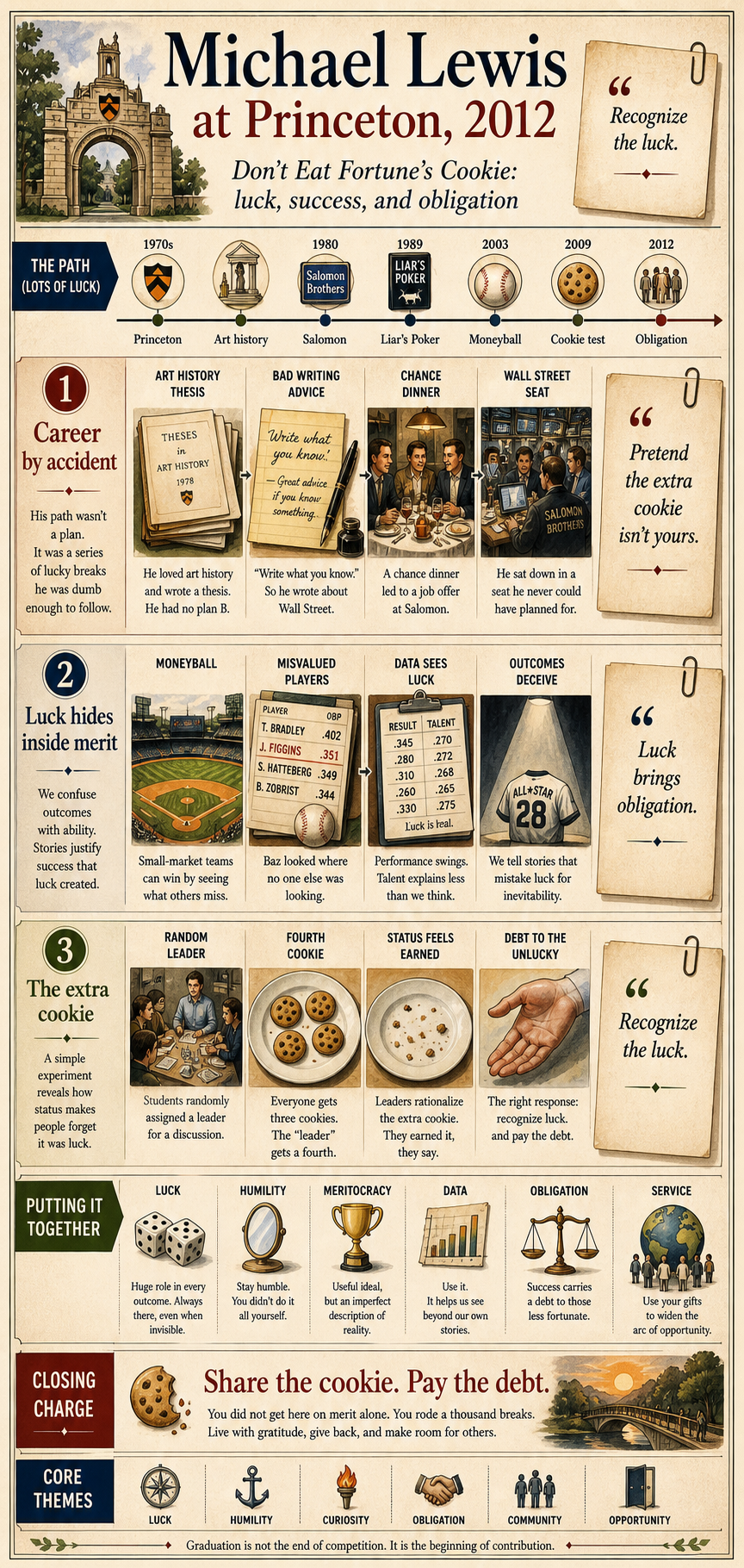
Michael Lewis at Princeton, 2012
A baccalaureate address about luck, merit, humility, and the obligation successful people owe to the less fortunate.
Speech arc
- 01Princeton art history
Opening move
- 02Chance dinner
Speech beat
- 03Salomon Brothers
Speech beat
- 04Liar's Poker
Speech beat
- 05Moneyball
Speech beat
- 06Cookie experiment
Speech beat
- 07Luck and merit
Speech beat
- 08Debt to the unlucky
Final charge
Origin story: A career that did not look planned
Lewis frames his path from art-history major to Wall Street employee to author as a chain of lucky breaks rather than proof of inevitable talent.
Princeton
A thesis adviser discourages writing as a career, but the experience helps Lewis recognize the pull of books.
Chance
A dinner seating leads to Salomon Brothers, giving him an accidental front-row seat to Wall Street.
Narrative
After Liar's Poker succeeds, other people retrofit the story into destiny; Lewis insists luck is the truer explanation.
Lewis frames his path from art-history major to Wall Street employee to author as a chain of lucky breaks rather than proof of inevitable talent.
Moneyball: Meritocracy misses luck
The baseball story becomes a way to show that even data-rich systems misread outcomes when they confuse good fortune with skill.
Mispricing
Players are credited and blamed for events shaped by context, teammates, and chance.
Blindness
If professional sports can misvalue luck, ordinary careers and institutions can do the same.
Warning
Life outcomes are not random, but a large amount of luck is baked into them.
The baseball story becomes a way to show that even data-rich systems misread outcomes when they confuse good fortune with skill.
Experiment: The extra cookie reveals status
A Berkeley experiment shows how quickly arbitrary rank can feel deserved when one randomly appointed leader takes the fourth cookie.
Status
The leader performs no special task, yet behaves as if the extra cookie naturally belongs to him.
Mirror
Lewis applies the lesson to graduates who have benefited from family, country, institutions, and timing.
Charge
Recognize the lucky part of success before entitlement turns opportunity into self-congratulation.
A Berkeley experiment shows how quickly arbitrary rank can feel deserved when one randomly appointed leader takes the fourth cookie.
• Key takeaways •
Luck shapes outcomes
Connects to luck.
Merit stories simplify
Connects to humility.
Data can reveal blind spots
Connects to success.
Status breeds entitlement
Connects to obligation.
Success carries debt
Connects to meritocracy.
Closing charge
The speech ends with a practical moral instruction: successful people should remember the unlucky and act as if the extra cookie is not automatically theirs.
Luck creates obligation
Humility
Success is easier to carry honestly when luck remains visible.
Debt
Privilege creates duties toward people who did not receive the same breaks.
Practice
Make room for others rather than treating every reward as fully earned.
The speech ends with a practical moral instruction: successful people should remember the unlucky and act as if the extra cookie is not automatically theirs.
Visual speech maps
Browse more visual maps from Princeton University or continue with related mapped speeches below.
Transcript
The full transcript is hosted by the original publisher. Commencement Archive links to the source rather than republishing copyrighted text.
Read the full transcript at source →Provenance
Imported from NPR commencement archive; cross-referenced with Open Commencement DB
NPR archive last updated in 2015; destination availability has not been exhaustively rechecked | Open Commencement DB transcript; not independently verified against the original recording
Explore this speech
Find the next thread through the archive
Themes in this address
Speeches like this one
Search all speeches ->