Carl Schramm
Field: business
Carl Schramm urges University of Illinois graduates to consider entrepreneurship as a vocation, telling the story of Ewing Kauffman, who built a pharmaceutical company from nothing and later created a foundation to teach entrepreneurship. He challenges the notion that non-profit and government work is inherently more virtuous than business, arguing that entrepreneurship is itself a form of service that creates wealth, jobs, and innovation. Speaking during the 2009 recession, he places current economic hardship in historical context and calls on graduates to become America's most entrepreneurial generation.
Key moments
- 01 Story of Ewing Kauffman building Marion Laboratories and founding the Kauffman Foundation
- 02 Placing the 2009 recession in historical context against past depressions and wars
- 03 Rejecting the false dichotomy between business and non-profit or government service
- 04 Arguing entrepreneurs and economic growth are essential to solving national problems and alleviating poverty
Save the visual map
Download or open the generated poster as a standalone PNG.
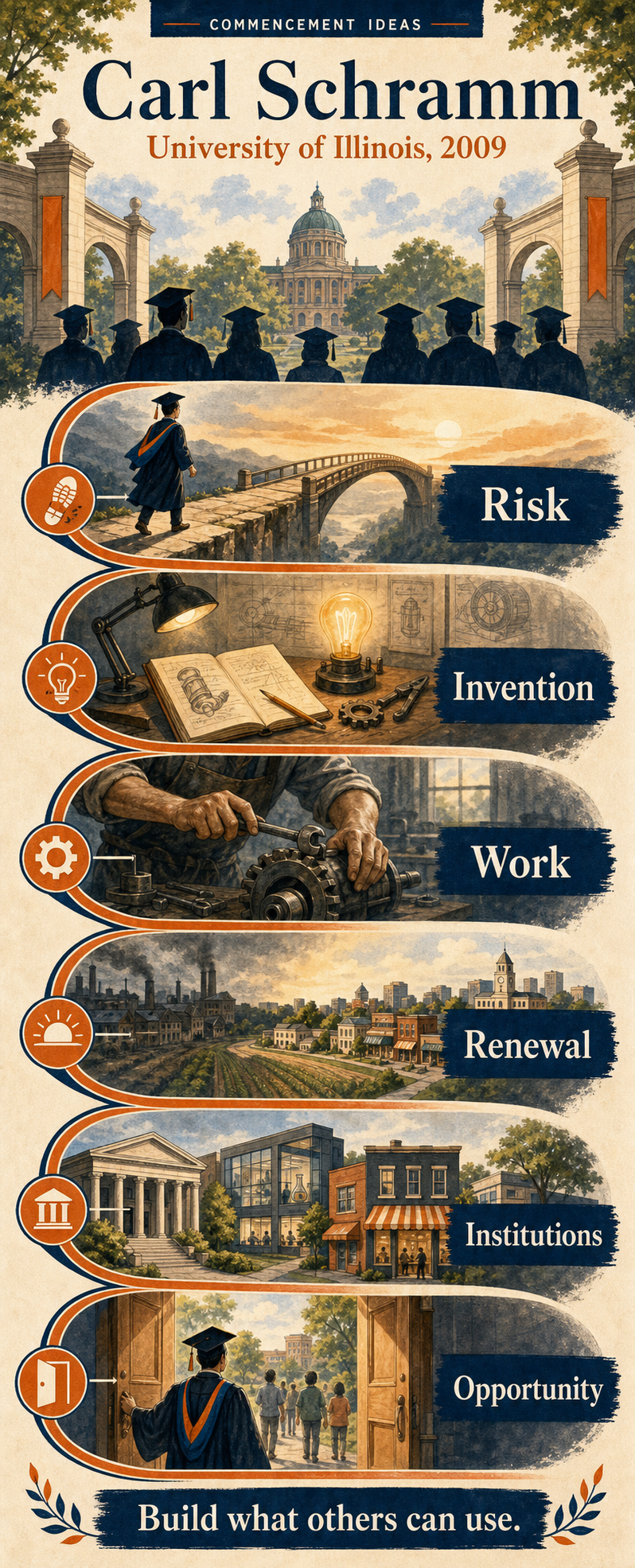
Carl Schramm at Illinois, 2009
A commencement address about entrepreneurship as public service, recession-era courage, innovation, wealth creation, jobs, and becoming an entrepreneurial generation.
Speech arc
- 01Recession frame
Opening move
- 02Kauffman story
Speech beat
- 03Startup vocation
Speech beat
- 04Service debate
Speech beat
- 05Jobs and wealth
Speech beat
- 06Innovation
Speech beat
- 07National problems
Speech beat
- 08Entrepreneurial generation
Final charge
Frame: Recession makes the charge concrete
Schramm addresses graduates during economic contraction, placing their uncertainty within a longer American story of recovery, invention, and risk.
2009
The downturn is not minimized; it becomes the setting for a more demanding form of opportunity.
History
Past crises show that hardship can produce new institutions and industries.
Agency
Graduates are treated as builders of recovery, not spectators waiting for conditions to improve.
Schramm addresses graduates during economic contraction, placing their uncertainty within a longer American story of recovery, invention, and risk.
Model: Ewing Kauffman turns business into service
The Kauffman story gives the speech its working example: a company can create jobs, wealth, medicines, and a foundation that teaches others to build.
Founder
Entrepreneurship begins with a person willing to organize uncertainty into a working enterprise.
Company
Business success is measured by value created for employees, customers, and communities.
Foundation
Private enterprise can compound into civic infrastructure and education.
The Kauffman story gives the speech its working example: a company can create jobs, wealth, medicines, and a foundation that teaches others to build.
Argument: Service is not confined to government or nonprofits
Schramm rejects the idea that only public-sector or nonprofit paths count as virtuous, arguing that entrepreneurial growth solves public problems too.
False split
Business and service are separated too easily in conventional moral language.
Jobs
Employment, innovation, and rising productivity become civic contributions.
Poverty
Growth is framed as one tool for addressing material need at scale.
Schramm rejects the idea that only public-sector or nonprofit paths count as virtuous, arguing that entrepreneurial growth solves public problems too.
• Key takeaways •
Entrepreneurship can serve
Connects to entrepreneurship.
Recession calls for builders
Connects to economic growth.
Growth creates public goods
Connects to public service.
Innovation needs risk
Connects to recession.
Build the next recovery
Connects to innovation.
Closing charge
The closing challenge asks graduates to treat venture creation, risk, and innovation as a vocation equal to the scale of national problems.
Become the most entrepreneurial generation
Risk
Uncertain conditions are not a reason to shrink from building.
Innovation
New firms and ideas can reset what a damaged economy believes is possible.
Generation
The class is asked to define itself by creation rather than caution.
The closing challenge asks graduates to treat venture creation, risk, and innovation as a vocation equal to the scale of national problems.
Visual speech maps
Browse more visual maps from University of Illinois at Urbana-Champaign or continue with related mapped speeches below.
Transcript
The full transcript is hosted by the original publisher. Commencement Archive links to the source rather than republishing copyrighted text.
Read the full transcript at source →Provenance
Imported from NPR commencement archive; cross-referenced with Open Commencement DB
NPR archive last updated in 2015; destination availability has not been exhaustively rechecked | Open Commencement DB transcript; not independently verified against the original recording
Explore this speech
Find the next thread through the archive
Themes in this address
Speeches like this one
Search all speeches ->