Ben Bernanke
Chairman, Federal Reserve
Federal Reserve Chair Ben Bernanke delivered the principal address at MIT's 140th Commencement, offering a brief history of economics at MIT and praising its faculty, including Nobel laureates Samuelson, Modigliani, and Solow. He described a 'virtuous circle' in which economics, science, and technology mutually reinforce innovation and economic development, and emphasized the benefits of global competition and free trade. He urged graduates to seek new opportunities and to make a difference through service, volunteering, and their choice of work.
“New opportunities will always arise for those who seek them.”
Key moments
- 01 History of economics at MIT and tribute to its faculty and Nobel laureates
- 02 The 'virtuous circle' linking economics, science, and technology
- 03 Benefits of global competition and free, open trade
- 04 Encouragement to seek opportunities and make a difference through service
Save the visual map
Download or open the generated poster as a standalone PNG.
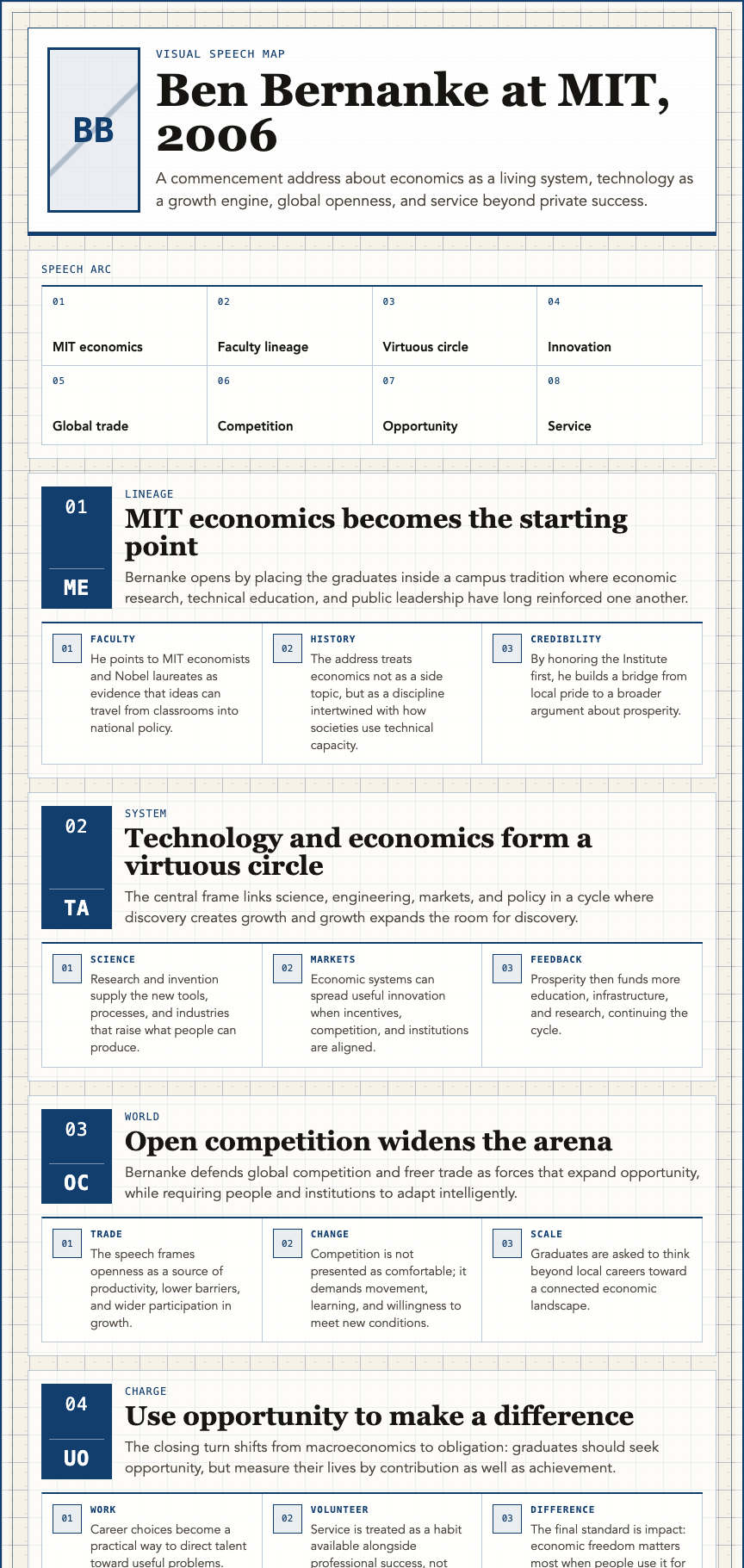
Ben Bernanke at MIT, 2006
A commencement address about economics as a living system, technology as a growth engine, global openness, and service beyond private success.
Speech arc
- 01MIT economics
Opening move
- 02Faculty lineage
Speech beat
- 03Virtuous circle
Speech beat
- 04Innovation
Speech beat
- 05Global trade
Speech beat
- 06Competition
Speech beat
- 07Opportunity
Speech beat
- 08Service
Final charge
Lineage: MIT economics becomes the starting point
Bernanke opens by placing the graduates inside a campus tradition where economic research, technical education, and public leadership have long reinforced one another.
Faculty
He points to MIT economists and Nobel laureates as evidence that ideas can travel from classrooms into national policy.
History
The address treats economics not as a side topic, but as a discipline intertwined with how societies use technical capacity.
Credibility
By honoring the Institute first, he builds a bridge from local pride to a broader argument about prosperity.
Bernanke opens by placing the graduates inside a campus tradition where economic research, technical education, and public leadership have long reinforced one another.
System: Technology and economics form a virtuous circle
The central frame links science, engineering, markets, and policy in a cycle where discovery creates growth and growth expands the room for discovery.
Science
Research and invention supply the new tools, processes, and industries that raise what people can produce.
Markets
Economic systems can spread useful innovation when incentives, competition, and institutions are aligned.
Feedback
Prosperity then funds more education, infrastructure, and research, continuing the cycle.
The central frame links science, engineering, markets, and policy in a cycle where discovery creates growth and growth expands the room for discovery.
World: Open competition widens the arena
Bernanke defends global competition and freer trade as forces that expand opportunity, while requiring people and institutions to adapt intelligently.
Trade
The speech frames openness as a source of productivity, lower barriers, and wider participation in growth.
Change
Competition is not presented as comfortable; it demands movement, learning, and willingness to meet new conditions.
Scale
Graduates are asked to think beyond local careers toward a connected economic landscape.
Bernanke defends global competition and freer trade as forces that expand opportunity, while requiring people and institutions to adapt intelligently.
• Key takeaways •
Ideas move into institutions
Connects to economics.
Innovation needs economic context
Connects to innovation.
Open systems create pressure
Connects to global trade.
Opportunity carries obligation
Connects to public service.
Service completes success
Connects to technology.
Closing charge
The closing turn shifts from macroeconomics to obligation: graduates should seek opportunity, but measure their lives by contribution as well as achievement.
Use opportunity to make a difference
Work
Career choices become a practical way to direct talent toward useful problems.
Volunteer
Service is treated as a habit available alongside professional success, not after it.
Difference
The final standard is impact: economic freedom matters most when people use it for others.
The closing turn shifts from macroeconomics to obligation: graduates should seek opportunity, but measure their lives by contribution as well as achievement.
Visual speech maps
Browse more visual maps from Massachusetts Institute of Technology or continue with related mapped speeches below.
Transcript
No official full transcript has been located yet. If you know of one, suggestions are welcome.
Provenance
Verified from official archive
Explore this speech
Find the next thread through the archive
Themes in this address
Speeches like this one
Search all speeches ->