Hank Green
Science communicator, video creator, and entrepreneur
Hank Green, science communicator and online video creator, addresses MIT's Class of 2025 with humor about his unconventional background before turning to serious advice for graduates entering an unstable world. Drawing on survey responses he collected from the graduates themselves, he argues that curiosity is the key to success but warns that social media and capitalist incentives can misdirect attention away from the everyday, solvable problems of ordinary people. He encourages graduates to orient their curiosity toward people rather than just tools, to release their ideas into the world, and to find joy and meaning in human life.
“The greatest thing you build in your life will be yourself, and trust me on this you are not done yet”
Key moments
- 01 Opening with self-deprecating humor and bone facts to thank the graduating class
- 02 Drawing on graduates' own survey responses for advice and reflections
- 03 Naming current threats to science, speech, higher education, and democracy
- 04 Arguing curiosity must be deliberately oriented toward overlooked, solvable human problems
- 05 Closing advice to build oneself and find meaning in people, not just tools
Save the visual map
Download or open the generated poster as a standalone PNG.
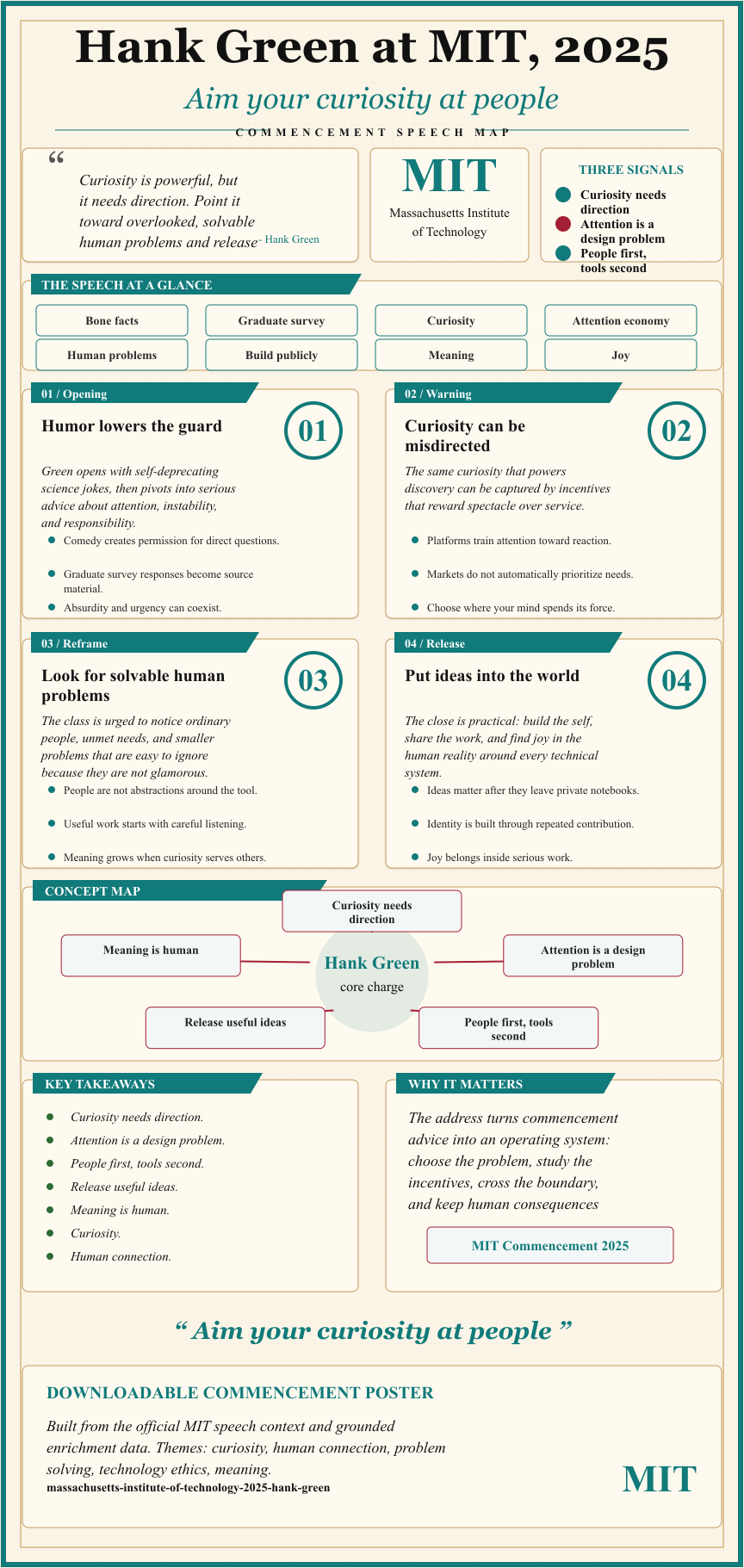
Hank Green at MIT, 2025
A commencement address about curiosity, attention, technology incentives, human problems, and building meaning through useful work.
Speech arc
- 01Bone facts
Opening move
- 02Graduate survey
Speech beat
- 03Curiosity
Speech beat
- 04Attention economy
Speech beat
- 05Human problems
Speech beat
- 06Build publicly
Speech beat
- 07Meaning
Speech beat
- 08Joy
Final charge
Opening: Humor lowers the guard
Green opens with self-deprecating science jokes, then pivots into serious advice about attention, instability, and responsibility.
Comedy
Humor creates permission to ask direct questions without turning away from difficulty.
Survey
The graduates' own responses become source material for the address.
Tone
Absurdity and urgency can coexist when the point is honest attention.
Green opens with self-deprecating science jokes, then pivots into serious advice about attention, instability, and responsibility.
Warning: Curiosity can be misdirected
The same curiosity that powers discovery can be captured by incentives that reward spectacle over service.
Platforms
Social systems train attention toward reaction, novelty, and conflict.
Markets
Capitalist incentives do not automatically prioritize ordinary human needs.
Choice
Graduates must choose where their minds spend force.
The same curiosity that powers discovery can be captured by incentives that reward spectacle over service.
Reframe: Look for solvable human problems
The class is urged to notice ordinary people, unmet needs, and smaller problems that are easy to ignore because they are not glamorous.
People
People are not abstractions around the tool; they are the point of the work.
Listening
Useful work often starts with careful attention to overlooked experience.
Meaning
Meaning grows when curiosity serves lives beyond the self.
The class is urged to notice ordinary people, unmet needs, and smaller problems that are easy to ignore because they are not glamorous.
• Key takeaways •
Curiosity needs direction
Connects to curiosity.
Attention is a design problem
Connects to human connection.
People first, tools second
Connects to problem solving.
Release useful ideas
Connects to technology ethics.
Meaning is human
Connects to meaning.
Closing charge
The closing advice is practical: build the self, share the work, and find joy in the human reality around every technical system.
Put ideas into the world
Publish
Ideas matter after they leave private notebooks and meet other people.
Identity
A self is built through repeated contribution.
Joy
Joy is not a distraction from serious work; it helps sustain it.
The closing advice is practical: build the self, share the work, and find joy in the human reality around every technical system.
Visual speech maps
Browse more visual maps from Massachusetts Institute of Technology or continue with related mapped speeches below.
Transcript
No official full transcript has been located yet. If you know of one, suggestions are welcome.
Provenance
Verified from official archive
Explore this speech
Find the next thread through the archive
Themes in this address
Speeches like this one
Search all speeches ->