Ahmed Zewail
Nobel laureate Ahmed Zewail addresses Caltech's 2011 graduates, sharing his personal journey from Egypt to America and Caltech in pursuit of knowledge, and crediting passion and optimism for his success. He urges graduates to use their exceptional education to shape the future through science, which he argues drives societal advancement more than politics. Drawing on the recent Egyptian uprising and his role as U.S. Science Envoy, he advocates for science diplomacy and 'soft power' as tools for global progress and democracy.
Key moments
- 01 Recounts arriving in the U.S. in 1969 and his quest for knowledge leading to the 1999 Nobel Prize
- 02 Asks graduates to give their parents a standing ovation
- 03 Argues science is central to societal progress and democracy, citing the Egyptian revolution's use of social media
- 04 Calls for science diplomacy and global investment in education, quoting Jefferson and Martin Luther King Jr.
Save the visual map
Download or open the generated poster as a standalone PNG.
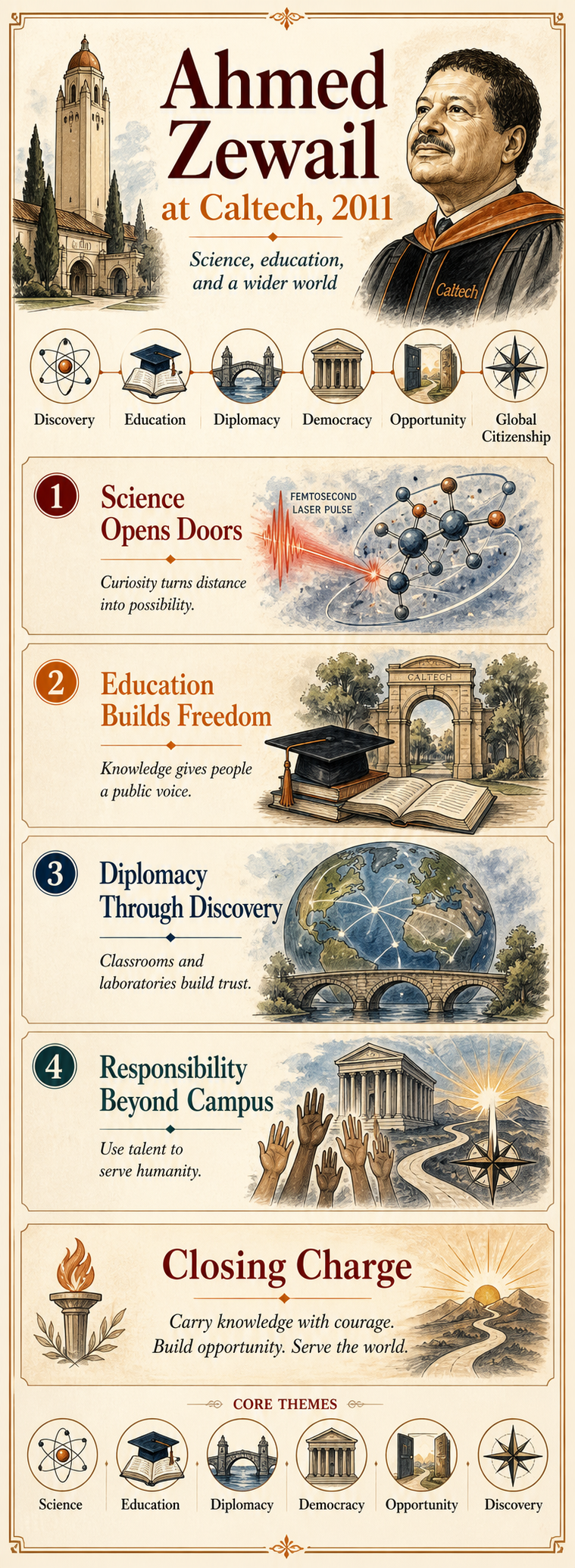
Ahmed Zewail at Caltech, 2011
A commencement address about scientific passion, education, optimism, democracy, soft power, and using knowledge to shape a wider world.
Speech arc
- 01Caltech
Opening move
- 02Quest for knowledge
Speech beat
- 03Nobel journey
Speech beat
- 04Parents
Speech beat
- 05Science
Speech beat
- 06Egypt
Speech beat
- 07Soft power
Speech beat
- 08Future
Final charge
Origin: A life of science begins as a quest
Zewail frames his path from Egypt to America and Caltech as a search for knowledge, with passion and optimism converting distance into possibility.
Journey
The personal story makes science feel like movement across borders, cultures, and institutions.
Passion
Achievement is tied to sustained fascination rather than credentials alone.
Optimism
Hope is not sentiment; it is a working condition for discovery and risk.
Zewail frames his path from Egypt to America and Caltech as a search for knowledge, with passion and optimism converting distance into possibility.
Community: Graduation expands beyond the graduate
The address pauses to honor families, especially parents, making success communal before it becomes professional advice.
Parents
The celebration acknowledges the sacrifices and belief systems that make elite education possible.
Caltech
The institute becomes both a technical home and a platform for public obligation.
Humility
Gratitude keeps scientific ambition connected to people rather than prestige alone.
The address pauses to honor families, especially parents, making success communal before it becomes professional advice.
Society: Science can do democratic work
Drawing on the Egyptian uprising and his public role in science diplomacy, Zewail argues that education and scientific exchange are tools of social progress.
Democracy
Knowledge enlarges participation because educated societies are harder to isolate and easier to connect.
Diplomacy
Soft power works through laboratories, classrooms, exchange, and trust across national boundaries.
Technology
Social media and modern science appear as forces that can accelerate civic change when joined to human courage.
Drawing on the Egyptian uprising and his public role in science diplomacy, Zewail argues that education and scientific exchange are tools of social progress.
• Key takeaways •
Science is public work
Connects to science.
Education enables democracy
Connects to education.
Optimism fuels discovery
Connects to diplomacy.
Soft power builds trust
Connects to democracy.
Knowledge needs wisdom
Connects to opportunity.
Closing charge
The closing charge asks graduates to use Caltech training not only to solve technical problems, but to shape the future of country and world.
Let knowledge carry responsibility
Future
Scientific capacity becomes a responsibility to build institutions, opportunity, and peace.
Wisdom
Knowledge needs ethical direction so it does not become narrow expertise.
World
The graduate's field is larger than the campus: discovery belongs in public life.
The closing charge asks graduates to use Caltech training not only to solve technical problems, but to shape the future of country and world.
Visual speech maps
Browse more visual maps from Caltech or continue with related mapped speeches below.
Transcript
The full transcript is hosted by the original publisher. Commencement Archive links to the source rather than republishing copyrighted text.
Read the full transcript at source →Provenance
Imported from NPR commencement archive; cross-referenced with Open Commencement DB
NPR archive last updated in 2015; destination availability has not been exhaustively rechecked | Open Commencement DB transcript; not independently verified against the original recording
Explore this speech
Find the next thread through the archive
Themes in this address
Speeches like this one
Search all speeches ->