Paul Hawken
Field: letters
Paul Hawken tells the University of Portland's Class of 2009 that they are entering a world where every living system is in decline, and challenges them to help build a new way of living on earth. He argues that a vast, largely invisible global movement of ordinary people and organizations is working to restore the planet and aid the poor, tracing its roots to the abolitionists who first organized on behalf of strangers. He contrasts an economy that 'steals' the future through exploitation with one that 'heals' it through restoration, and urges graduates to be hopeful and act despite seemingly impossible odds.
Key moments
- 01 Declaration that 'you are brilliant, and the earth is hiring'
- 02 Both pessimism (from the science) and optimism (from the people restoring the earth) are justified
- 03 Abolitionists as the first movement to defend the rights of strangers
- 04 Distinction between an economy that heals the future versus one that steals it
- 05 Reflection on the body's cellular complexity and humanity's interconnectedness
Save the visual map
Download or open the generated poster as a standalone PNG.
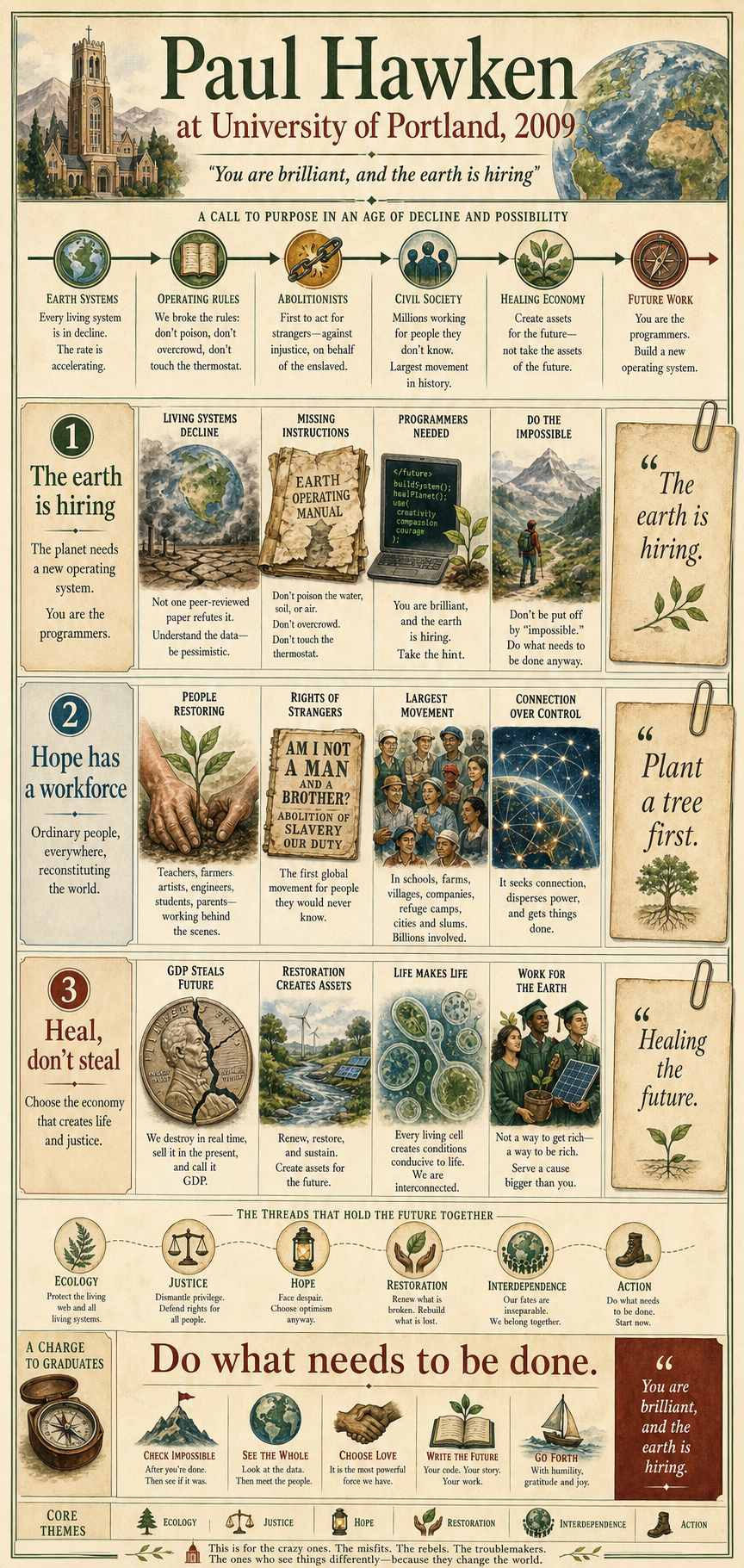
Paul Hawken at University of Portland, 2009
A commencement address about ecological crisis, civil society, restoration, and doing necessary work before asking whether it is possible.
Speech arc
- 01Earth is hiring
Opening move
- 02Living systems decline
Speech beat
- 03New operating system
Speech beat
- 04Abolitionist roots
Speech beat
- 05Largest movement
Speech beat
- 06Healing economy
Speech beat
- 07Interdependence
Speech beat
- 08Do the work
Final charge
Problem: The earth needs a new operating system
Hawken tells graduates they enter a world where living systems are declining and the old rules for water, soil, air, and climate have been broken.
Data
Pessimism is justified when one looks honestly at ecological decline.
Role
Graduates are cast as programmers of a new way to live on earth.
Action
The test is not whether the task looks possible before starting, but whether the necessary work gets done.
Hawken tells graduates they enter a world where living systems are declining and the old rules for water, soil, air, and climate have been broken.
Hope: Ordinary people are already restoring the world
The speech balances ecological alarm with hope drawn from people confronting despair, power, poverty, and environmental damage.
Movement
Teachers, farmers, engineers, students, artists, and organizers form a vast civil-society response.
Abolition
Hawken traces the lineage to people who organized for the rights of strangers.
Method
The movement seeks connection and dispersed power rather than domination.
The speech balances ecological alarm with hope drawn from people confronting despair, power, poverty, and environmental damage.
Economy: Heal the future instead of stealing it
Hawken contrasts an economy that converts future life into present GDP with one based on renewal, restoration, and sustaining life.
Theft
Destroying earth in real time is presented as stealing from the future.
Restoration
A healing economy creates assets for the future rather than extracting them.
Wealth
Working for the earth may not make graduates rich, but it is framed as a way to be rich.
Hawken contrasts an economy that converts future life into present GDP with one based on renewal, restoration, and sustaining life.
• Key takeaways •
Ecology is urgent
Connects to environment.
Hope is embodied work
Connects to activism.
Justice extends to strangers
Connects to hope.
Restoration creates assets
Connects to interconnectedness.
Action precedes certainty
Connects to social justice.
Closing charge
The address asks graduates to act with humility, ecological imagination, and faith in people already reconstituting the world.
Do what needs to be done
Hope
Optimism comes from meeting people who restore what has been damaged.
Interdependence
Human fates are inseparable from one another and from the living world.
Practice
Plant the tree first; check whether it was impossible after the work has begun.
The address asks graduates to act with humility, ecological imagination, and faith in people already reconstituting the world.
Visual speech maps
Browse more visual maps from University of Portland or continue with related mapped speeches below.
Transcript
The full transcript is hosted by the original publisher. Commencement Archive links to the source rather than republishing copyrighted text.
Read the full transcript at source →Provenance
Imported from NPR commencement archive; cross-referenced with Open Commencement DB
NPR archive last updated in 2015; destination availability has not been exhaustively rechecked | Open Commencement DB transcript; not independently verified against the original recording
Explore this speech
Find the next thread through the archive
Themes in this address
Speeches like this one
Search all speeches ->