Barack Obama
Field: politics
President Obama addresses the University of Michigan's class of 2010, reflecting on the health of American democracy amid economic crisis and divisive politics. He argues that democracy has thrived through adapting government to changing times, maintaining civility in public debate, and active citizen participation. Drawing on historical examples and Kennedy's Peace Corps speech delivered at Michigan, he urges graduates to seek out opposing views, engage with diverse people, and contribute to public life.
Key moments
- 01 Reading letters from ordinary Americans, including a kindergartener asking if people are being nice
- 02 Arguing that the debate over government should focus on smarter government rather than big versus small
- 03 Calling for civility and warning that vilifying rhetoric forecloses compromise
- 04 Urging graduates to seek out opposing views and participate in public life, invoking JFK's Peace Corps challenge
Save the visual map
Download or open the generated poster as a standalone PNG.
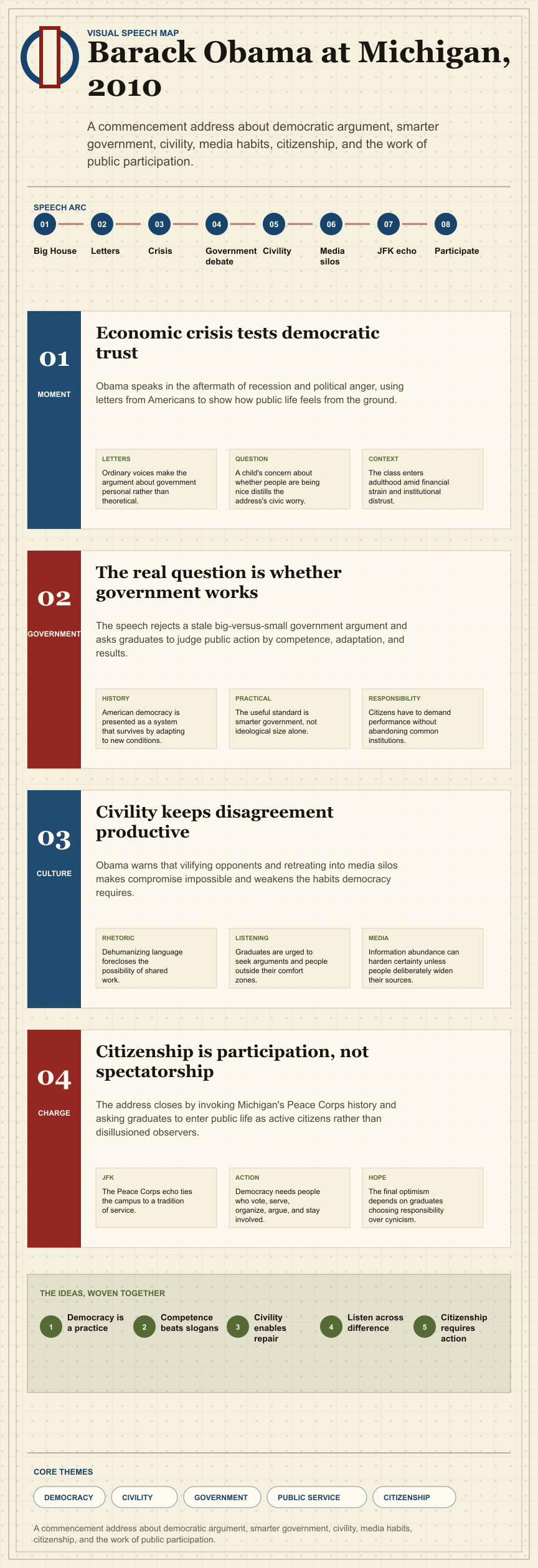
Barack Obama at Michigan, 2010
A commencement address about democratic argument, smarter government, civility, media habits, citizenship, and the work of public participation.
Speech arc
- 01Big House
Opening move
- 02Letters
Speech beat
- 03Crisis
Speech beat
- 04Government debate
Speech beat
- 05Civility
Speech beat
- 06Media silos
Speech beat
- 07JFK echo
Speech beat
- 08Participate
Final charge
Moment: Economic crisis tests democratic trust
Obama speaks in the aftermath of recession and political anger, using letters from Americans to show how public life feels from the ground.
Letters
Ordinary voices make the argument about government personal rather than theoretical.
Question
A child's concern about whether people are being nice distills the address's civic worry.
Context
The class enters adulthood amid financial strain and institutional distrust.
Obama speaks in the aftermath of recession and political anger, using letters from Americans to show how public life feels from the ground.
Government: The real question is whether government works
The speech rejects a stale big-versus-small government argument and asks graduates to judge public action by competence, adaptation, and results.
History
American democracy is presented as a system that survives by adapting to new conditions.
Practical
The useful standard is smarter government, not ideological size alone.
Responsibility
Citizens have to demand performance without abandoning common institutions.
The speech rejects a stale big-versus-small government argument and asks graduates to judge public action by competence, adaptation, and results.
Culture: Civility keeps disagreement productive
Obama warns that vilifying opponents and retreating into media silos makes compromise impossible and weakens the habits democracy requires.
Rhetoric
Dehumanizing language forecloses the possibility of shared work.
Listening
Graduates are urged to seek arguments and people outside their comfort zones.
Media
Information abundance can harden certainty unless people deliberately widen their sources.
Obama warns that vilifying opponents and retreating into media silos makes compromise impossible and weakens the habits democracy requires.
• Key takeaways •
Democracy is a practice
Connects to democracy.
Competence beats slogans
Connects to civility.
Civility enables repair
Connects to government.
Listen across difference
Connects to public service.
Citizenship requires action
Connects to citizenship.
Closing charge
The address closes by invoking Michigan's Peace Corps history and asking graduates to enter public life as active citizens rather than disillusioned observers.
Citizenship is participation, not spectatorship
JFK
The Peace Corps echo ties the campus to a tradition of service.
Action
Democracy needs people who vote, serve, organize, argue, and stay involved.
Hope
The final optimism depends on graduates choosing responsibility over cynicism.
The address closes by invoking Michigan's Peace Corps history and asking graduates to enter public life as active citizens rather than disillusioned observers.
Visual speech maps
Browse more visual maps from University of Michigan or continue with related mapped speeches below.
Transcript
The full transcript is hosted by the original publisher. Commencement Archive links to the source rather than republishing copyrighted text.
Read the full transcript at source →Provenance
Imported from NPR commencement archive; cross-referenced with Open Commencement DB
NPR archive last updated in 2015; destination availability has not been exhaustively rechecked | Open Commencement DB transcript; not independently verified against the original recording
Explore this speech
Find the next thread through the archive
Themes in this address
Speeches like this one
Search all speeches ->