Ken Burns
Documentary filmmaker
Filmmaker and historian Ken Burns reflects on the value of studying history as a way to understand the present and confront human mortality, sharing a personal memory of community generosity during his mother's illness. He invokes Abraham Lincoln's words to argue that the graduating class is charged with preserving the American union, and delivers a pointed warning against an unqualified presidential candidate he characterizes as exhibiting proto-fascist tendencies. He closes with extended life advice, urging graduates toward curiosity, civic engagement, service, the arts, and voting.
“history and memory can prepare you.”
Key moments
- 01 History as a malleable, illuminating lens on the present and a counter to existential fear
- 02 Personal story of neighbors' generosity during his mother's fatal illness as a lesson in community
- 03 Citing Lincoln's 'house divided' and Annual Message to charge graduates with saving the Union
- 04 Explicit warning against an unqualified, dangerous presidential candidate and a call to vote and speak out
- 05 Closing list of life advice: be curious, read, serve country, support the arts, and vote
Save the visual map
Download or open the generated poster as a standalone PNG.
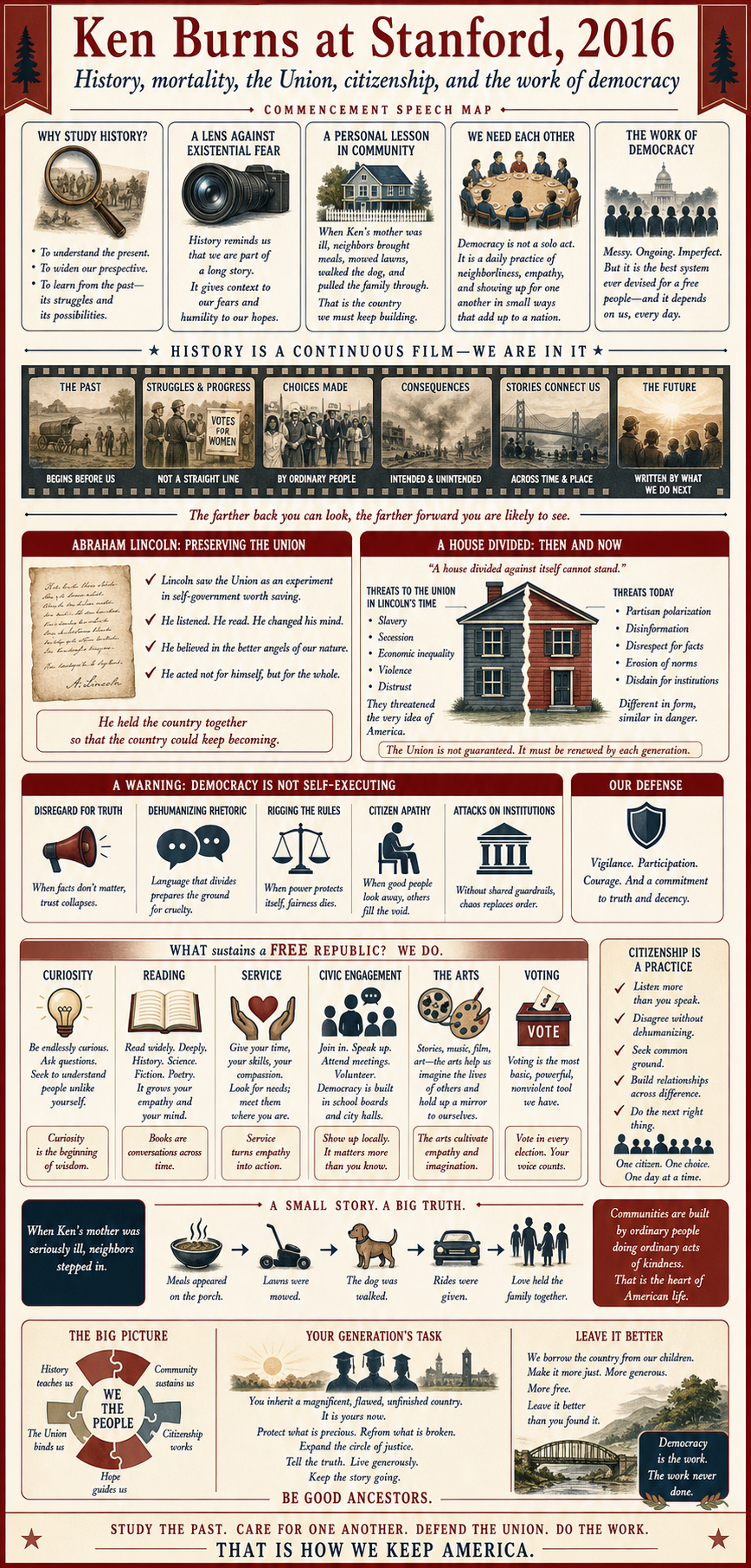
Ken Burns at Stanford, 2016
A commencement address about history, mortality, community, the Union, citizenship, and democratic responsibility.
Speech arc
- 01History lens
Opening move
- 02Mortality
Speech beat
- 03Neighbor care
Speech beat
- 04Lincoln
Speech beat
- 05Union
Speech beat
- 06Warning
Speech beat
- 07Curiosity
Speech beat
- 08Vote and serve
Final charge
History: The past explains the present
Burns frames history as a living lens that helps graduates understand their moment and their mortality.
Lens
History is not static; it illuminates current choices.
Mortality
Remembering the past helps humans face finitude.
Curiosity
Studying history becomes an act of humility.
Burns frames history as a living lens that helps graduates understand their moment and their mortality.
Memory: Community in illness
A story of neighbors helping during his mother's illness becomes a model of practical generosity.
Care
Community is made visible in ordinary acts.
Grief
Private loss becomes public instruction.
Generosity
The neighborly response becomes civic education.
A story of neighbors helping during his mother's illness becomes a model of practical generosity.
Union: Democracy must be defended
Lincoln and the Union anchor Burns's warning that democracy requires active protection, not passive admiration.
Lincoln
The Union becomes a continuing responsibility.
Norms
Democratic culture can decay when citizens look away.
Voice
Graduates are urged to speak and vote.
Lincoln and the Union anchor Burns's warning that democracy requires active protection, not passive admiration.
• Key takeaways •
History sharpens the present
Connects to history.
Community teaches citizenship
Connects to democracy.
Democracy needs defense
Connects to citizenship.
Curiosity is civic work
Connects to community.
Vote, serve, and read
Connects to service.
Closing charge
The closing advice joins curiosity, reading, service, the arts, and voting into a daily practice of citizenship.
Live civically
Read
Intellectual life is treated as civic preparation.
Arts
Culture keeps empathy and memory alive.
Vote
Participation is the minimum form of stewardship.
The closing advice joins curiosity, reading, service, the arts, and voting into a daily practice of citizenship.
Visual speech maps
Browse more visual maps from Stanford University or continue with related mapped speeches below.
Transcript
The full transcript is hosted by the original publisher. Commencement Archive links to the source rather than republishing copyrighted text.
Read the full transcript at source →Provenance
Verified from official archive
Explore this speech
Find the next thread through the archive
Themes in this address
Speeches like this one
Search all speeches ->