Richard Engel
NBC News chief foreign correspondent
NBC chief foreign correspondent Richard Engel recounts his decision to move to Cairo after graduation with little money and no job, urging graduates to take risks and gamble on the unknown. He describes his career covering wars in the Middle East, explaining that conflict reveals human nature, and offers predictions that urbanization, climate pressures, and communications technology will shape the graduates' era. He encourages students to identify where history is heading and to seek inspiration rather than chase comfort.
“Don't be afraid. Take the leap. Take it every time.”
Key moments
- 01 Recounting his post-graduation move to Cairo with $2,000 and no job
- 02 Describing war as revealing human nature, compared to a car crash
- 03 Posing as a human shield to enter Iraq in 2002
- 04 Predicting urbanization, climate pressures, and technology will reshape the world
- 05 Recalling a rejuvenating swim in ancient ruins during the Libyan war
Save the visual map
Download or open the generated poster as a standalone PNG.
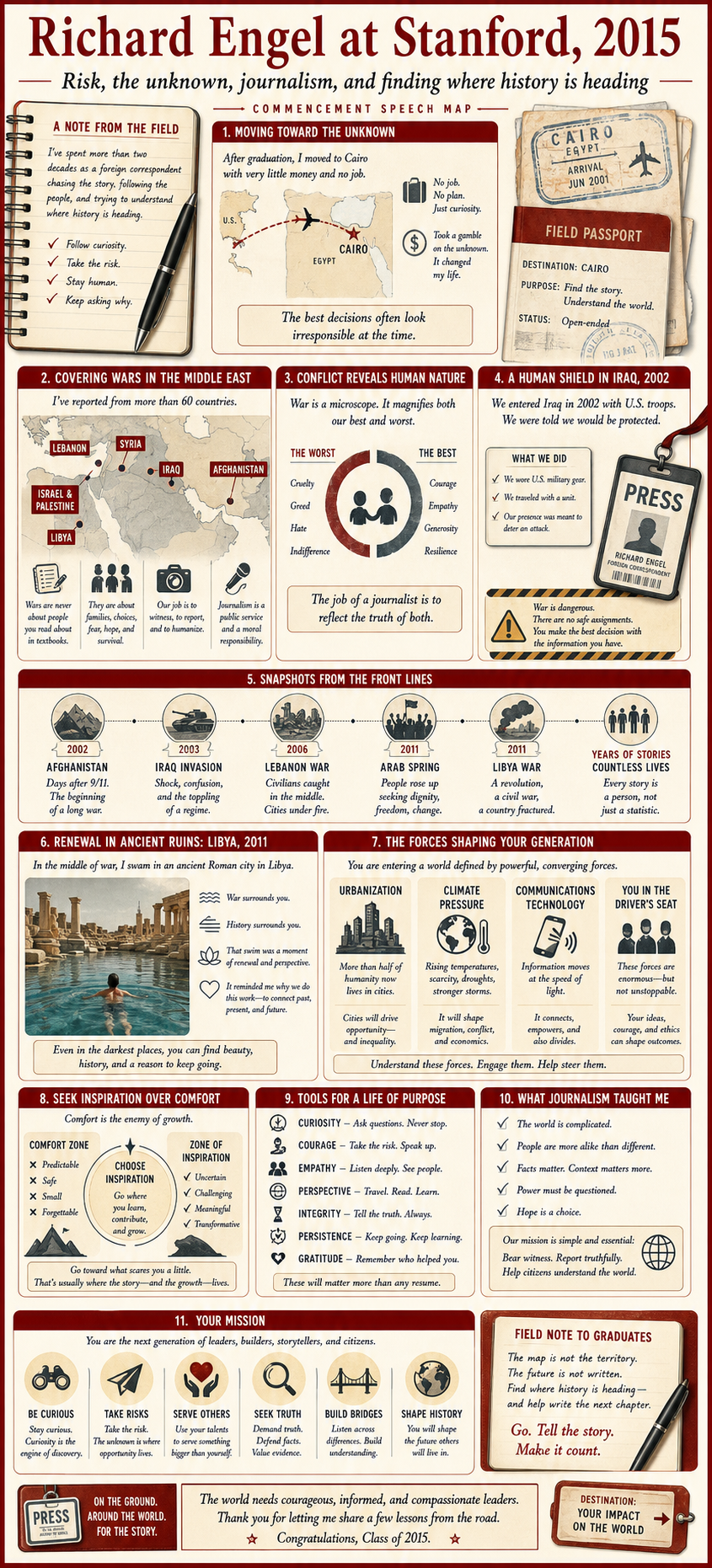
Richard Engel at Stanford, 2015
A commencement address about risk, journalism, war, inspiration, and gambling on the unknown.
Speech arc
- 01Cairo leap
Opening move
- 02No job
Speech beat
- 03War reporting
Speech beat
- 04Human nature
Speech beat
- 05Iraq risk
Speech beat
- 06Future forces
Speech beat
- 07Ancient ruins
Speech beat
- 08Seek inspiration
Final charge
Leap: Move toward the unknown
Engel's post-graduation move to Cairo becomes the speech's central wager: meaningful lives often begin without guarantees.
Risk
He leaves with little money and no settled job.
Unknown
The absence of certainty becomes the point.
Agency
Graduates are urged to choose direction over comfort.
Engel's post-graduation move to Cairo becomes the speech's central wager: meaningful lives often begin without guarantees.
Witness: War reveals character
Foreign correspondence is described as a harsh lens on human nature, danger, resilience, and moral pressure.
Conflict
War exposes what people value under stress.
Reporter
The journalist stands close enough to witness.
Cost
The work carries danger and consequence.
Foreign correspondence is described as a harsh lens on human nature, danger, resilience, and moral pressure.
Forecast: Read where history is going
Urbanization, climate pressure, and communications technology become signals graduates must learn to interpret.
Cities
Urban growth reshapes politics and life.
Climate
Environmental pressure becomes historical force.
Networks
Communication technology changes power and witness.
Urbanization, climate pressure, and communications technology become signals graduates must learn to interpret.
• Key takeaways •
Risk begins the story
Connects to risk.
Witness changes understanding
Connects to journalism.
History has direction
Connects to war.
Comfort is not enough
Connects to future forces.
Inspiration renews courage
Connects to inspiration.
Closing charge
A swim among ancient ruins becomes an image of renewal inside chaos and a reminder to find work that wakes the spirit.
Seek inspiration, not comfort
Ruins
History and beauty interrupt the war zone.
Inspiration
Meaning is stronger than ease.
Charge
Find the place where history and purpose meet.
A swim among ancient ruins becomes an image of renewal inside chaos and a reminder to find work that wakes the spirit.
Visual speech maps
Browse more visual maps from Stanford University or continue with related mapped speeches below.
Transcript
The full transcript is hosted by the original publisher. Commencement Archive links to the source rather than republishing copyrighted text.
Read the full transcript at source →Provenance
Verified from official archive
Explore this speech
Find the next thread through the archive
Themes in this address
Speeches like this one
Search all speeches ->