Elias Zerhouni
Director, National Institutes of Health
NIH director Elias Zerhouni told MIT's Class of 2004 that the life sciences will be the defining challenge of the 21st century, arguing that humanity changes its environment faster than it can biologically adapt, as illustrated by rising obesity. He emphasized the importance of collaboration and connection across disciplines, drawing on his own immigrant experience, and offered his '50/50 Rules of Life' about questioning knowledge, reading broadly, and dreaming big.
“You cannot put a full life in a small dream box.”
Key moments
- 01 Framing life sciences as the defining 21st-century challenge through three 'Big Bangs'
- 02 Citing obesity as evidence humans adapt slower than they change their environment
- 03 Stressing connection and cross-disciplinary collaboration, drawing on his arrival from Algeria
- 04 Sharing the '50/50 Rules of Life' about knowledge, reading widely, and ambition
Save the visual map
Download or open the generated poster as a standalone PNG.
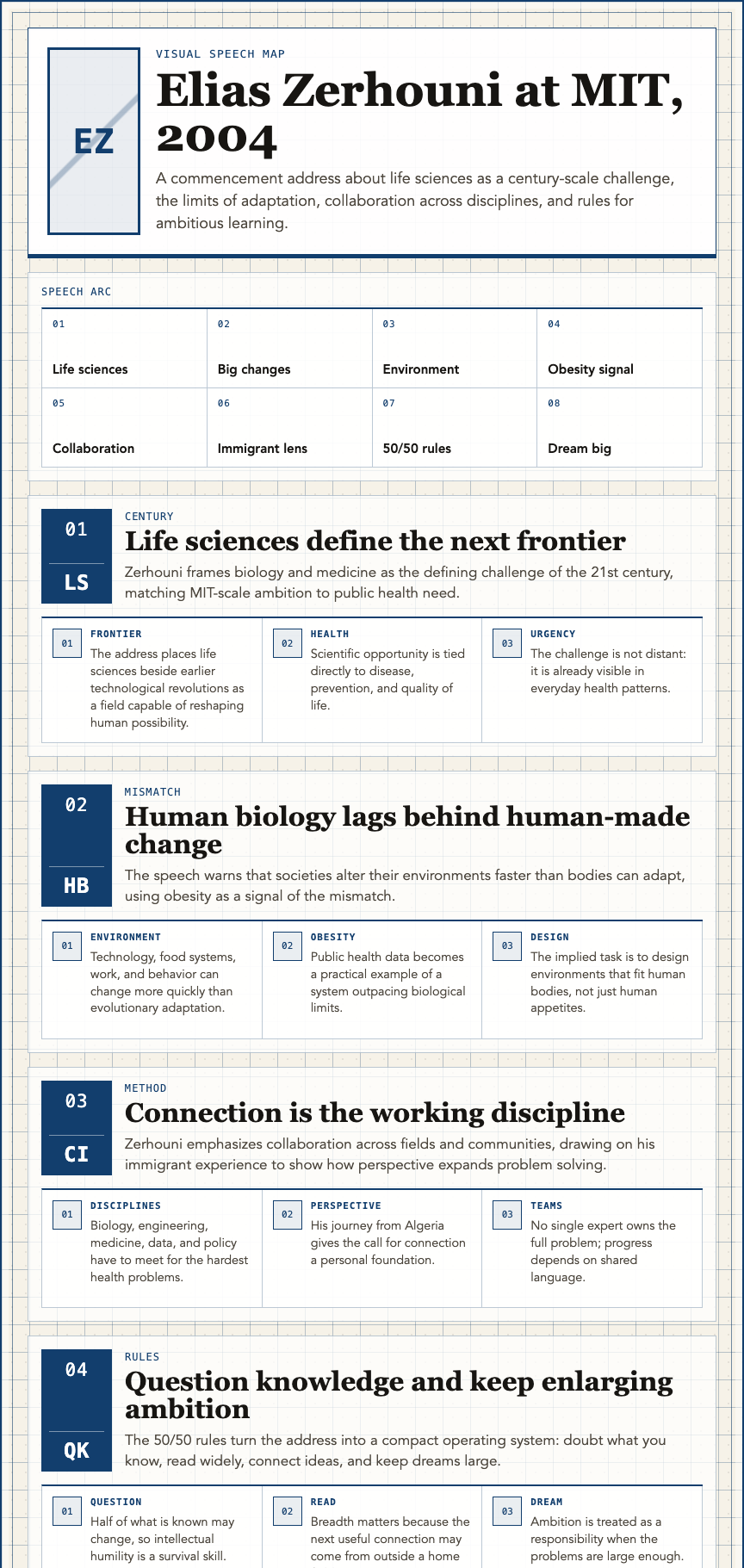
Elias Zerhouni at MIT, 2004
A commencement address about life sciences as a century-scale challenge, the limits of adaptation, collaboration across disciplines, and rules for ambitious learning.
Speech arc
- 01Life sciences
Opening move
- 02Big changes
Speech beat
- 03Environment
Speech beat
- 04Obesity signal
Speech beat
- 05Collaboration
Speech beat
- 06Immigrant lens
Speech beat
- 0750/50 rules
Speech beat
- 08Dream big
Final charge
Century: Life sciences define the next frontier
Zerhouni frames biology and medicine as the defining challenge of the 21st century, matching MIT-scale ambition to public health need.
Frontier
The address places life sciences beside earlier technological revolutions as a field capable of reshaping human possibility.
Health
Scientific opportunity is tied directly to disease, prevention, and quality of life.
Urgency
The challenge is not distant: it is already visible in everyday health patterns.
Zerhouni frames biology and medicine as the defining challenge of the 21st century, matching MIT-scale ambition to public health need.
Mismatch: Human biology lags behind human-made change
The speech warns that societies alter their environments faster than bodies can adapt, using obesity as a signal of the mismatch.
Environment
Technology, food systems, work, and behavior can change more quickly than evolutionary adaptation.
Obesity
Public health data becomes a practical example of a system outpacing biological limits.
Design
The implied task is to design environments that fit human bodies, not just human appetites.
The speech warns that societies alter their environments faster than bodies can adapt, using obesity as a signal of the mismatch.
Method: Connection is the working discipline
Zerhouni emphasizes collaboration across fields and communities, drawing on his immigrant experience to show how perspective expands problem solving.
Disciplines
Biology, engineering, medicine, data, and policy have to meet for the hardest health problems.
Perspective
His journey from Algeria gives the call for connection a personal foundation.
Teams
No single expert owns the full problem; progress depends on shared language.
Zerhouni emphasizes collaboration across fields and communities, drawing on his immigrant experience to show how perspective expands problem solving.
• Key takeaways •
Health is a systems problem
Connects to life sciences.
Adaptation has limits
Connects to collaboration.
Collaboration creates reach
Connects to public health.
Humility protects learning
Connects to ambition.
Ambition should widen
Connects to interdisciplinarity.
Closing charge
The 50/50 rules turn the address into a compact operating system: doubt what you know, read widely, connect ideas, and keep dreams large.
Question knowledge and keep enlarging ambition
Question
Half of what is known may change, so intellectual humility is a survival skill.
Read
Breadth matters because the next useful connection may come from outside a home field.
Dream
Ambition is treated as a responsibility when the problems are large enough.
The 50/50 rules turn the address into a compact operating system: doubt what you know, read widely, connect ideas, and keep dreams large.
Visual speech maps
Browse more visual maps from Massachusetts Institute of Technology or continue with related mapped speeches below.
Transcript
No official full transcript has been located yet. If you know of one, suggestions are welcome.
Provenance
Verified from official archive; cross-referenced with NPR commencement archive; cross-referenced with Open Commencement DB
NPR archive last updated in 2015; destination availability has not been exhaustively rechecked | Open Commencement DB transcript; not independently verified against the original recording
Explore this speech
Find the next thread through the archive
Themes in this address
Speeches like this one
Search all speeches ->