George Mitchell
Former U.S. senator
At MIT's 137th Commencement, former U.S. Senator George Mitchell told graduates that a resolution to the Middle East conflict is possible but requires each side to recognize the other's needs—Palestinians seeking a viable state and Israelis seeking security. Drawing on his peace work, he argued that no conflict is impossible to end and urged Americans not to turn away when setbacks occur. He called on graduates, as a privileged elite, to speak out against discrimination and injustice and to help others achieve education and a clean environment.
“Conflicts are created and sustained by human beings; they can be ended by human beings.”
Key moments
- 01 Argues a two-state Middle East solution is achievable only through negotiation
- 02 Notes total mutual mistrust creates a zero-sum conflict harming both sides
- 03 Declares that conflicts made by humans can be ended by humans
- 04 Urges Americans not to despair at setbacks and graduates to fight injustice
Save the visual map
Download or open the generated poster as a standalone PNG.
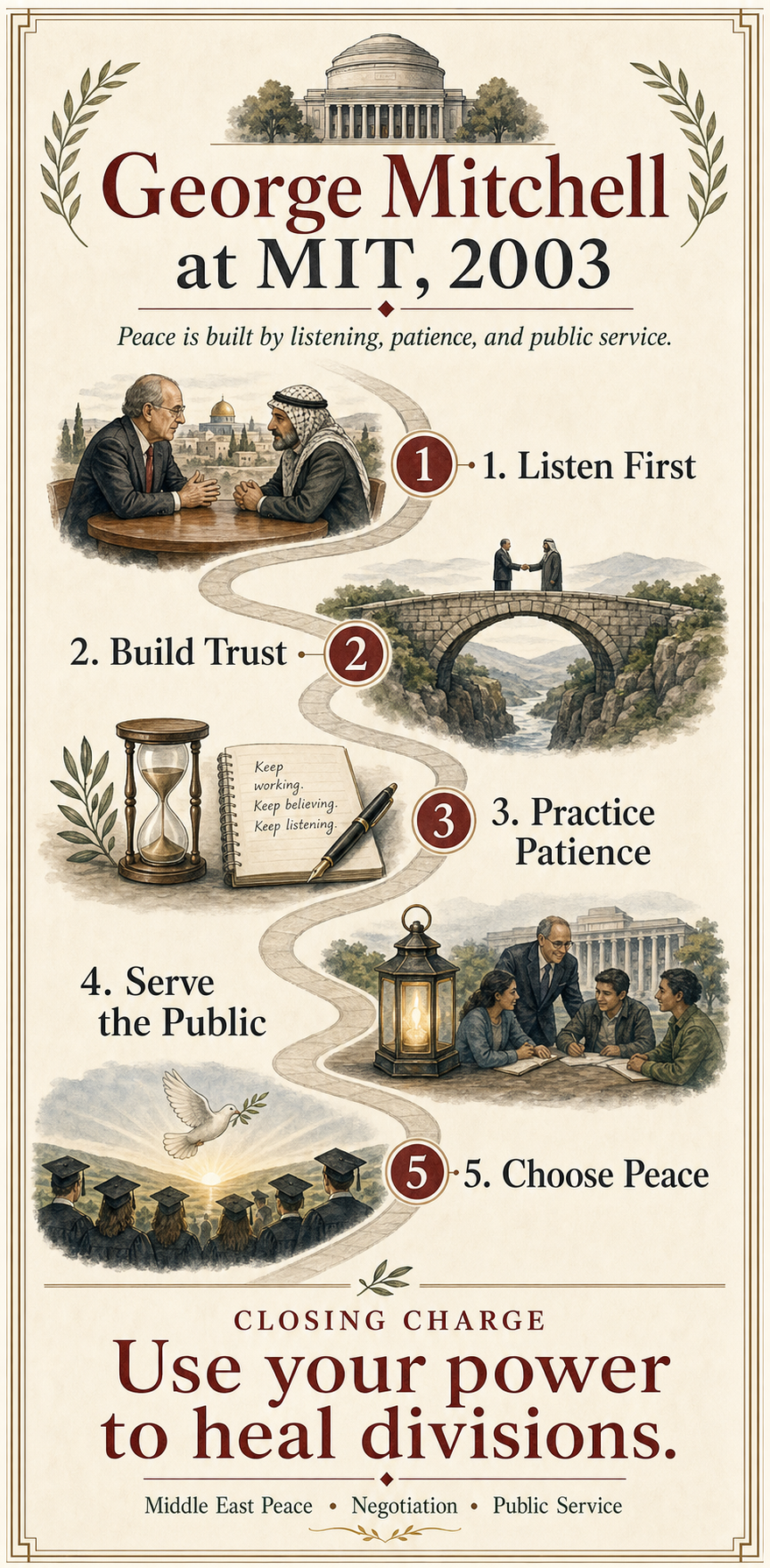
George Mitchell at MIT, 2003
A commencement address about negotiated peace, refusing despair, confronting injustice, and using elite education for public responsibility.
Speech arc
- 01Middle East
Opening move
- 02Mutual needs
Speech beat
- 03Negotiation
Speech beat
- 04Mistrust
Speech beat
- 05No inevitability
Speech beat
- 06American role
Speech beat
- 07Privilege
Speech beat
- 08Justice
Final charge
Conflict: Peace begins by naming both peoples' needs
Mitchell frames the Middle East conflict around two legitimate human requirements: Palestinians need a viable state, and Israelis need durable security.
Balance
The address refuses a one-sided moral map and asks listeners to see needs on both sides.
Statehood
A viable Palestinian state is presented as a practical condition for lasting settlement.
Security
Israeli safety is treated as equally real, not as an obstacle to be wished away.
Mitchell frames the Middle East conflict around two legitimate human requirements: Palestinians need a viable state, and Israelis need durable security.
Method: Negotiation is the alternative to fatalism
The speech argues that even deeply rooted conflict is not permanent when people choose negotiation over despair and zero-sum thinking.
Trust
Total mutual mistrust turns every concession into a perceived loss and keeps both sides trapped.
Talks
The path forward is structured negotiation, not waiting for exhaustion or victory.
Hope
No conflict made by human beings is beyond human repair.
The speech argues that even deeply rooted conflict is not permanent when people choose negotiation over despair and zero-sum thinking.
Public: Setbacks cannot become an excuse to withdraw
Mitchell warns Americans not to turn away when diplomacy suffers reversals, because distance does not remove responsibility.
Patience
Peace work is measured across years of effort, interrupted progress, and repeated return.
Witness
Citizens outside the conflict still shape the political conditions around it.
Resolve
The central civic discipline is staying engaged after disappointment.
Mitchell warns Americans not to turn away when diplomacy suffers reversals, because distance does not remove responsibility.
• Key takeaways •
Peace requires recognition
Connects to middle east peace.
Negotiation resists despair
Connects to conflict resolution.
Setbacks test commitment
Connects to social responsibility.
Privilege creates duty
Connects to public service.
Justice needs public voice
A core idea carried through the address.
Closing charge
The closing charge turns from geopolitics to the graduates: education and status are obligations to fight discrimination, expand opportunity, and serve others.
Privilege has to answer injustice directly
Voice
Graduates are urged to speak out when discrimination and injustice are visible.
Access
Helping others gain education becomes one test of whether privilege is being used well.
Service
A clean environment and a fair society are presented as shared responsibilities.
The closing charge turns from geopolitics to the graduates: education and status are obligations to fight discrimination, expand opportunity, and serve others.
Visual speech maps
Browse more visual maps from Massachusetts Institute of Technology or continue with related mapped speeches below.
Transcript
No official full transcript has been located yet. If you know of one, suggestions are welcome.
Provenance
Verified from official archive
Explore this speech
Find the next thread through the archive
Themes in this address
Speeches like this one
Search all speeches ->