Irwin Jacobs
Co-founder and CEO, QUALCOMM
At MIT's 2005 Commencement, Qualcomm co-founder and CEO Irwin Jacobs drew on his own career to encourage graduates to prepare for change, recounting how he switched from hotel management to engineering and later co-founded Linkabit and Qualcomm. He urged graduates to consider teaching, to not be swayed by conventional wisdom, to view their work in a global context, and to pursue philanthropy.
“The opportunity for philanthropy never goes away.”
Key moments
- 01 Describing his own shift from hotel management to engineering
- 02 Recounting founding Linkabit and Qualcomm
- 03 Encouraging graduates to question conventional wisdom, citing cellphone forecasts
- 04 Emphasizing global context and ongoing opportunity for philanthropy
Save the visual map
Download or open the generated poster as a standalone PNG.
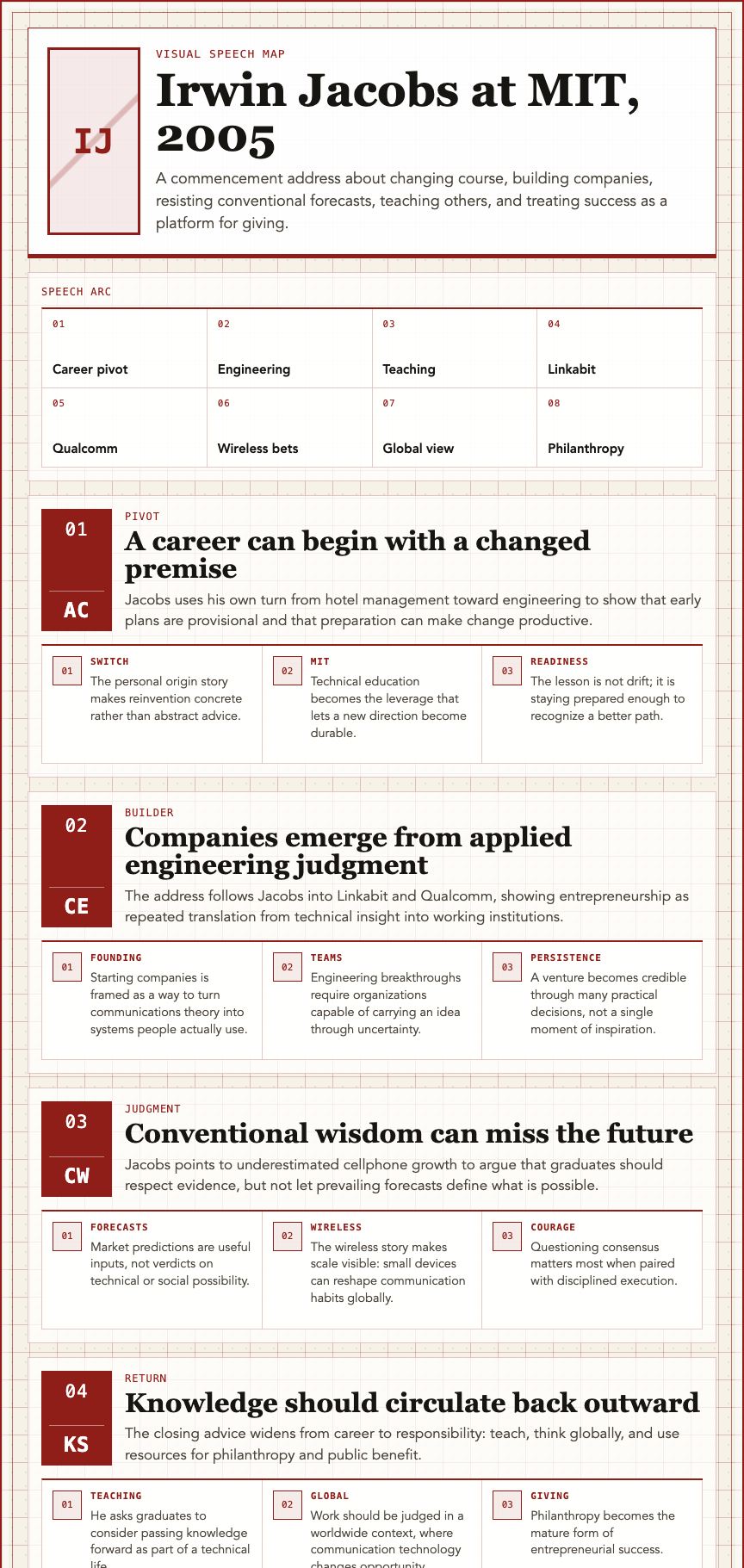
Irwin Jacobs at MIT, 2005
A commencement address about changing course, building companies, resisting conventional forecasts, teaching others, and treating success as a platform for giving.
Speech arc
- 01Career pivot
Opening move
- 02Engineering
Speech beat
- 03Teaching
Speech beat
- 04Linkabit
Speech beat
- 05Qualcomm
Speech beat
- 06Wireless bets
Speech beat
- 07Global view
Speech beat
- 08Philanthropy
Final charge
Pivot: A career can begin with a changed premise
Jacobs uses his own turn from hotel management toward engineering to show that early plans are provisional and that preparation can make change productive.
Switch
The personal origin story makes reinvention concrete rather than abstract advice.
MIT
Technical education becomes the leverage that lets a new direction become durable.
Readiness
The lesson is not drift; it is staying prepared enough to recognize a better path.
Jacobs uses his own turn from hotel management toward engineering to show that early plans are provisional and that preparation can make change productive.
Builder: Companies emerge from applied engineering judgment
The address follows Jacobs into Linkabit and Qualcomm, showing entrepreneurship as repeated translation from technical insight into working institutions.
Founding
Starting companies is framed as a way to turn communications theory into systems people actually use.
Teams
Engineering breakthroughs require organizations capable of carrying an idea through uncertainty.
Persistence
A venture becomes credible through many practical decisions, not a single moment of inspiration.
The address follows Jacobs into Linkabit and Qualcomm, showing entrepreneurship as repeated translation from technical insight into working institutions.
Judgment: Conventional wisdom can miss the future
Jacobs points to underestimated cellphone growth to argue that graduates should respect evidence, but not let prevailing forecasts define what is possible.
Forecasts
Market predictions are useful inputs, not verdicts on technical or social possibility.
Wireless
The wireless story makes scale visible: small devices can reshape communication habits globally.
Courage
Questioning consensus matters most when paired with disciplined execution.
Jacobs points to underestimated cellphone growth to argue that graduates should respect evidence, but not let prevailing forecasts define what is possible.
• Key takeaways •
Plans can be revised
Connects to engineering.
Engineering becomes enterprise
Connects to entrepreneurship.
Forecasts deserve challenge
Connects to philanthropy.
Scale brings responsibility
Connects to career change.
Success should be shared
Connects to global perspective.
Closing charge
The closing advice widens from career to responsibility: teach, think globally, and use resources for philanthropy and public benefit.
Knowledge should circulate back outward
Teaching
He asks graduates to consider passing knowledge forward as part of a technical life.
Global
Work should be judged in a worldwide context, where communication technology changes opportunity.
Giving
Philanthropy becomes the mature form of entrepreneurial success.
The closing advice widens from career to responsibility: teach, think globally, and use resources for philanthropy and public benefit.
Visual speech maps
Browse more visual maps from Massachusetts Institute of Technology or continue with related mapped speeches below.
Transcript
No official full transcript has been located yet. If you know of one, suggestions are welcome.
Provenance
Verified from official archive
Explore this speech
Find the next thread through the archive
Themes in this address
Speeches like this one
Search all speeches ->