Neil deGrasse Tyson
Neil deGrasse Tyson uses Rice University's connection to the space program—including President Kennedy's 1962 'we choose to go to the Moon' speech delivered at Rice Stadium—to argue that major human endeavors are historically driven by war, money, or the praise of royalty and deity. He contends that the Apollo program succeeded because of a Cold War driver, and that the Earthrise photograph transformed environmental and cultural attitudes. He urges graduates to see their diploma as an invitation to keep learning and to help lead America back toward exploration.
Key moments
- 01 Recounting Kennedy's moon speech at Rice and NASA's Cold War origins
- 02 Identifying war, money, and royalty/deity as the three drivers of great endeavors
- 03 Explaining how the Earthrise photo spurred environmental laws and a global perspective
- 04 Calling on the class of 2013 to lead a renewed exploratory vision
Save the visual map
Download or open the generated poster as a standalone PNG.
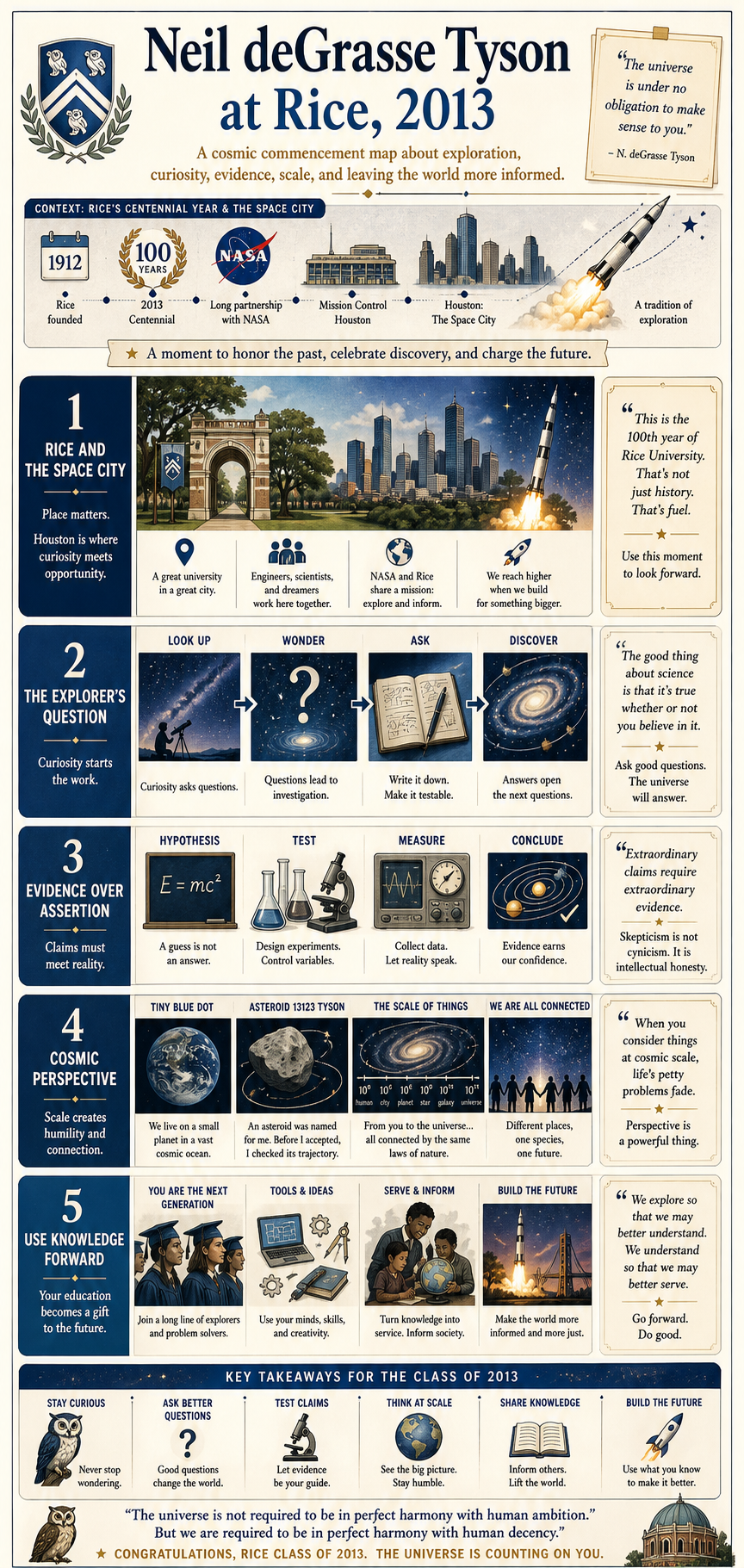
Neil deGrasse Tyson at Rice, 2013
A cosmic commencement address about exploration, curiosity, evidence, scale, and leaving the world more informed.
Speech arc
- 01Rice centennial
Opening move
- 02Houston
Speech beat
- 03NASA
Speech beat
- 04Curiosity
Speech beat
- 05Evidence
Speech beat
- 06Cosmic scale
Speech beat
- 07Public knowledge
Speech beat
- 08Build the future
Final charge
Place: Rice stands inside a space-city story
Tyson links the centennial commencement to Houston, NASA, Rice’s scientific setting, and a tradition of exploration that gives the day public scale.
Centennial
The address marks Rice’s hundred-year milestone as more than institutional memory.
Houston
The city’s space identity turns the campus moment toward discovery.
Tradition
Graduates inherit a culture of asking larger questions.
Tyson links the centennial commencement to Houston, NASA, Rice’s scientific setting, and a tradition of exploration that gives the day public scale.
Curiosity: The explorer starts with better questions
The speech treats curiosity as the engine of discovery: looking up, wondering, writing the question down, and following it into investigation.
Wonder
Questions begin where ordinary assumptions stop.
Inquiry
A good question becomes testable work.
Discovery
Answers often open the next, deeper question.
The speech treats curiosity as the engine of discovery: looking up, wondering, writing the question down, and following it into investigation.
Evidence: Claims must meet reality
Tyson’s scientific ethic privileges testing, measurement, and evidence over assertion, making skepticism a disciplined public virtue.
Hypothesis
A guess is the start of work, not the end of argument.
Test
Experiments and measurements let reality answer back.
Trust
Evidence earns confidence because it survives scrutiny.
Tyson’s scientific ethic privileges testing, measurement, and evidence over assertion, making skepticism a disciplined public virtue.
Scale: Cosmic perspective creates humility
The address uses planets, asteroids, galaxies, and scale to shrink petty concerns and enlarge the sense of human connection.
Tiny planet
Earth appears small against the cosmic ocean.
Asteroid
His named asteroid becomes a humorous doorway into scale.
Connection
Different places share one species, one future, and one set of natural laws.
The address uses planets, asteroids, galaxies, and scale to shrink petty concerns and enlarge the sense of human connection.
• Key takeaways •
Stay curious
Connects to curiosity.
Ask better questions
Connects to science.
Test claims
Connects to evidence.
Think at scale
Connects to exploration.
Share knowledge
Connects to humility.
Build the future
Connects to public service.
Closing charge
The final charge turns education into contribution: graduates should inform society, solve problems, and use knowledge to make the future more just and more intelligent.
Use knowledge in public service
Tools
Skills and ideas become instruments for public work.
Service
Knowledge matters when it helps people understand and act.
Build
The class joins a long line of explorers and problem solvers.
The final charge turns education into contribution: graduates should inform society, solve problems, and use knowledge to make the future more just and more intelligent.
Visual speech maps
Browse more visual maps from Rice University or continue with related mapped speeches below.
Transcript
The previously catalogued transcript link is no longer live and is queued for re-sourcing. A video of the address is available above.
Machine transcript available for archive analysis; it is unverified and may contain transcription errors. Machine transcript source ->
Provenance
BROKEN transcript link (checked 2026-06-26): gradspeeches.com is a parked/redirecting domain serving no real content. Provenance: Imported from NPR commencement archive; cross-referenced with Open Commencement DB
NPR archive last updated in 2015; destination availability has not been exhaustively rechecked | Open Commencement DB transcript; not independently verified against the original recording | Transcript URL dead (gradspeeches.com is a parked/redirecting domain serving no real content); video fallback present
Explore this speech
Find the next thread through the archive
Themes in this address
Speeches like this one
Search all speeches ->