David Brooks
Field: arts
David Brooks opens with humor about commencement etiquette and status-driven happiness before turning to research on what actually produces well-being, noting that friendship, marriage, and shared meals matter more than money. He describes a hierarchy of happiness culminating in meaning and fulfillment, then contrasts two paths: Clay Christensen's approach of defining a life purpose early, and Victor Frankl's idea of being summoned by the tasks life presents. Brooks argues that most young people cannot chart a fixed purpose at 20 and should instead put themselves in circumstances where meaningful summons will emerge.
Key moments
- 01 Research showing friendship and marriage boost happiness more than wealth
- 02 Satirical critique of status- and beauty-oriented happiness
- 03 Christensen's method of defining life purpose versus Frankl's summoned life
- 04 Advice that graduates need not panic without a fixed plan but should seek circumstances that call them
Save the visual map
Download or open the generated poster as a standalone PNG.
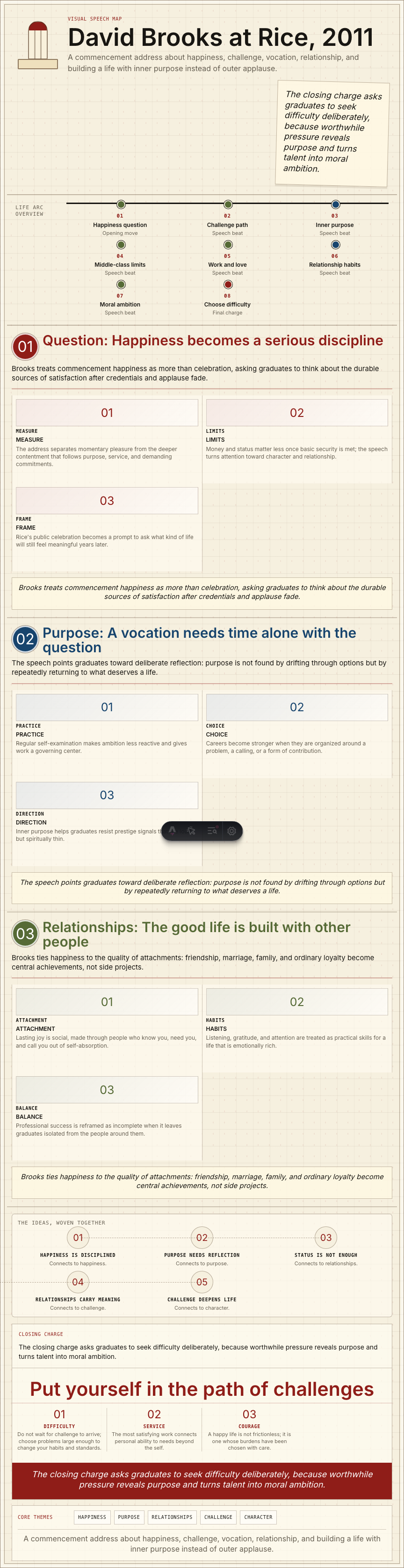
David Brooks at Rice, 2011
A commencement address about happiness, challenge, vocation, relationship, and building a life with inner purpose instead of outer applause.
Speech arc
- 01Happiness question
Opening move
- 02Challenge path
Speech beat
- 03Inner purpose
Speech beat
- 04Middle-class limits
Speech beat
- 05Work and love
Speech beat
- 06Relationship habits
Speech beat
- 07Moral ambition
Speech beat
- 08Choose difficulty
Final charge
Question: Happiness becomes a serious discipline
Brooks treats commencement happiness as more than celebration, asking graduates to think about the durable sources of satisfaction after credentials and applause fade.
Measure
The address separates momentary pleasure from the deeper contentment that follows purpose, service, and demanding commitments.
Limits
Money and status matter less once basic security is met; the speech turns attention toward character and relationship.
Frame
Rice's public celebration becomes a prompt to ask what kind of life will still feel meaningful years later.
Brooks treats commencement happiness as more than celebration, asking graduates to think about the durable sources of satisfaction after credentials and applause fade.
Purpose: A vocation needs time alone with the question
The speech points graduates toward deliberate reflection: purpose is not found by drifting through options but by repeatedly returning to what deserves a life.
Practice
Regular self-examination makes ambition less reactive and gives work a governing center.
Choice
Careers become stronger when they are organized around a problem, a calling, or a form of contribution.
Direction
Inner purpose helps graduates resist prestige signals that are loud but spiritually thin.
The speech points graduates toward deliberate reflection: purpose is not found by drifting through options but by repeatedly returning to what deserves a life.
Relationships: The good life is built with other people
Brooks ties happiness to the quality of attachments: friendship, marriage, family, and ordinary loyalty become central achievements, not side projects.
Attachment
Lasting joy is social, made through people who know you, need you, and call you out of self-absorption.
Habits
Listening, gratitude, and attention are treated as practical skills for a life that is emotionally rich.
Balance
Professional success is reframed as incomplete when it leaves graduates isolated from the people around them.
Brooks ties happiness to the quality of attachments: friendship, marriage, family, and ordinary loyalty become central achievements, not side projects.
• Key takeaways •
Happiness is disciplined
Connects to happiness.
Purpose needs reflection
Connects to purpose.
Status is not enough
Connects to relationships.
Relationships carry meaning
Connects to challenge.
Challenge deepens life
Connects to character.
Closing charge
The closing charge asks graduates to seek difficulty deliberately, because worthwhile pressure reveals purpose and turns talent into moral ambition.
Put yourself in the path of challenges
Difficulty
Do not wait for challenge to arrive; choose problems large enough to change your habits and standards.
Service
The most satisfying work connects personal ability to needs beyond the self.
Courage
A happy life is not frictionless; it is one whose burdens have been chosen with care.
The closing charge asks graduates to seek difficulty deliberately, because worthwhile pressure reveals purpose and turns talent into moral ambition.
Visual speech maps
Browse more visual maps from Rice University or continue with related mapped speeches below.
Transcript
The previously catalogued transcript link is no longer live and is queued for re-sourcing. A video of the address is available above.
Machine transcript available for archive analysis; it is unverified and may contain transcription errors. Machine transcript source ->
Provenance
BROKEN transcript link (checked 2026-06-26): graduationwisdom.com repurposed into lifestyle blog; speech pages gone. Provenance: Imported from NPR commencement archive; cross-referenced with Open Commencement DB
NPR archive last updated in 2015; destination availability has not been exhaustively rechecked | Open Commencement DB transcript; not independently verified against the original recording | Transcript URL dead (graduationwisdom.com repurposed into lifestyle blog; speech pages gone); video fallback present
Explore this speech
Find the next thread through the archive
Themes in this address
Speeches like this one
Search all speeches ->