James Wolfensohn
President of the World Bank
World Bank president James Wolfensohn reflects on his own journey from Australia to MIT decades earlier and argues that the world is no longer a bipolar divide between rich and poor but an interdependent place. He contends that poverty and inequity anywhere—made vivid by the events of September 11th—affect everyone, and challenges graduates to make 'planetary equity' their central concern. He urges them to use their education with humility and to commit to social justice, development, and peace.
“poverty somewhere is poverty everywhere, that global issues are local issues”
Key moments
- 01 Recalls his first visit to MIT in the 1950s and praises the OpenCourseWare program as a global contribution
- 02 Describes his earlier view of the world as bipolar—rich versus poor—and how that view changed
- 03 Cites September 11th and statistics on global poverty to argue inequity is unstable and shared
- 04 Tells the 'picking up the dog' anecdote to urge graduates to use their education with humility
Save the visual map
Download or open the generated poster as a standalone PNG.
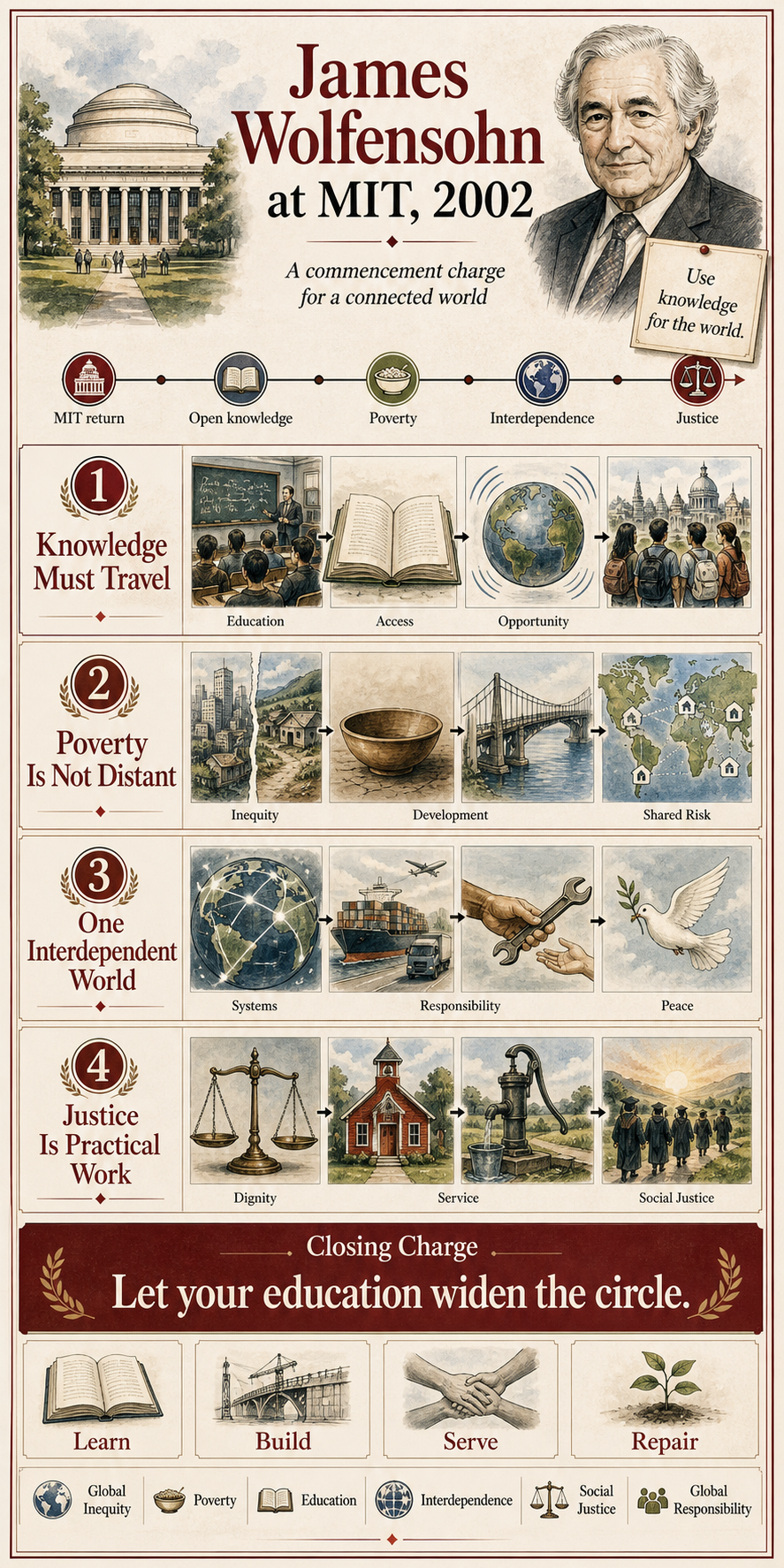
James Wolfensohn at MIT, 2002
A commencement address about global interdependence, poverty, planetary equity, humility, and using knowledge for development and peace.
Speech arc
- 01MIT return
Opening move
- 02OpenCourseWare
Speech beat
- 03Old divides
Speech beat
- 04Interdependence
Speech beat
- 05September 11
Speech beat
- 06Poverty
Speech beat
- 07Humility
Speech beat
- 08Planetary equity
Final charge
Return: MIT knowledge becomes a global public resource
Wolfensohn begins from his own MIT connection and praises OpenCourseWare as an example of education moving beyond campus boundaries.
Memory
A personal return to MIT gives the address the perspective of an alumnus looking across decades.
Access
OpenCourseWare becomes a symbol of knowledge shared at planetary scale.
Duty
The institution's excellence matters most when it widens who can learn.
Wolfensohn begins from his own MIT connection and praises OpenCourseWare as an example of education moving beyond campus boundaries.
World: The rich-poor divide is no longer distant
He rejects an old bipolar picture of rich and poor worlds, arguing that poverty and inequity now move through one interdependent system.
Shift
The speech changes the map from separate worlds to connected consequences.
Poverty
Global deprivation is not background tragedy; it is a structural fact shaping everyone's future.
Security
September 11 makes instability and injustice impossible to treat as remote.
He rejects an old bipolar picture of rich and poor worlds, arguing that poverty and inequity now move through one interdependent system.
Standard: Planetary equity is the central assignment
The address asks graduates to make equity the measure of their careers, linking development, peace, and social justice.
Equity
The phrase turns compassion into a governing principle for technical and professional choices.
Development
Growth is incomplete if it leaves vast numbers outside opportunity.
Peace
Lasting peace depends on reducing the conditions that make exclusion and anger durable.
The address asks graduates to make equity the measure of their careers, linking development, peace, and social justice.
• Key takeaways •
Knowledge should travel
Connects to global inequity.
Poverty is shared risk
Connects to poverty.
Equity is a design goal
Connects to education.
Humility disciplines power
Connects to interdependence.
Peace requires justice
Connects to social justice.
Closing charge
Through a practical anecdote about humility, Wolfensohn warns that elite training should enlarge responsibility rather than ego.
Education must be carried without arrogance
Lesson
The anecdote cuts against credential pride and returns attention to ordinary human decency.
Use
Knowledge is judged by what graduates do with it, especially for those without power.
Service
Humility keeps public purpose from becoming performance.
Through a practical anecdote about humility, Wolfensohn warns that elite training should enlarge responsibility rather than ego.
Visual speech maps
Browse more visual maps from Massachusetts Institute of Technology or continue with related mapped speeches below.
Transcript
The full transcript is hosted by the original publisher. Commencement Archive links to the source rather than republishing copyrighted text.
Read the full transcript at source →Provenance
Verified from official archive; targeted event-level link verified (2026-06-26)
Full prepared text on MIT News (136th Commencement, June 2002). Coverage page also linked. Verified live 2026-06-26. Category: Global development
Explore this speech
Find the next thread through the archive
Themes in this address
Speeches like this one
Search all speeches ->