Bill Gates
Field: business
Bill Gates reflects humorously on his time at Harvard before dropping out to found Microsoft, then turns to the global inequities in health, wealth, and opportunity he only learned about after leaving. He argues that the barrier to addressing such problems is not lack of caring but complexity, and outlines a method—see the problem, find a solution, measure the impact—for cutting through it. He calls on Harvard and its graduates to dedicate their talent and the new tools of technology to reducing the world's deepest inequities.
“Don't let complexity stop you.”
Key moments
- 01 Joking about being Harvard's most successful dropout and finally getting recognized
- 02 His regret at leaving Harvard unaware of global inequities in health and wealth
- 03 Discovering children dying from preventable diseases like rotavirus and the failure of markets and governments
- 04 Arguing complexity, not lack of caring, blocks action, with a four-step problem-solving framework
- 05 Citing George Marshall's 1947 commencement and the role of technology in connecting minds
- 06 Calling on Harvard and graduates to take on the world's worst inequities, echoing his mother's words
Save the visual map
Download or open the generated poster as a standalone PNG.
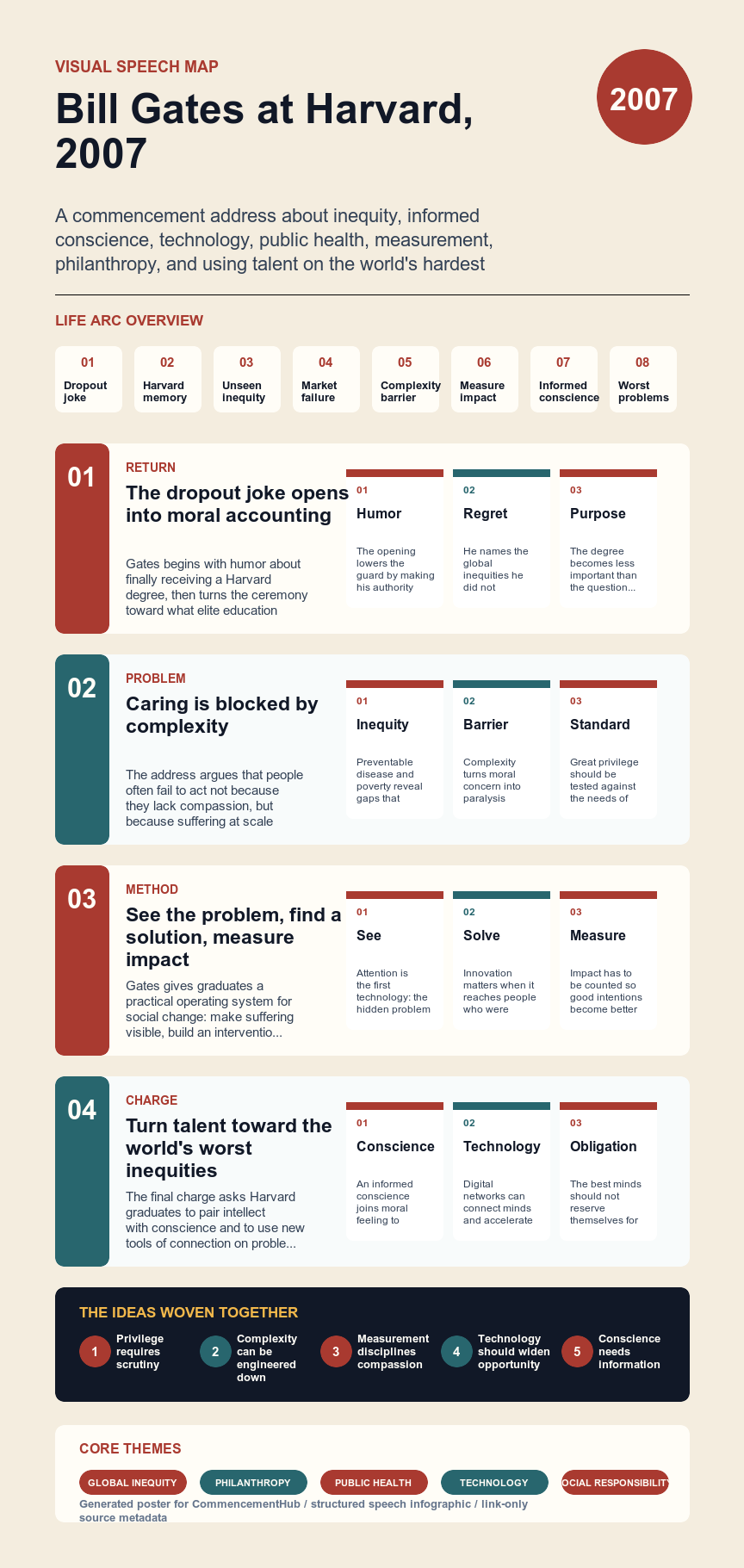
Bill Gates at Harvard, 2007
A commencement address about inequity, informed conscience, technology, public health, measurement, philanthropy, and using talent on the world's hardest problems.
Speech arc
- 01Dropout joke
Opening move
- 02Harvard memory
Speech beat
- 03Unseen inequity
Speech beat
- 04Market failure
Speech beat
- 05Complexity barrier
Speech beat
- 06Measure impact
Speech beat
- 07Informed conscience
Speech beat
- 08Worst problems
Final charge
Return: The dropout joke opens into moral accounting
Gates begins with humor about finally receiving a Harvard degree, then turns the ceremony toward what elite education failed to make visible to him.
Humor
The opening lowers the guard by making his authority playful rather than solemn.
Regret
He names the global inequities he did not understand when he left campus.
Purpose
The degree becomes less important than the question of what knowledge is for.
Gates begins with humor about finally receiving a Harvard degree, then turns the ceremony toward what elite education failed to make visible to him.
Problem: Caring is blocked by complexity
The address argues that people often fail to act not because they lack compassion, but because suffering at scale feels too complicated to enter.
Inequity
Preventable disease and poverty reveal gaps that markets and governments often miss.
Barrier
Complexity turns moral concern into paralysis unless the problem is made tractable.
Standard
Great privilege should be tested against the needs of people with the least power.
The address argues that people often fail to act not because they lack compassion, but because suffering at scale feels too complicated to enter.
Method: See the problem, find a solution, measure impact
Gates gives graduates a practical operating system for social change: make suffering visible, build an intervention, then track whether it actually works.
See
Attention is the first technology: the hidden problem must be brought into view.
Solve
Innovation matters when it reaches people who were excluded from prior progress.
Measure
Impact has to be counted so good intentions become better systems.
Gates gives graduates a practical operating system for social change: make suffering visible, build an intervention, then track whether it actually works.
• Key takeaways •
Privilege requires scrutiny
Connects to global inequity.
Complexity can be engineered down
Connects to philanthropy.
Measurement disciplines compassion
Connects to public health.
Technology should widen opportunity
Connects to technology.
Conscience needs information
Connects to social responsibility.
Closing charge
The final charge asks Harvard graduates to pair intellect with conscience and to use new tools of connection on problems that have been ignored for too long.
Turn talent toward the world's worst inequities
Conscience
An informed conscience joins moral feeling to facts, proximity, and responsibility.
Technology
Digital networks can connect minds and accelerate problem-solving across distance.
Obligation
The best minds should not reserve themselves for the easiest or most rewarded work.
The final charge asks Harvard graduates to pair intellect with conscience and to use new tools of connection on problems that have been ignored for too long.
Visual speech maps
Browse more visual maps from Harvard University or continue with related mapped speeches below.
Transcript
The full transcript is hosted by the original publisher. Commencement Archive links to the source rather than republishing copyrighted text.
Read the full transcript at source →Provenance
Imported from NPR commencement archive; cross-referenced with Open Commencement DB
NPR archive last updated in 2015; destination availability has not been exhaustively rechecked | Open Commencement DB transcript; not independently verified against the original recording
Explore this speech
Find the next thread through the archive
Themes in this address
Speeches like this one
Search all speeches ->