Ali G
Field: arts
Save the visual map
Download or open the generated poster as a standalone PNG.
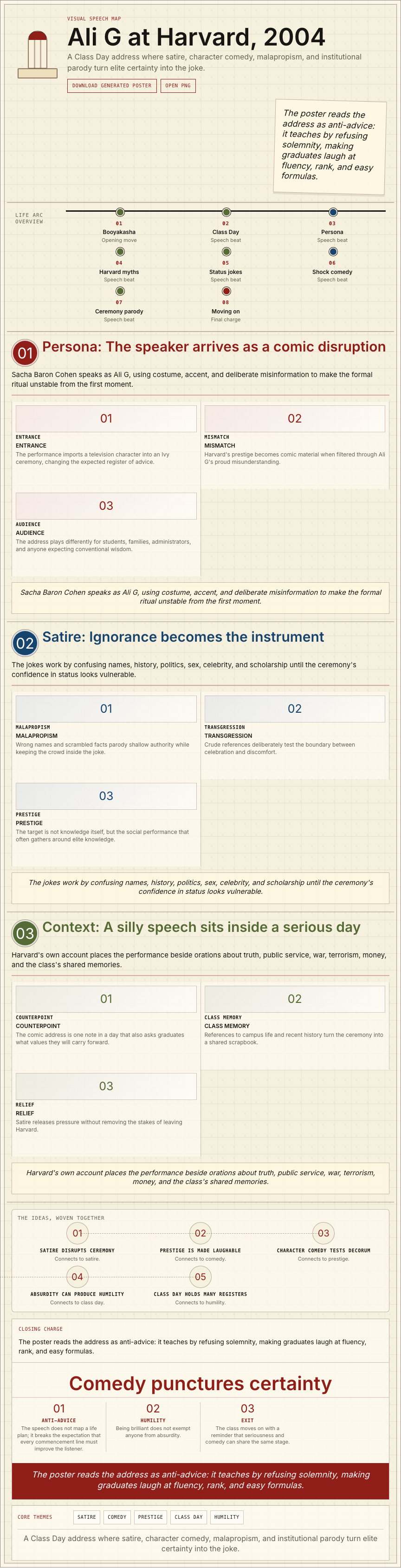
Ali G at Harvard, 2004
A Class Day address where satire, character comedy, malapropism, and institutional parody turn elite certainty into the joke.
Speech arc
- 01Booyakasha
Opening move
- 02Class Day
Speech beat
- 03Persona
Speech beat
- 04Harvard myths
Speech beat
- 05Status jokes
Speech beat
- 06Shock comedy
Speech beat
- 07Ceremony parody
Speech beat
- 08Moving on
Final charge
Persona: The speaker arrives as a comic disruption
Sacha Baron Cohen speaks as Ali G, using costume, accent, and deliberate misinformation to make the formal ritual unstable from the first moment.
Entrance
The performance imports a television character into an Ivy ceremony, changing the expected register of advice.
Mismatch
Harvard's prestige becomes comic material when filtered through Ali G's proud misunderstanding.
Audience
The address plays differently for students, families, administrators, and anyone expecting conventional wisdom.
Sacha Baron Cohen speaks as Ali G, using costume, accent, and deliberate misinformation to make the formal ritual unstable from the first moment.
Satire: Ignorance becomes the instrument
The jokes work by confusing names, history, politics, sex, celebrity, and scholarship until the ceremony's confidence in status looks vulnerable.
Malapropism
Wrong names and scrambled facts parody shallow authority while keeping the crowd inside the joke.
Transgression
Crude references deliberately test the boundary between celebration and discomfort.
Prestige
The target is not knowledge itself, but the social performance that often gathers around elite knowledge.
The jokes work by confusing names, history, politics, sex, celebrity, and scholarship until the ceremony's confidence in status looks vulnerable.
Context: A silly speech sits inside a serious day
Harvard's own account places the performance beside orations about truth, public service, war, terrorism, money, and the class's shared memories.
Counterpoint
The comic address is one note in a day that also asks graduates what values they will carry forward.
Class memory
References to campus life and recent history turn the ceremony into a shared scrapbook.
Relief
Satire releases pressure without removing the stakes of leaving Harvard.
Harvard's own account places the performance beside orations about truth, public service, war, terrorism, money, and the class's shared memories.
• Key takeaways •
Satire disrupts ceremony
Connects to satire.
Prestige is made laughable
Connects to comedy.
Character comedy tests decorum
Connects to prestige.
Absurdity can produce humility
Connects to class day.
Class Day holds many registers
Connects to humility.
Closing charge
The poster reads the address as anti-advice: it teaches by refusing solemnity, making graduates laugh at fluency, rank, and easy formulas.
Comedy punctures certainty
Anti-advice
The speech does not map a life plan; it breaks the expectation that every commencement line must improve the listener.
Humility
Being brilliant does not exempt anyone from absurdity.
Exit
The class moves on with a reminder that seriousness and comedy can share the same stage.
The poster reads the address as anti-advice: it teaches by refusing solemnity, making graduates laugh at fluency, rank, and easy formulas.
Visual speech maps
Browse more visual maps from Harvard University or continue with related mapped speeches below.
Transcript
The full transcript is hosted by the original publisher. Commencement Archive links to the source rather than republishing copyrighted text.
Read the full transcript at source →Provenance
Imported from NPR commencement archive
NPR archive last updated in 2015; destination availability has not been exhaustively rechecked
Explore this speech
Find the next thread through the archive
Themes in this address
No canonical themes have been assigned yet.
Speeches like this one
Search all speeches ->