J.K. Rowling
Field: letters
“Rock bottom became the solid foundation on which I rebuilt my life.”
Save the visual map
Download or open the generated poster as a standalone PNG.
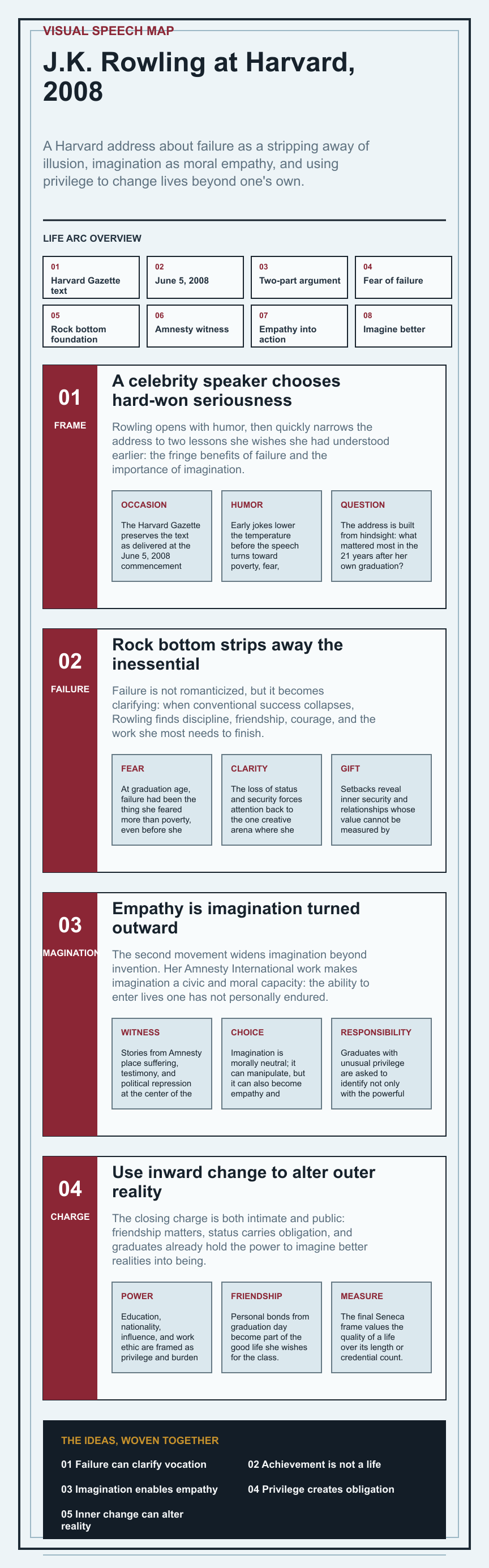
J.K. Rowling at Harvard, 2008
A Harvard address about failure as a stripping away of illusion, imagination as moral empathy, and using privilege to change lives beyond one's own.
Speech arc
- 01Harvard Gazette text
Opening move
- 02June 5, 2008
Speech beat
- 03Two-part argument
Speech beat
- 04Fear of failure
Speech beat
- 05Rock bottom foundation
Speech beat
- 06Amnesty witness
Speech beat
- 07Empathy into action
Speech beat
- 08Imagine better
Final charge
Frame: A celebrity speaker chooses hard-won seriousness
Rowling opens with humor, then quickly narrows the address to two lessons she wishes she had understood earlier: the fringe benefits of failure and the importance of imagination.
Occasion
The Harvard Gazette preserves the text as delivered at the June 5, 2008 commencement ceremony.
Humor
Early jokes lower the temperature before the speech turns toward poverty, fear, vocation, and responsibility.
Question
The address is built from hindsight: what mattered most in the 21 years after her own graduation?
Rowling opens with humor, then quickly narrows the address to two lessons she wishes she had understood earlier: the fringe benefits of failure and the importance of imagination.
Failure: Rock bottom strips away the inessential
Failure is not romanticized, but it becomes clarifying: when conventional success collapses, Rowling finds discipline, friendship, courage, and the work she most needs to finish.
Fear
At graduation age, failure had been the thing she feared more than poverty, even before she fully understood either.
Clarity
The loss of status and security forces attention back to the one creative arena where she feels she belongs.
Gift
Setbacks reveal inner security and relationships whose value cannot be measured by achievement.
Failure is not romanticized, but it becomes clarifying: when conventional success collapses, Rowling finds discipline, friendship, courage, and the work she most needs to finish.
Imagination: Empathy is imagination turned outward
The second movement widens imagination beyond invention. Her Amnesty International work makes imagination a civic and moral capacity: the ability to enter lives one has not personally endured.
Witness
Stories from Amnesty place suffering, testimony, and political repression at the center of the address.
Choice
Imagination is morally neutral; it can manipulate, but it can also become empathy and collective action.
Responsibility
Graduates with unusual privilege are asked to identify not only with the powerful but with the powerless.
The second movement widens imagination beyond invention.
Her Amnesty International work makes imagination a civic and moral capacity: the ability to enter lives one has not personally endured.
• Key takeaways •
Failure can clarify vocation
Connects to failure.
Achievement is not a life
Connects to imagination.
Imagination enables empathy
Connects to empathy.
Privilege creates obligation
Connects to responsibility.
Inner change can alter reality
Connects to purpose.
Closing charge
The closing charge is both intimate and public: friendship matters, status carries obligation, and graduates already hold the power to imagine better realities into being.
Use inward change to alter outer reality
Power
Education, nationality, influence, and work ethic are framed as privilege and burden together.
Friendship
Personal bonds from graduation day become part of the good life she wishes for the class.
Measure
The final Seneca frame values the quality of a life over its length or credential count.
The closing charge is both intimate and public: friendship matters, status carries obligation, and graduates already hold the power to imagine better realities into being.
Visual speech maps
Browse more visual maps from Harvard University or continue with related mapped speeches below.
Transcript
The previously catalogued transcript link is no longer live and is queued for re-sourcing. A video of the address is available above.
Machine transcript available for archive analysis; it is unverified and may contain transcription errors. Machine transcript source ->
Provenance
BROKEN transcript link (checked 2026-06-26): returns 404 Not Found. Provenance: Imported from NPR commencement archive; cross-referenced with Open Commencement DB
NPR archive last updated in 2015; destination availability has not been exhaustively rechecked | Open Commencement DB transcript; not independently verified against the original recording | Transcript URL dead (returns 404 Not Found); video fallback present
Explore this speech
Find the next thread through the archive
Themes in this address
No canonical themes have been assigned yet.
Speeches like this one
Search all speeches ->