Year
Class of 2004
Browse commencement speeches from 2004, including addresses by Bono, Bradley Whitford, and Sandra Day O’Connor. Each record links to the available source material, transcript, video, and archive context.
18 addresses 10 themes 6 highlights
Highlights from 2004
Records with stronger source signals, summaries, transcripts, videos, or visual archive material.
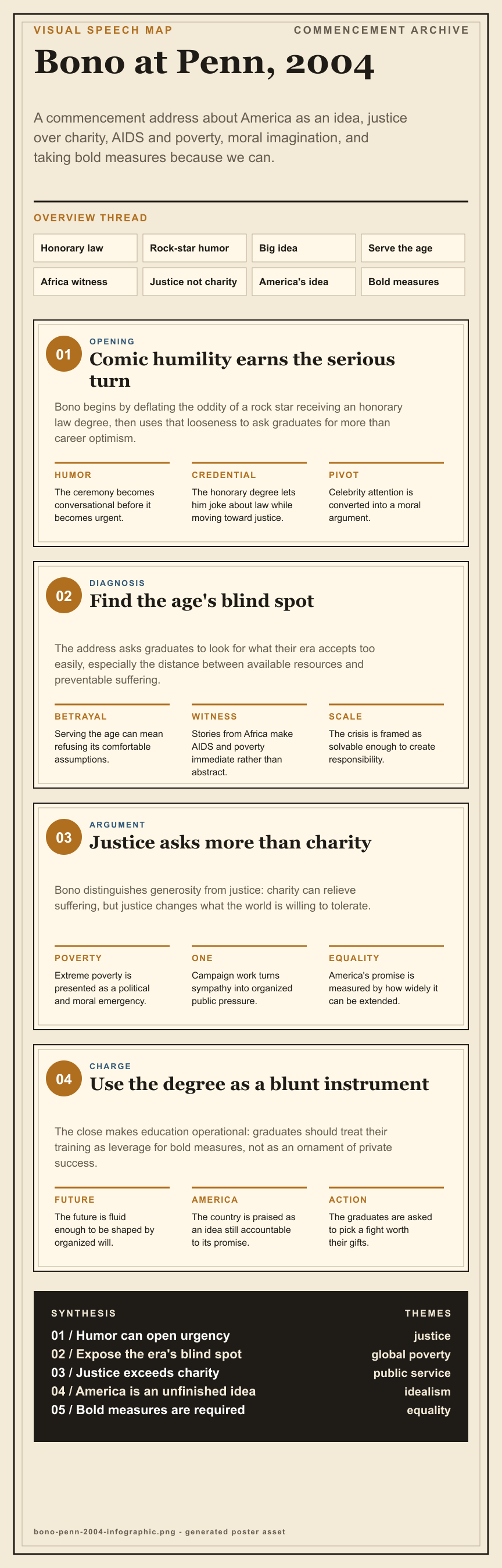 Bono University of Pennsylvania Bono opens with self-deprecating humor about being a rock star receiving an honorary law degree before challenging graduates to identify and pursue a 'big idea' worth their moral and intellectual investment. Drawing on his experiences in Africa, he frames the AIDS crisis and extreme poverty as an emergency demanding justice rather than charity, arguing this generation has the resources to end it. He celebrates America as an idea built on equality and possibility, and urges graduates to take bold action and shape the future. InfographicSummaryTranscriptVideoOfficial source
  Bradley Whitford University of Wisconsin Actor Bradley Whitford, a Madison native, addresses graduates with humor about the awkwardness of commencement speeches before sharing six life principles drawn from his acting career, framed as 'Everything I Need to Know in Life I Learned on My Way to a Humiliating Audition.' He urges graduates to fall in love with their work, prepare diligently yet stay open to surprise, listen, and take action rather than remaining passive. He closes with a call to civic participation, democracy, and gratitude for the generations whose efforts made the graduates' achievements possible. InfographicSummaryTranscriptOfficial source
 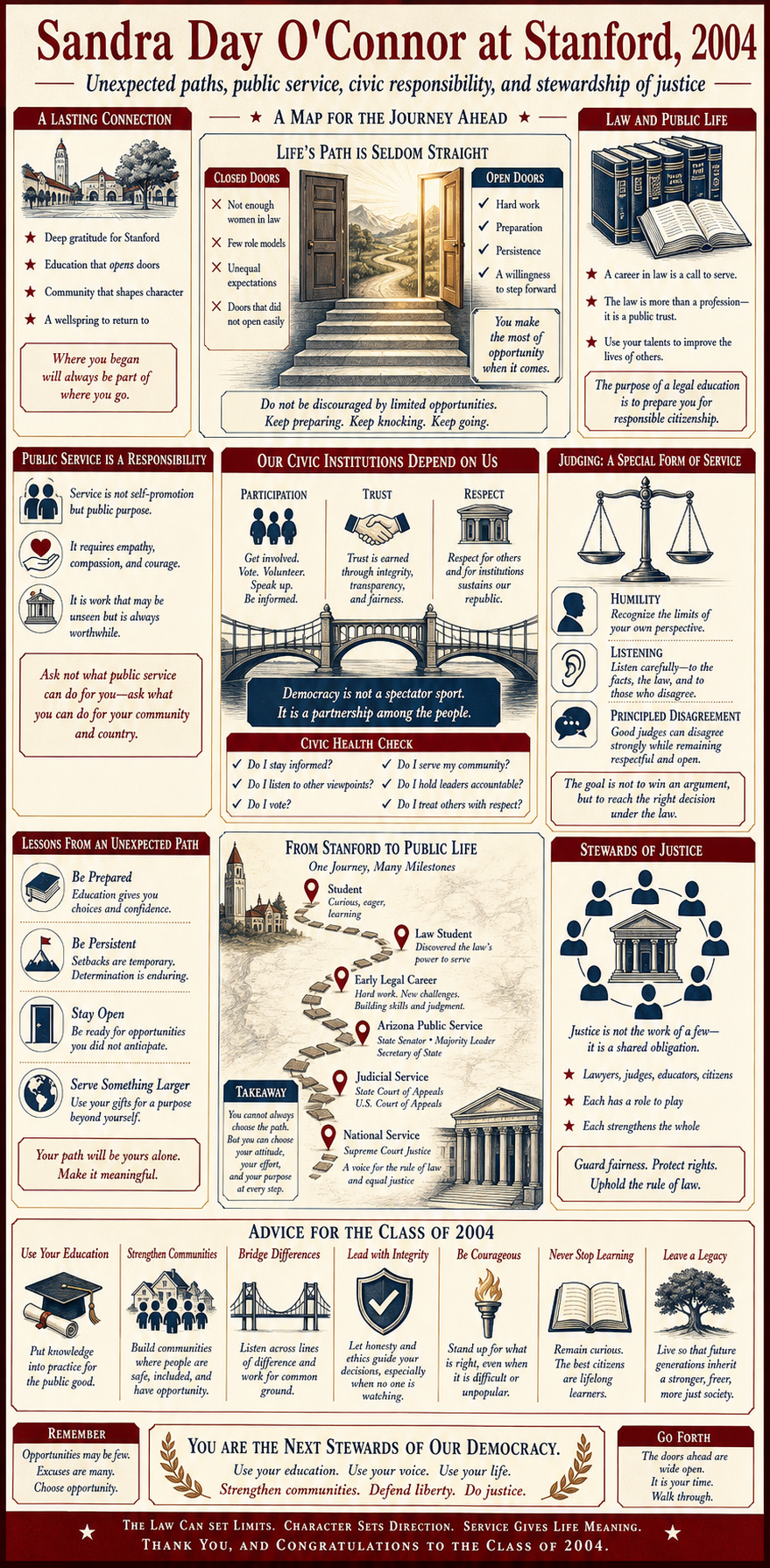 Sandra Day O’Connor Stanford University Justice Sandra Day O'Connor addresses Stanford's 2004 graduates, using the metaphor of bridge-building to urge them toward public service. She recounts her own path into public service after being denied private law firm jobs due to her gender, and honors bridge builders including Ronald Reagan, who appointed her as the first woman on the Supreme Court, and the young lawyers who advanced civil rights toward Brown v. Board of Education. She emphasizes that meaningful change requires patience, sacrifice, and small incremental efforts. InfographicSummaryTranscriptOfficial source
 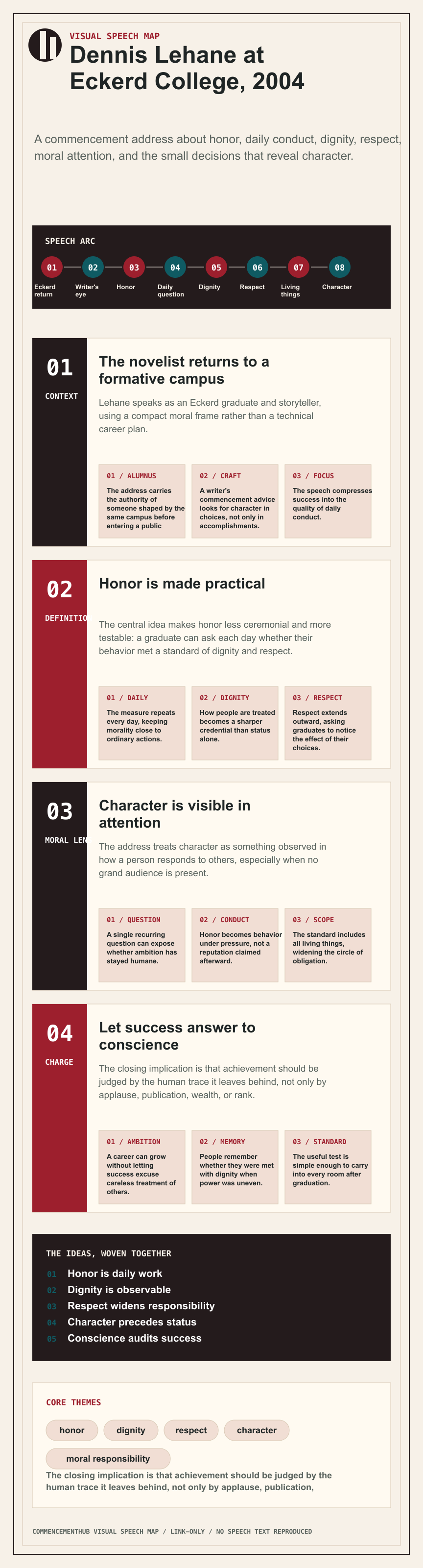 Dennis Lehane Eckerd College Dennis Lehane, a college dropout who returned to receive an honorary degree, reflects on his own unconventional path and rejects clichéd graduation advice. He argues that honor is a daily practice of treating all living things with dignity, and distinguishes empathy from sympathy, crediting his working-class parents and public education for his success. He criticizes those who dismiss mercy and the helping hand as weakness, and urges graduates to carry compassion and empathy into the world. InfographicSummaryVideoOfficial source
 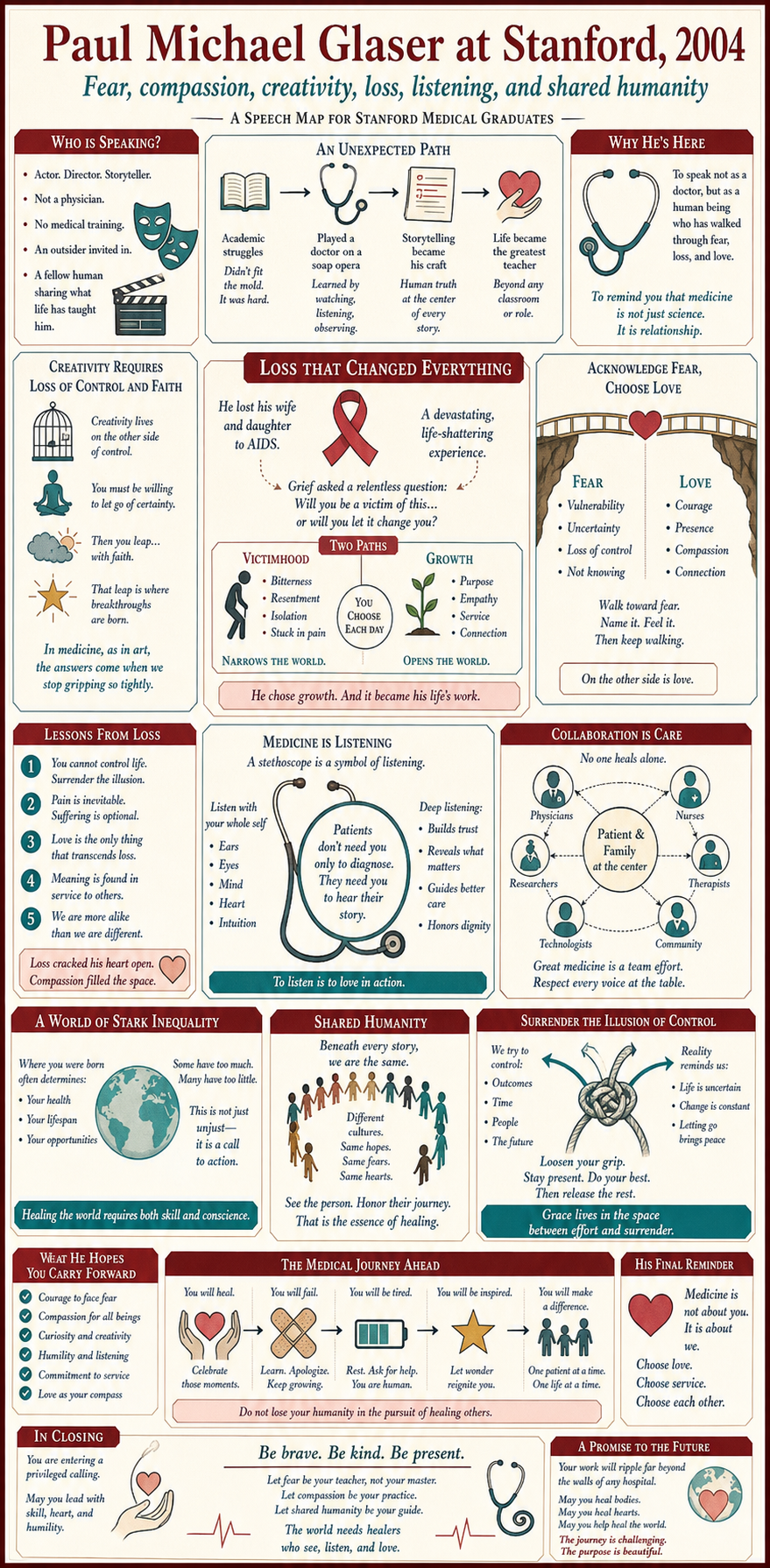 Paul Glaser Stanford University Paul Michael Glaser, honorary chair of the Elizabeth Glaser Pediatric AIDS Foundation, addresses Stanford medical graduates by reflecting on his own lack of medical training, his career in acting and directing, and his experience losing his wife and daughter to AIDS. He argues that acknowledging fear and vulnerability is the path to compassion, creativity, and connection, urging the graduates to surrender the illusion of control. He frames good medicine and research as acts of listening, collaboration, and recognizing common humanity, while critiquing global inequality and what he sees as fear-driven control in society and politics. InfographicSummaryTranscript
 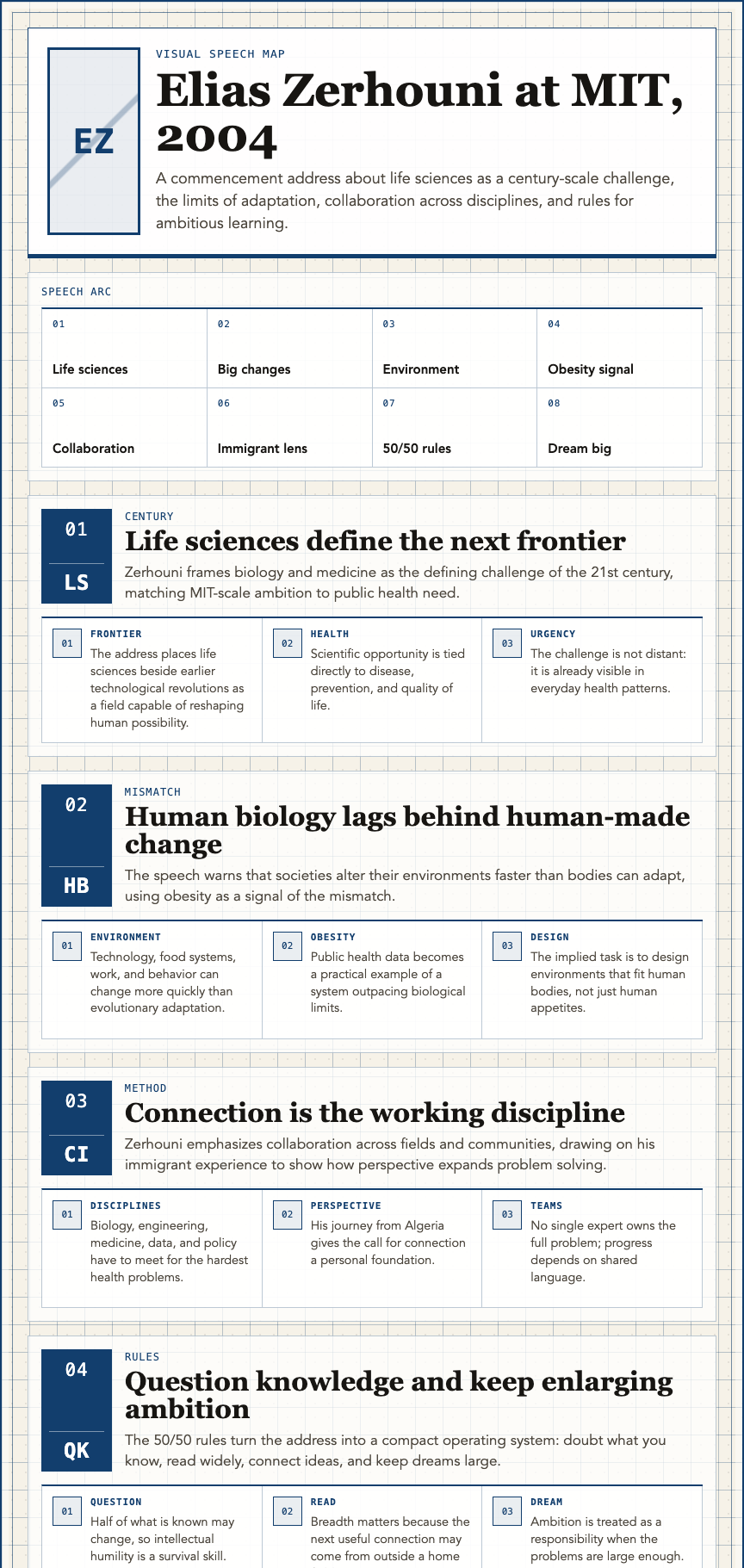 Elias Zerhouni Massachusetts Institute of Technology NIH director Elias Zerhouni told MIT's Class of 2004 that the life sciences will be the defining challenge of the 21st century, arguing that humanity changes its environment faster than it can biologically adapt, as illustrated by rising obesity. He emphasized the importance of collaboration and connection across disciplines, drawing on his own immigrant experience, and offered his '50/50 Rules of Life' about questioning knowledge, reading broadly, and dreaming big. InfographicSummaryOfficial source
 Represented themes
Common ideas classified across this year's speeches.
All 2004 addresses
Complete archive records for this year, sorted by institution.
№ 2004.001 № 2004.002 № 2004.003 № 2004.004 № 2004.005 № 2004.006 № 2004.007 № 2004.008 № 2004.009 № 2004.011 № 2004.010 № 2004.012 № 2004.013 № 2004.014 № 2004.015 № 2004.016 № 2004.017 № 2004.018
Sean Lebowitz
Binghamton University
Richard Russo
Colby College
Jon Stewart
College of William and Mary
Anita L. DeFrantz
Connecticut College
Martin Marty
Eastern Mennonite University
Dennis Lehane
Eckerd College
Ali G
Harvard University
Seth MacFarlane
Harvard University
Elias Zerhouni
Massachusetts Institute of Technology
Sandra Day O’Connor
Stanford University
Paul Glaser
Stanford University
Ruth Westheimer
Trinity College
Earl Bakken
University of Hawaii
Bono
University of Pennsylvania
Bradley Whitford
University of Wisconsin
Toni Morrison
Wellesley College
Njabulo S. Ndebele
Wesleyan University
Ken Burns
Yale University