Toni Morrison
Field: letters
Toni Morrison reflects on her ambivalence about giving the address, working through conventional graduation topics—the future, past, present responsibility, and happiness—and finding each inadequate or troubling. She critiques commercial and cultural forces that keep people in perpetual adolescence and voices concern about political, corporate, and military interests threatening civil liberties. She ultimately reframes her critiques as commentary on her own generation, and urges graduates to reject imposed categories and to author their own lives as their own stories.
Key moments
- 01 Admits ambivalence about accepting the invitation and rejects clichés about the future being theirs to make
- 02 Warns against threats to civil liberties from combined political, corporate, and military interests
- 03 Critiques commercialism that keeps adults in eternal juvenilia and questions equating this with the best years of life
- 04 Reveals her critiques target her own generation and urges graduates to author their own stories and reject media labels
Save the visual map
Download or open the generated poster as a standalone PNG.
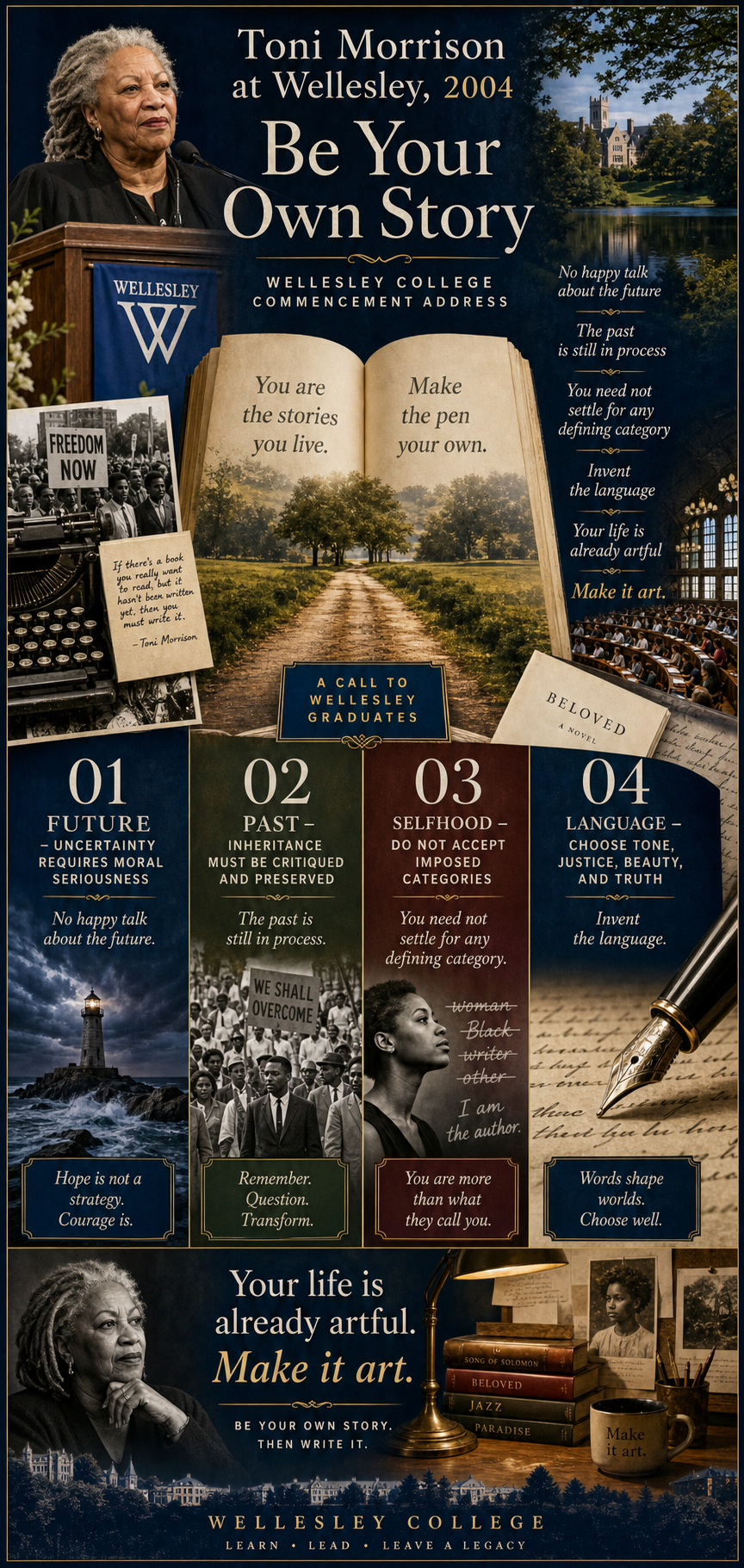
Toni Morrison at Wellesley, 2004
A Wellesley College address about uncertain futures, inherited pasts, refusing imposed categories, inventing language, and becoming the author of an artful life.
Speech arc
- 01Wellesley College
Opening move
- 02Class of 2004
Speech beat
- 03No easy future
Speech beat
- 04The past is unfinished
Speech beat
- 05Reject categories
Speech beat
- 06Choose the tone
Speech beat
- 07Invent language
Speech beat
- 08Make life art
Final charge
Future: Graduation does not guarantee a simple future
Morrison refuses a cheerful formula, telling graduates that the future is morally serious, politically unstable, and not automatically redeemed by optimism.
Refusal
The address starts by rejecting empty happy talk about what lies ahead.
Reality
Graduates enter a world shaped by violence, power, fear, and competing narratives.
Task
Seriousness becomes a form of respect for their agency and intelligence.
Morrison refuses a cheerful formula, telling graduates that the future is morally serious, politically unstable, and not automatically redeemed by optimism.
Past: The past is still being made useful or dangerous
The speech treats history as active material: something inherited, interpreted, revised, and either weaponized or transformed by the living.
Inheritance
The past is not inert; it continues to press on identity, institutions, and public imagination.
Judgment
Graduates must decide what to carry, what to expose, and what to resist.
Continuity
The address links individual life stories to older civic and cultural struggles.
The speech treats history as active material: something inherited, interpreted, revised, and either weaponized or transformed by the living.
Selfhood: Do not accept the categories handed to you
Morrison urges graduates not to settle for definitions imposed by others, whether those definitions are flattering, diminishing, convenient, or false.
Categories
External labels can narrow the plot before a life has had room to unfold.
Agency
Being your own story means choosing tone even when the plot is disrupted.
Justice
Respect for others begins with paying close attention to the characters who enter the story.
Morrison urges graduates not to settle for definitions imposed by others, whether those definitions are flattering, diminishing, convenient, or false.
• Key takeaways •
Reject empty optimism
Connects to storytelling.
Treat history as active
Connects to language.
Refuse imposed categories
Connects to identity.
Choose the tone of your story
Connects to history.
Make life art through language
Connects to agency.
Closing charge
As a storyteller, Morrison makes language the core tool of freedom: the means by which graduates can name themselves, seek truth, and make life artful.
Invent the language for what you mean
Voice
The charge is not only to speak, but to invent language adequate to identity and meaning.
Beauty
Morrison ties truth, ethical attention, and beauty together rather than treating them as separate virtues.
Art
The closing vision sees each life as already artful and waiting to be made art.
As a storyteller, Morrison makes language the core tool of freedom: the means by which graduates can name themselves, seek truth, and make life artful.
Visual speech maps
Browse more visual maps from Wellesley College or continue with related mapped speeches below.
Transcript
The previously catalogued transcript link is no longer live and is queued for re-sourcing. A video of the address is available above.
Machine transcript available for archive analysis; it is unverified and may contain transcription errors. Machine transcript source ->
Provenance
BROKEN transcript link (checked 2026-06-26): humanity.org removed its /voices/commencements section. Provenance: Imported from NPR commencement archive; cross-referenced with Open Commencement DB
NPR archive last updated in 2015; destination availability has not been exhaustively rechecked | Open Commencement DB transcript; not independently verified against the original recording | Transcript URL dead (humanity.org removed its /voices/commencements section); video fallback present
Explore this speech
Find the next thread through the archive
Themes in this address
Speeches like this one
Search all speeches ->