Commencement Archive

Meryl Streep

Field: arts

Video Transcript

Meryl Streep addresses Barnard's class of 2010, using her acting career to reflect on pretending, empathy, and authenticity. She recounts how she once adjusted her personality in high school to appeal to boys before rediscovering herself at women's college, and argues that empathy lies at the heart of acting and of social change. She observes that men are increasingly able to identify with strong female characters, sees this as cultural progress, and urges the graduates to address gender inequality and other global issues, concluding that fame matters less than making one's family proud.

Key moments

  • 01 Childhood and high school memories of first acting and 'pretending' to be appealing
  • 02 Rediscovering her real self at a single-sex college among supportive friends
  • 03 Contrast between male audiences relating to Linda in 'The Deer Hunter' versus Miranda Priestly
  • 04 Argument that empathy drives both acting and broader cultural and gender change
  • 05 Reflection that fame separates you from reality while purpose comes from empathy and loved ones
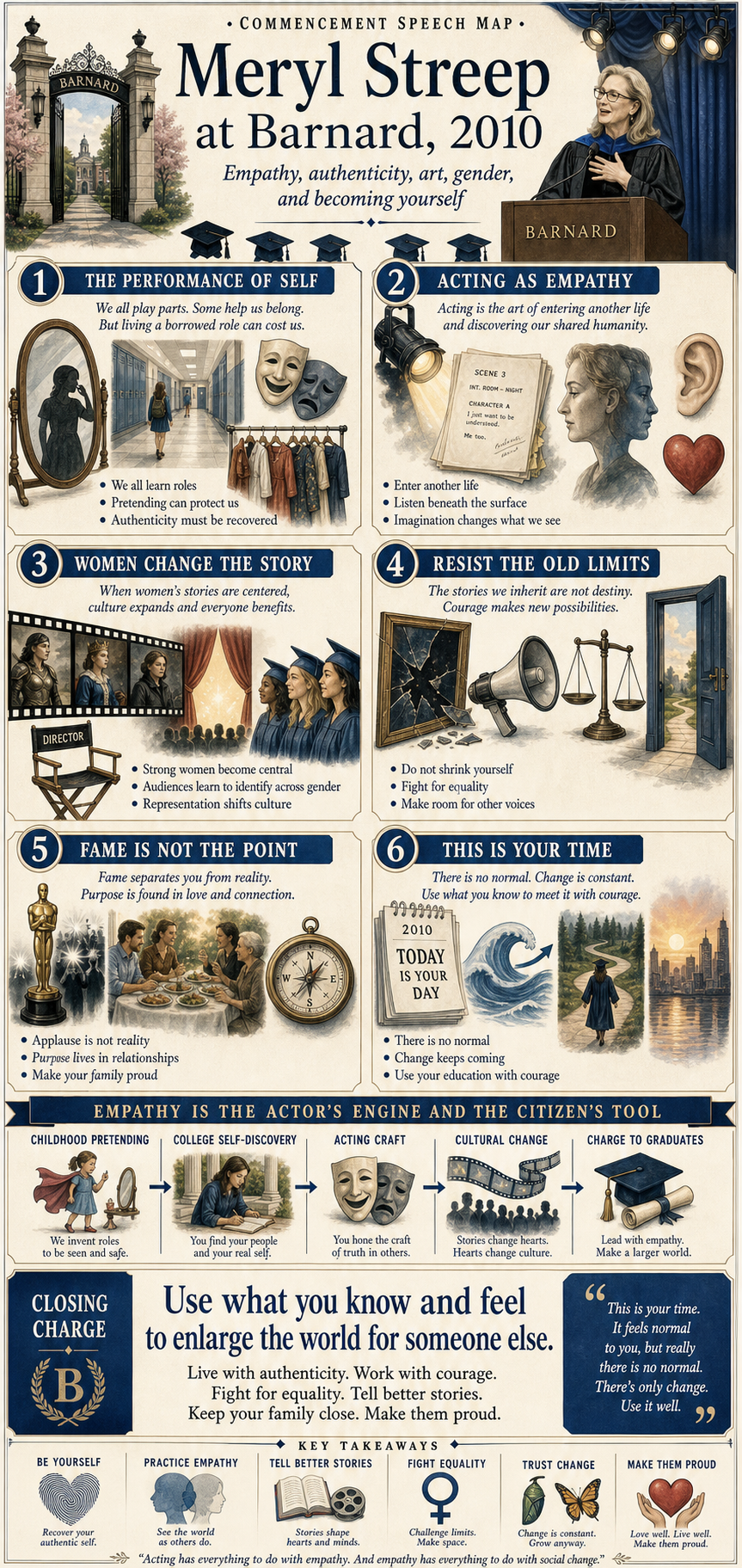
Save the visual map

Download or open the generated poster as a standalone PNG.

Meryl Streep at Barnard, 2010. A Barnard address about empathy, authenticity, performance, gender, fame, and using education to enlarge another person's world.
Generated poster PNG

Meryl Streep at Barnard, 2010

A Barnard address about empathy, authenticity, performance, gender, fame, and using education to enlarge another person's world.

Speech arc

  1. 01Barnard College

    Opening move

  2. 02Full-text source

    Speech beat

  3. 03Performance of self

    Speech beat

  4. 04Acting and empathy

    Speech beat

  5. 05Women's stories

    Speech beat

  6. 06Equality

    Speech beat

  7. 07Fame and reality

    Speech beat

  8. 08Becoming yourself

    Final charge

01

Self: Performance can reveal what authenticity costs

Streep uses the language of acting and self-presentation to explore how people learn roles, when those roles protect them, and when they need to recover a truer self.

Roles

The address treats identity as something shaped by expectation, imitation, and social pressure.

Recovery

The women's college setting becomes a place where graduates can see and claim themselves more clearly.

Craft

Acting becomes a way to understand human behavior rather than a narrow career anecdote.

Streep uses the language of acting and self-presentation to explore how people learn roles, when those roles protect them, and when they need to recover a truer self.

02

Empathy: Acting is practice in entering another life

The speech links acting to empathy: the actor's job is to listen, imagine, and inhabit other lives, which becomes a broader civic and relational skill.

Listening

Empathy begins with attention to what another person feels and fears beneath the surface.

Imagination

Streep frames imagination as the engine that lets people cross distance without erasing difference.

Connection

The craft of performance becomes a model for recognizing shared humanity.

The speech links acting to empathy: the actor's job is to listen, imagine, and inhabit other lives, which becomes a broader civic and relational skill.

03

Culture: Women's stories change who audiences can identify with

Streep argues that representation matters because strong female characters and women's perspectives expand cultural imagination and shift what audiences accept as central.

Center

Women's stories are not side stories; centering them changes the scale of identification.

Audience

The speech notes cultural progress when viewers learn to identify across gender.

Equality

Graduates are urged not to shrink themselves and to make room for other voices.

Streep argues that representation matters because strong female characters and women's perspectives expand cultural imagination and shift what audiences accept as central.

• Key takeaways •

Recover the self beneath performance

Connects to empathy.

Empathy is disciplined imagination

Connects to authenticity.

Representation reshapes culture

Connects to gender equality.

Equality requires making room

Connects to acting.

Purpose lives beyond applause

Connects to purpose.

Closing charge

The closing movement separates applause from meaning, returning purpose to relationships, courage, family pride, and the graduate's ability to enlarge the world for someone else.

Fame is not the same as reality or purpose

Reality

Public acclaim is treated as unstable and insufficient as a source of identity.

Change

The address prepares graduates for a world where change is constant rather than exceptional.

Charge

The final advice turns empathy into action: live authentically and help widen possibility for others.

The closing movement separates applause from meaning, returning purpose to relationships, courage, family pride, and the graduate's ability to enlarge the world for someone else.

Fame is not the same as reality or purpose

empathyauthenticitygender equalityactingpurpose

A Barnard address about empathy, authenticity, performance, gender, fame, and using education to enlarge another person's world.

Transcript

The full transcript is hosted by the original publisher. Commencement Archive links to the source rather than republishing copyrighted text.

Read the full transcript at source →

Provenance

Imported from NPR commencement archive; cross-referenced with Open Commencement DB

NPR archive last updated in 2015; destination availability has not been exhaustively rechecked | Open Commencement DB transcript; not independently verified against the original recording

Explore this speech

Find the next thread through the archive

Browse all themes ->

Speeches like this one

Search all speeches ->