Sandra Day O’Connor
U.S. Supreme Court justice
Justice Sandra Day O'Connor addresses Stanford's 2004 graduates, using the metaphor of bridge-building to urge them toward public service. She recounts her own path into public service after being denied private law firm jobs due to her gender, and honors bridge builders including Ronald Reagan, who appointed her as the first woman on the Supreme Court, and the young lawyers who advanced civil rights toward Brown v. Board of Education. She emphasizes that meaningful change requires patience, sacrifice, and small incremental efforts.
“Today I'd like to encourage you to do so.”
Key moments
- 01 Introduces the 'bridge builder' metaphor via a 19th-century poem
- 02 Honors Ronald Reagan as a public servant who built a bridge to equality
- 03 Recounts her own career beginning in public service after gender barriers
- 04 Traces the incremental legal path to Brown v. Board of Education
Save the visual map
Download or open the generated poster as a standalone PNG.
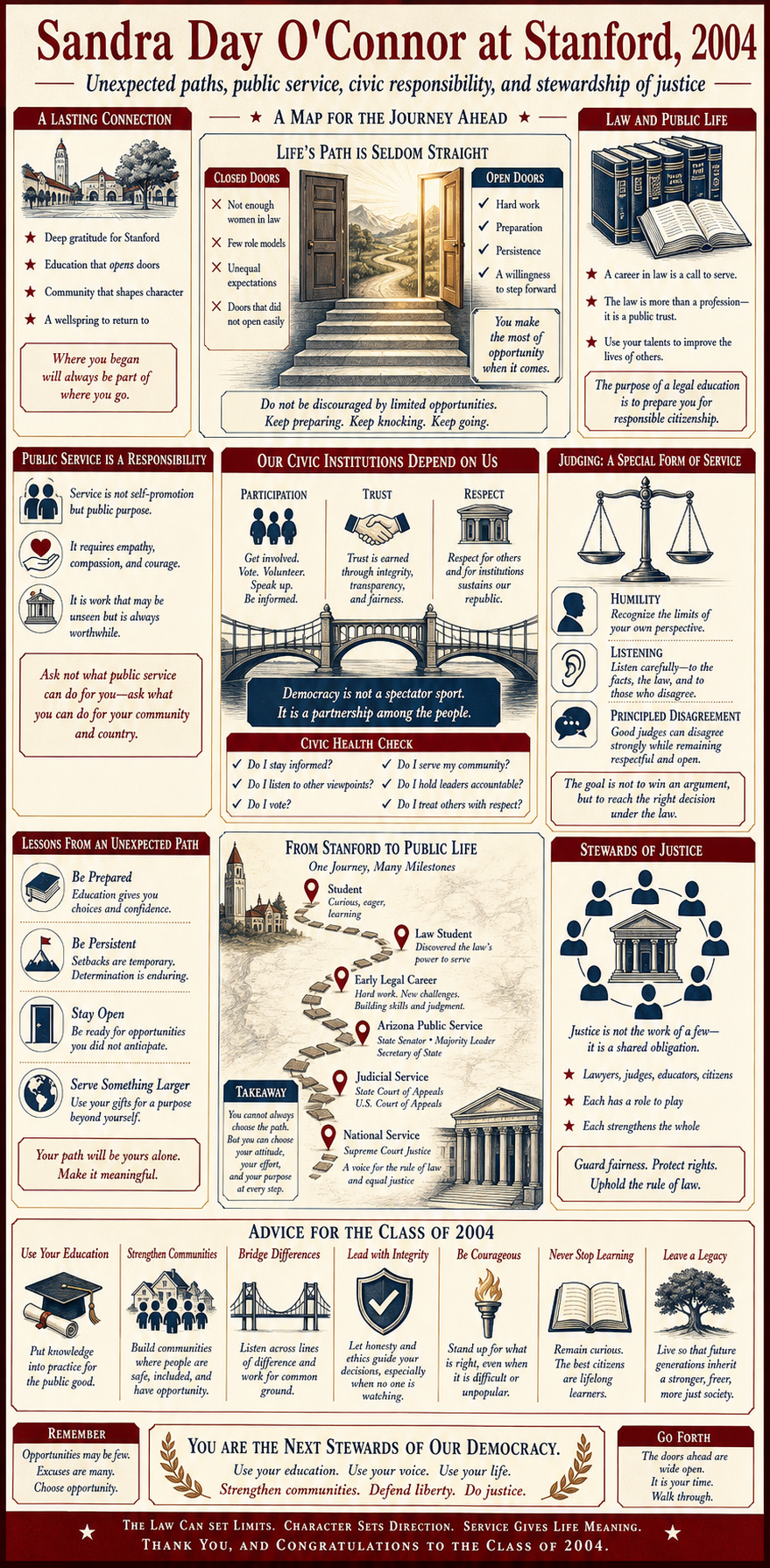
Sandra Day OConnor at Stanford, 2004
A commencement address about unexpected paths, public service, civic responsibility, and stewardship of justice.
Speech arc
- 01Stanford path
Opening move
- 02Closed doors
Speech beat
- 03Persistence
Speech beat
- 04Law
Speech beat
- 05Listening
Speech beat
- 06Public service
Speech beat
- 07Civic trust
Speech beat
- 08Justice stewardship
Final charge
Path: Unexpected doors
OConnor frames professional life as a path of persistence through doors that may not open easily.
Barriers
Limited opportunities test resolve.
Persistence
Closed doors can redirect without ending the journey.
Preparation
Education becomes portable strength.
OConnor frames professional life as a path of persistence through doors that may not open easily.
Law: Institutions need people
Law and civic institutions are presented as human structures that require trust, service, and participation.
Institutions
Justice is maintained by people, not abstractions.
Trust
Public life depends on confidence in fair process.
Service
Legal skill carries civic responsibility.
Law and civic institutions are presented as human structures that require trust, service, and participation.
Judgment: Listen before deciding
Judging becomes a discipline of humility, attention, and principled disagreement.
Humility
Authority requires restraint.
Listening
Understanding comes before judgment.
Disagreement
Democracy needs principled conflict.
Judging becomes a discipline of humility, attention, and principled disagreement.
• Key takeaways •
Persist through closed doors
Connects to law.
Institutions need trust
Connects to public service.
Judgment requires humility
Connects to justice.
Service strengthens democracy
Connects to civic responsibility.
Justice is stewardship
Connects to persistence.
Closing charge
Graduates are urged to use education to build communities, protect institutions, and practice responsible citizenship.
Strengthen the common life
Community
Professional achievement should serve public life.
Democracy
Institutions need renewing participation.
Stewardship
Justice is inherited work.
Graduates are urged to use education to build communities, protect institutions, and practice responsible citizenship.
Visual speech maps
Browse more visual maps from Stanford University or continue with related mapped speeches below.
Transcript
The full transcript is hosted by the original publisher. Commencement Archive links to the source rather than republishing copyrighted text.
Read the full transcript at source →Provenance
Verified from official archive; targeted event-level link verified
Explore this speech
Find the next thread through the archive
Themes in this address
Speeches like this one
Search all speeches ->