Steve Jobs
CEO, Apple and Pixar
In coverage of his 2005 Stanford Commencement address, Steve Jobs is described telling three stories from his life to urge graduates to pursue their dreams and find meaning in setbacks. He recounts dropping out of Reed College and later applying lessons from a calligraphy course, being fired from Apple and the creative period that followed, and his recent cancer diagnosis and what it taught him about mortality. He encourages graduates to trust that life's experiences will connect, to do work they love, and not to waste time living someone else's life.
“Stay hungry. Stay foolish.”
Key moments
- 01 Dropping out of college and the calligraphy course later inspiring Macintosh fonts
- 02 Being fired from Apple as the best thing that happened to him
- 03 Founding NeXT and returning to Apple after its acquisition
- 04 Cancer diagnosis and reflections on mortality and limited time
Save the visual map
Download or open the generated poster as a standalone PNG.
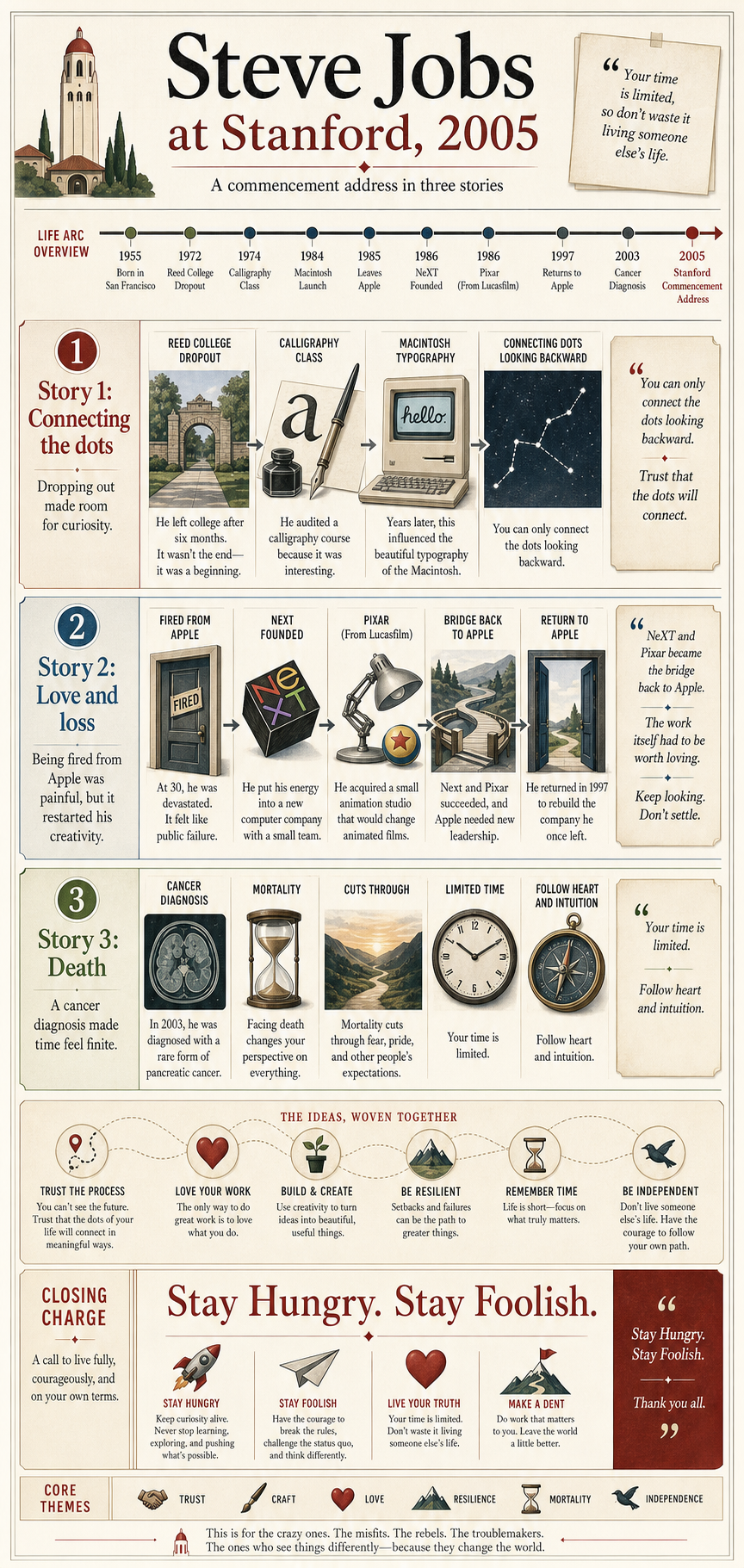
Steve Jobs at Stanford, 2005
A commencement address in three stories: craft, loss, mortality, and the courage to choose your own path.
Speech arc
- 1955Born
San Francisco
- 1972Reed College
Drops out
- 1974Calligraphy
Learns letterforms
- 1984Macintosh
Type becomes product
- 1985Leaves Apple
Public failure
- 1986NeXT + Pixar
Rebuilds creatively
- 1997Returns
Back to Apple
- 2003Diagnosis
Mortality sharpens focus
Story 1: Connecting the dots
Dropping out made room for curiosity.
The expected path breaks
Reed College dropout
He leaves college after six months. It is not an ending; it is a beginning.
Curiosity becomes craft
Calligraphy class
He follows beautiful typography because it feels interesting, not practical.
Craft becomes product
Macintosh typography
Years later, those letterforms help make the Macintosh feel human.
Meaning arrives later
Looking backward
The dots only connect after experience has had time to reveal its pattern.
You can only connect the dots looking backward.
Trust that the dots will connect.
Story 2: Love and loss
Being fired from Apple restarted his creativity.
Status disappears
Fired from Apple
At 30, he is publicly removed from the company he helped build.
A smaller beginning
NeXT founded
He pours energy into a new computer company and a smaller team.
A new medium opens
Pixar
A small animation studio becomes a force that changes animated film.
Loss becomes route
Bridge back
NeXT and Pixar succeed, and Apple needs the leadership he developed outside it.
The work continues
Return to Apple
He returns in 1997 to rebuild the company he once left.
NeXT and Pixar became the bridge back to Apple.
The work itself had to be worth loving.
Story 3: Death
A cancer diagnosis made time feel finite.
A direct encounter
Cancer diagnosis
In 2003, doctors diagnose a rare form of pancreatic cancer.
Everything changes scale
Mortality
Facing death changes his perspective on fear, pride, and embarrassment.
Noise falls away
Cuts through
Mortality strips away expectations and clarifies what matters.
The clock is real
Limited time
Time becomes the central constraint and the central gift.
The inner compass
Heart and intuition
Graduates are urged to follow the signals that already know the path.
Your time is limited.
Follow heart and intuition.
• Key takeaways •
Trust the process
You cannot see the future; trust that your life will connect in meaningful ways.
Love your work
The only way to do great work is to love what you do.
Build and create
Curiosity turns into beautiful, useful things.
Be resilient
Setbacks and failures can become the path to greater things.
Remember time
Life is short. Focus on what truly matters.
Be independent
Do not live someone else's life. Have the courage to follow your own path.
Closing charge
A call to live fully, courageously, and on your own terms.
Stay Hungry. Stay Foolish.
Stay hungry
Keep curiosity alive. Never stop learning, exploring, and pushing what is possible.
Stay foolish
Have the courage to break rules, challenge the status quo, and think differently.
Live your truth
Your time is limited. Do not waste it living someone else's life.
Make a dent
Do work that matters to you. Leave the world a little better.
Stay Hungry.
Stay Foolish.
Visual speech maps
Browse more visual maps from Stanford University or continue with related mapped speeches below.
Transcript
The full transcript is hosted by the original publisher. Commencement Archive links to the source rather than republishing copyrighted text.
Read the full transcript at source →Provenance
Verified from official archive; cross-referenced with NPR commencement archive; cross-referenced with Open Commencement DB
NPR archive last updated in 2015; destination availability has not been exhaustively rechecked | Open Commencement DB transcript; not independently verified against the original recording
Explore this speech
Find the next thread through the archive
Themes in this address
Speeches like this one
Search all speeches ->