Paul Glaser
Field: arts
Paul Michael Glaser, honorary chair of the Elizabeth Glaser Pediatric AIDS Foundation, addresses Stanford medical graduates by reflecting on his own lack of medical training, his career in acting and directing, and his experience losing his wife and daughter to AIDS. He argues that acknowledging fear and vulnerability is the path to compassion, creativity, and connection, urging the graduates to surrender the illusion of control. He frames good medicine and research as acts of listening, collaboration, and recognizing common humanity, while critiquing global inequality and what he sees as fear-driven control in society and politics.
“Our ability to love is our truest power”
Key moments
- 01 Recalls his own academic struggles and playing a doctor on a soap opera
- 02 Describes creativity as requiring a loss of control and faith
- 03 Reflects on losing his wife and daughter to AIDS and the choice between victimhood and growth
- 04 Argues that experiencing fear is necessary to find love and compassion
- 05 Calls on doctors and researchers to listen, collaborate, and recognize shared humanity
Save the visual map
Download or open the generated poster as a standalone PNG.
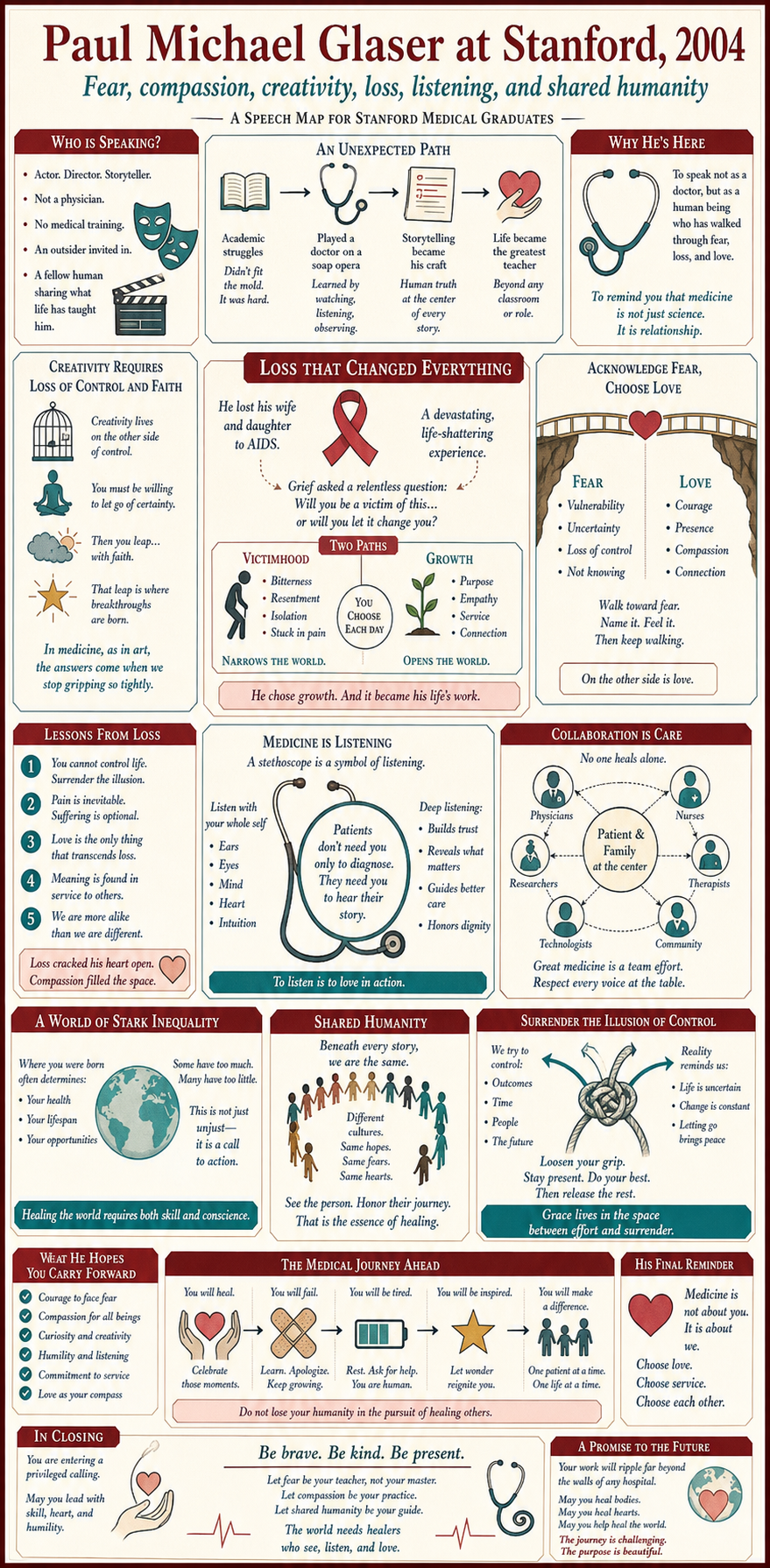
Paul Michael Glaser at Stanford, 2004
A medical commencement address about fear, vulnerability, compassion, creativity, listening, and shared humanity.
Speech arc
- 01Medical graduates
Opening move
- 02Actor as outsider
Speech beat
- 03Soap-opera doctor
Speech beat
- 04Creativity
Speech beat
- 05Loss to AIDS
Speech beat
- 06Fear and love
Speech beat
- 07Listening
Speech beat
- 08Shared humanity
Final charge
Outsider: A non-doctor addresses doctors
Glaser uses his outsider status, acting life, and academic struggles to speak honestly about medicine and humanity.
Humility
Not being a doctor becomes an opening.
Performance
Playing a doctor becomes a lens on real care.
Vulnerability
Authority begins by admitting limits.
Glaser uses his outsider status, acting life, and academic struggles to speak honestly about medicine and humanity.
Creativity: Surrender control
Creativity is described as requiring faith, loss of control, and willingness to enter the unknown.
Control
The illusion of mastery blocks connection.
Faith
Creative work requires surrender.
Medicine
Research and healing also need openness.
Creativity is described as requiring faith, loss of control, and willingness to enter the unknown.
Loss: Fear can become compassion
The deaths of his wife and daughter from AIDS frame the choice between victimhood and growth.
Grief
Loss becomes a severe teacher.
Fear
Acknowledging fear opens the path to love.
Compassion
Pain can widen connection rather than close it.
The deaths of his wife and daughter from AIDS frame the choice between victimhood and growth.
• Key takeaways •
Vulnerability opens compassion
Connects to fear.
Control is an illusion
Connects to compassion.
Loss can teach connection
Connects to medicine.
Medicine begins with listening
Connects to creativity.
Shared humanity is clinical wisdom
Connects to human connection.
Closing charge
Good medicine and research are framed as listening, collaboration, and recognition of common humanity amid global inequality.
Listen and collaborate
Listening
Patients and colleagues must be truly heard.
Collaboration
Healing is shared work.
Humanity
The doctor's task includes seeing the whole person.
Good medicine and research are framed as listening, collaboration, and recognition of common humanity amid global inequality.
Visual speech maps
Browse more visual maps from Stanford University or continue with related mapped speeches below.
Transcript
The full transcript is hosted by the original publisher. Commencement Archive links to the source rather than republishing copyrighted text.
Read the full transcript at source →Provenance
Imported from NPR commencement archive; cross-referenced with Open Commencement DB
NPR archive last updated in 2015; destination availability has not been exhaustively rechecked | Open Commencement DB transcript; not independently verified against the original recording
Explore this speech
Find the next thread through the archive
Themes in this address
Speeches like this one
Search all speeches ->