Alejandro Toledo
President of Peru
Peruvian President Alejandro Toledo recounts his personal journey from extreme poverty in the Andes—shining shoes and selling newspapers as a child—to studying in the U.S. and earning graduate degrees at Stanford. He credits education and Stanford's emphasis on independent thinking for enabling his rise to Peru's presidency, and describes the challenges of leading a developing nation, including a recent hostage crisis and teachers' strike. He argues that poverty must be eradicated in a lasting, dignified way and urges graduates to join the collective fight against poverty.
“Together, we can do it.”
Key moments
- 01 Recounting childhood poverty and work as a shoeshine boy in Chimbote
- 02 Meeting Peace Corps volunteers that led to studying in the U.S.
- 03 Learning independent thinking from Stanford professors
- 04 Describing the difficulties of governing Peru, including a hostage rescue
- 05 Calling for lasting eradication of poverty through investment in education and health
Save the visual map
Download or open the generated poster as a standalone PNG.
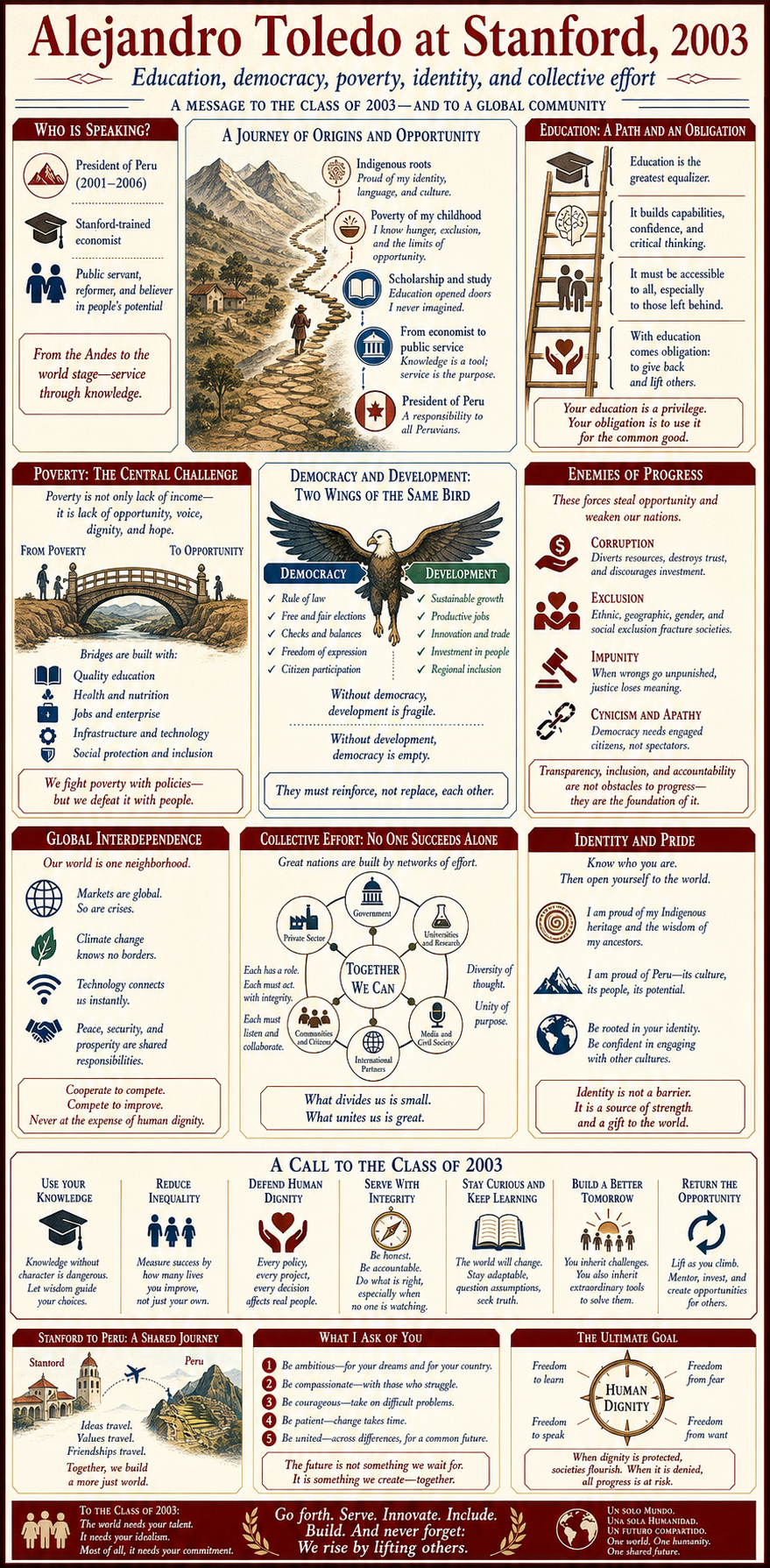
Alejandro Toledo at Stanford, 2003
A commencement address about education, democracy, poverty, identity, dignity, and collective effort.
Speech arc
- 01Peru and Stanford
Opening move
- 02Poverty
Speech beat
- 03Indigenous roots
Speech beat
- 04Education
Speech beat
- 05Democracy
Speech beat
- 06Development
Speech beat
- 07Collective effort
Speech beat
- 08Human dignity
Final charge
Origin: Education changes the path
Toledo connects his own rise from poverty and Indigenous roots to education as both path and obligation.
Identity
Personal history grounds the political message.
Education
Learning becomes a bridge out of exclusion.
Obligation
Opportunity must return to the world.
Toledo connects his own rise from poverty and Indigenous roots to education as both path and obligation.
Challenge: Fight poverty collectively
Poverty is framed as a collective problem requiring shared effort across institutions, nations, and professions.
Poverty
Inequality limits dignity and freedom.
Collective
No single actor can solve structural need.
Knowledge
Graduates have tools that should reduce suffering.
Poverty is framed as a collective problem requiring shared effort across institutions, nations, and professions.
Democracy: Development needs inclusion
Democracy and development are linked: corruption and exclusion undermine both prosperity and legitimacy.
Democracy
Voice and accountability matter to growth.
Corruption
Broken institutions steal public possibility.
Inclusion
Progress must reach those historically excluded.
Democracy and development are linked: corruption and exclusion undermine both prosperity and legitimacy.
• Key takeaways •
Education creates obligation
Connects to poverty.
Poverty needs collective effort
Connects to education.
Democracy and development reinforce each other
Connects to democracy.
Inclusion protects dignity
Connects to development.
Knowledge should reduce inequality
Connects to dignity.
Closing charge
Global interdependence turns education into a responsibility to protect dignity beyond one community or nation.
Lead across borders
Interdependence
National futures are linked.
Dignity
Development is finally about human worth.
Action
Use knowledge for equality.
Global interdependence turns education into a responsibility to protect dignity beyond one community or nation.
Visual speech maps
Browse more visual maps from Stanford University or continue with related mapped speeches below.
Transcript
The full transcript is hosted by the original publisher. Commencement Archive links to the source rather than republishing copyrighted text.
Read the full transcript at source →Provenance
Verified from official archive; targeted event-level link verified
Explore this speech
Find the next thread through the archive
Themes in this address
Speeches like this one
Search all speeches ->