Tom Brokaw
Journalist and author
Tom Brokaw addresses Stanford's Class of 2006, opening with humor about being a less-than-unanimous speaker choice before turning to serious reflection on the responsibilities facing the graduates. He urges them to honor those serving in the military, engage in debates over national security, and recognize the limits of technology in solving real-world problems like poverty, war, and the rising hostility between the West and the Muslim world. Drawing on his decades of journalism, he celebrates ordinary people who act on conscience and invites graduates to carry on the legacy of the 'greatest generation' by living their convictions beyond the keyboard.
“You have so many choices and so many opportunities.”
Key moments
- 01 Self-deprecating opening about being a lukewarm choice as commencement speaker
- 02 Call to honor military service members and engage in national security debate
- 03 Warning that technology cannot solve war, poverty, or genocide
- 04 Reflection on the contradictions and tragedies of the 20th century
- 05 Tribute to conscience-driven people and the legacy of the 'greatest generation'
Save the visual map
Download or open the generated poster as a standalone PNG.
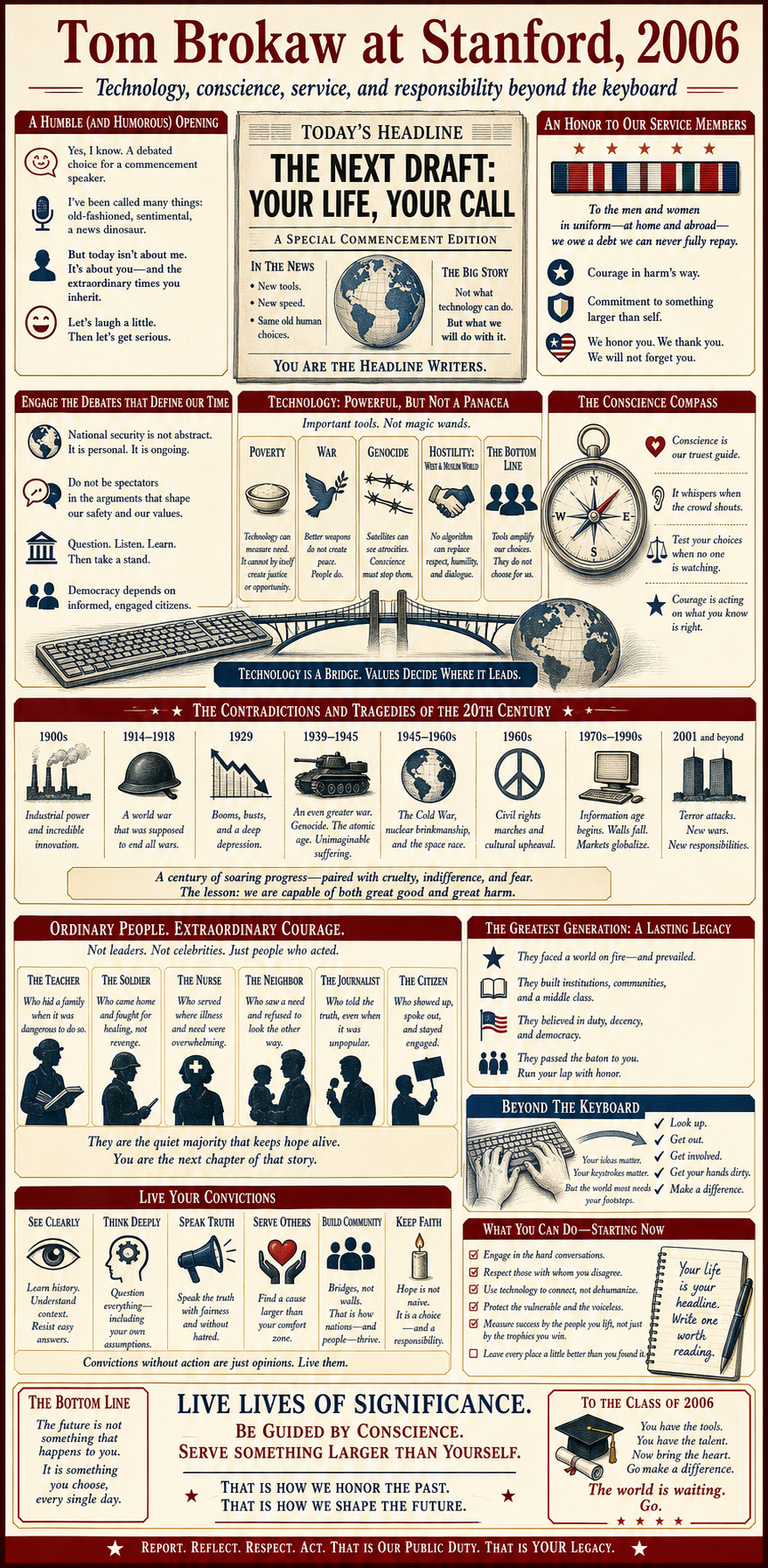
Tom Brokaw at Stanford, 2006
A commencement address about conscience, service, technology, patriotism, and responsibility beyond the keyboard.
Speech arc
- 01Humorous opening
Opening move
- 02Military service
Speech beat
- 03Security debate
Speech beat
- 04Tech limits
Speech beat
- 05War and poverty
Speech beat
- 0620th-century lessons
Speech beat
- 07Conscience
Speech beat
- 08Beyond keyboard
Final charge
Opening: Responsibility after applause
Brokaw moves from humor about his invitation to a serious charge about the world graduates inherit.
Humor
A self-deprecating opening lowers the temperature.
Turn
The speech quickly moves toward obligation.
Audience
Privilege is framed as preparation for duty.
Brokaw moves from humor about his invitation to a serious charge about the world graduates inherit.
Service: Honor those who serve
The speech asks graduates to respect military service and engage national security questions with seriousness.
Military
Service members become a test of civic attention.
Debate
Security questions require participation, not slogans.
Patriotism
Love of country means wrestling with hard choices.
The speech asks graduates to respect military service and engage national security questions with seriousness.
Limits: Technology is not enough
Brokaw warns that technology alone cannot solve poverty, war, genocide, or cultural hostility.
Keyboard
Digital fluency must reach beyond screens.
Problems
Human conflict resists purely technical answers.
Humility
Tools need conscience and judgment.
Brokaw warns that technology alone cannot solve poverty, war, genocide, or cultural hostility.
• Key takeaways •
Honor real service
Connects to conscience.
Technology needs conscience
Connects to technology.
Debate hard questions
Connects to service.
History demands memory
Connects to patriotism.
Live beyond the keyboard
Connects to global responsibility.
Closing charge
Ordinary conscience-driven people and the greatest-generation legacy become models for acting beyond comfort.
Live convictions
Conscience
Moral courage often looks ordinary.
History
The 20th century carries warning and example.
Charge
Live convictions in the world, not only online.
Ordinary conscience-driven people and the greatest-generation legacy become models for acting beyond comfort.
Visual speech maps
Browse more visual maps from Stanford University or continue with related mapped speeches below.
Transcript
The full transcript is hosted by the original publisher. Commencement Archive links to the source rather than republishing copyrighted text.
Read the full transcript at source →Provenance
Verified from official archive; targeted event-level link verified
Explore this speech
Find the next thread through the archive
Themes in this address
Speeches like this one
Search all speeches ->