Dana Gioia
Poet and chairman, National Endowment for the Arts
Dana Gioia argues that American culture increasingly ignores artists, intellectuals, and scientists in favor of celebrity and commercial entertainment, and that this shift impoverishes public life and offers fewer meaningful role models to the young. He contends that education, especially arts education in public schools, is the primary social force that can counterbalance the market's reduction of everything to price, and that its true purpose is to create complete human beings rather than merely more artists. He also faults artists and intellectuals for losing their ability to converse with the broader public, and cites studies linking arts participation and reading to greater civic engagement.
Key moments
- 01 Personal reflection on his working-class immigrant family and his father's hope he would attend Stanford
- 02 Comparison of past cultural figures Americans could name versus today's focus on sports and entertainment celebrities
- 03 Argument that the marketplace prices everything while culture must define value and the good life
- 04 Call to reframe arts education as producing complete citizens, and criticism of artists' estrangement from the public
Save the visual map
Download or open the generated poster as a standalone PNG.
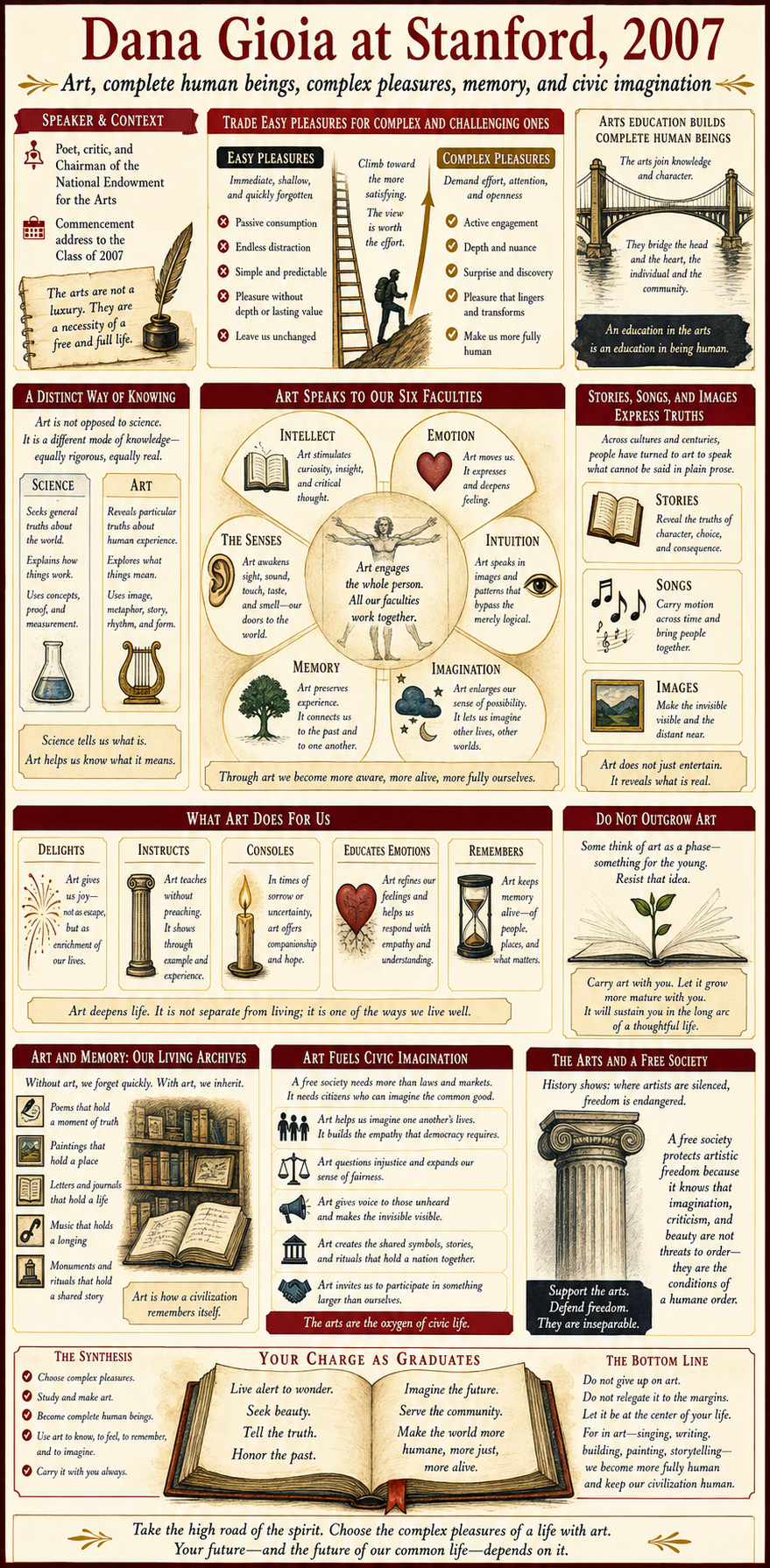
Dana Gioia at Stanford, 2007
A commencement address about art, complex pleasures, complete human beings, memory, and civic imagination.
Speech arc
- 01Arts matter
Opening move
- 02Complex pleasures
Speech beat
- 03Complete humans
Speech beat
- 04Art as knowing
Speech beat
- 05Emotion and intuition
Speech beat
- 06Memory
Speech beat
- 07Consolation
Speech beat
- 08Do not outgrow art
Final charge
Challenge: Choose complex pleasures
Gioia asks graduates not to settle for easy entertainment when deeper art can enlarge their lives.
Pleasure
Difficult works can produce richer rewards.
Attention
Art asks for patience and full presence.
Growth
Challenge becomes a form of human development.
Gioia asks graduates not to settle for easy entertainment when deeper art can enlarge their lives.
Education: Art makes complete people
The speech argues that arts education is not ornamental; it helps form complete human beings.
Whole person
Art educates more than the analytical mind.
Balance
Science and concepts need imagination beside them.
Formation
A full education trains perception and feeling.
The speech argues that arts education is not ornamental; it helps form complete human beings.
Knowing: Truth beyond concepts
Stories, songs, images, and performances express truths unavailable to abstraction alone.
Faculties
Art engages intellect, emotion, intuition, memory, senses, and imagination.
Expression
Art says what argument cannot always carry.
Memory
Culture stores what communities cannot afford to forget.
Stories, songs, images, and performances express truths unavailable to abstraction alone.
• Key takeaways •
Choose depth over ease
Connects to art.
Art forms the whole person
Connects to humanities.
Imagination is knowledge
Connects to imagination.
Memory needs culture
Connects to memory.
Do not outgrow art
Connects to education.
Closing charge
Gioia closes by asking graduates to keep art inside adult life as delight, instruction, consolation, and civic imagination.
Keep art alive
Delight
Art gives pleasure without becoming trivial.
Consolation
Art helps people suffer and remember.
Citizenship
A free society needs imaginative people.
Gioia closes by asking graduates to keep art inside adult life as delight, instruction, consolation, and civic imagination.
Visual speech maps
Browse more visual maps from Stanford University or continue with related mapped speeches below.
Transcript
The previously catalogued transcript link is no longer live and is queued for re-sourcing. A video of the address is available above.
Machine transcript available for archive analysis; it is unverified and may contain transcription errors. Machine transcript source ->
Provenance
BROKEN transcript link (checked 2026-06-26): gradspeeches.com is a parked/redirecting domain serving no real content. Provenance: Verified from official archive; cross-referenced with NPR commencement archive; cross-referenced with Open Commencement DB
NPR archive last updated in 2015; destination availability has not been exhaustively rechecked | Open Commencement DB transcript; not independently verified against the original recording | Transcript URL dead (gradspeeches.com is a parked/redirecting domain serving no real content); video fallback present
Explore this speech
Find the next thread through the archive
Themes in this address
Speeches like this one
Search all speeches ->